
This section provides teachers with a bird’s-eye view of the materials available in the Abenaki Culture Curriculum. Full details, activities, and instructions are found in the Comprehensive Inquiry.
Staging the Compelling Question
How have the Abenaki people survived and adapted to their environment for thousands of years?
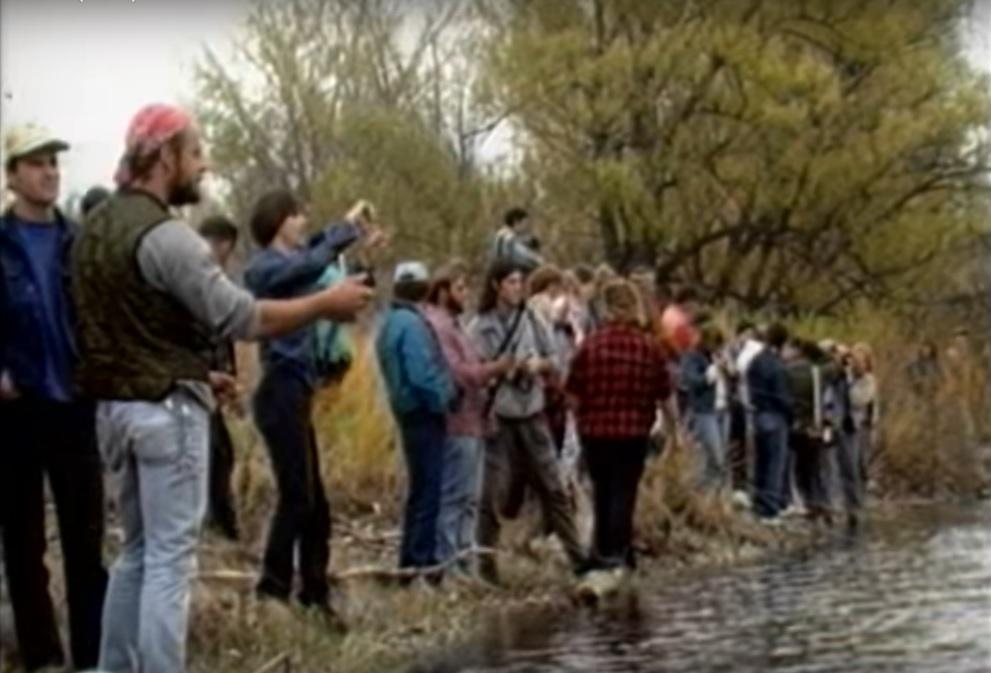
Visual Thinking Strategy:
Share an image of Abenaki people in their modern environment and ask students what they see. Students should provide an answer using evidence from the image to formulate their response.
Photo Credit: “The Abenakis of Vermont. 1987.” YouTube (robinbirkw, 2009)
Generating Curiosity:
Record questions about the image that students ask. Revisit the questions periodically as students take part in subsequent activities to see if they can answer them and if this process helps them answer the Compelling Question.
Supporting Questions
Supporting Question 1
How do geographic features and the environment affect the daily lives, cultural practices, and relationships of the Abenaki people? Read More…
Supporting Question 2
What are some examples of significant Abenaki lifeways (food, clothing, shelter, and arts), and how have the Abenaki people adapted these lifeways to their environment? Read More…
Supporting Question 3
How have the American Abenaki people demonstrated resilience and resourcefulness in maintaining their culture from colonial times to today? Read More…
Question 1 Formative Performance Task
Assessment Objective:
Students can explain how geography impacts the cultural practices of the Abenaki and can document their learning in a variety of ways.
Question 2 Formative Performance Task
Assessment Objective:
Students can explain how Abenaki lifeways are adapted to their environment, can document their learning in a variety of ways, and communicate observations in written or spoken form.
Question 3 Formative Performance Task
Assessment Objective:
Students can ask and answer informed questions and write about how the American Abenaki people have maintained their cultural identity.
Activities for Supporting Question 1
Matching Natural Resources to Their Uses (Grade 3) Students engage in a matching activity in which they identify the relationship between Abenaki culture and geography/natural resources.
Activities for Supporting Question 2
Students are assigned different lifeways about which to gain knowledge. They meet in mixed groups to share what they have learned and then craft statements about how the Abenaki have adapted to their environment. (Social Psychology Network, 2025)
Activities for Supporting Question 3
PART 1: Generate Questions – Asking Informed Questions (REQUIRED ACTIVITY)
This Part 1 activity is required for successful completion of the Inquiry Design Model. The class brainstorms informed questions about how American Abenaki people have maintained their culture and identifies those questions they need to learn more about.
PART 2: Using Evidence to Construct Answers (ACTIVITY OPTIONS)
Creating a Graphic Organizer (Grades 5 and up) Students complete a graphic organizer demonstrating the relationship between Abenaki culture and geography/natural resources.
Give One, Get One (Grades 3 through 12) Students complete one section of a Give One, Get One chart about a particular Abenaki lifeway. Then, they move around the room to interact with their peers. Students “Give” their explanation and “Get” explanations from others until their chart is complete.
Using Sentence Stems and Sentence Frames Students use a sentence-completion worksheet to reflect on their prior research and spark further discussion.
Turn-and-Talk Discussions (Grades 3 through 12) Students participate in a discussion in which they explain the relationship between geography/natural resources and the culture of the Abenaki.
Writing Informational Text (Grades 3 through 12) Students use worksheets with writing prompts in the form of guiding questions.
Using Peer Review Partners (Grades 3 through 12) Students respond to prompts about how American Abenaki people have maintained their culture over time. They draft Venn diagrams or write essays and get feedback from peers to revise their work.
Writing Informational Text
(Grades 3 through 12) Students use worksheets with writing prompts in the form of guiding questions.
Visual Arts Integration—Drawing Using Color (Grades 3 through 12) Students create an illustration of Abenaki lifeways, showing how they have changed over time.
Class Debrief and Record (Grades 3 through 12) Students do research and share claims and evidence about how American Abenaki have maintained their cultural identity. They assemble a class record to share resources they found particularly helpful.
Visual Arts Integration—Make a Map (Grades 3 through 12)
Students construct a map with a key showing Abenaki homelands.
Summative Performance Task
The Summative Performance Task is an assessment opportunity at the conclusion of students’ unit of study. The task aligns with C3 standards D4.6.3-5 and D3.3.3-5, the Compelling Question for the Inquiry, and the accompanying learning scales. Teachers may decide to have all students complete the same assessment option or allow students to choose.
Assessment Objective
Students will use what they have learned about Abenaki culture to explain the challenges the Abenaki have faced and share examples from multiple sources (written narrative, artwork, photographs, etc.) of how the American Abenaki have survived and adapted.
Task Options:
Portfolio
Students compile a portfolio of evidence using materials they developed during the Formative Performance Tasks to support their claim about how Abenaki people survived and adapted over thousands of years until today.
Oral Presentation With Poster
Students develop a claim about how Abenaki people survived and adapted over thousands of years until today, support it with evidence, and share it through a combined verbal and illustrated presentation.
Taking Informed Action
Taking Informed Action is essential to the Inquiry Design Model (IDM) because it supports transferring students’ new learning to civic engagement in their communities.
Community Action Proposal
Students develop Community Action Proposals that outline tangible ways to support their school or local community. Proposals may include organizing relevant morning announcements, a resilience reading list, an exhibition, or a new students greeting.