
“We arrived at this point because of so many people that frankly persevered in light of defeat time and time again.”
— Gov. Peter Shumlin, upon signing the Vermont State-Recognition
(Related word: recognized): An acknowledgment by a state government when a Native American tribe presents proof that it has existed as a distinct community in that state. bills for the Elnu and Nulhegan AbenakiHistorically, this name was used by the French to refer to many different Indigenous communities in Vermont, New Hampshire, and Maine. During the colonial wars, some New England Indians moved to southern Canada as war refugees. They were joined by refugees from other tribes and together became known as Abenaki. (Calloway, 1994) Tribes. April 22, 2011
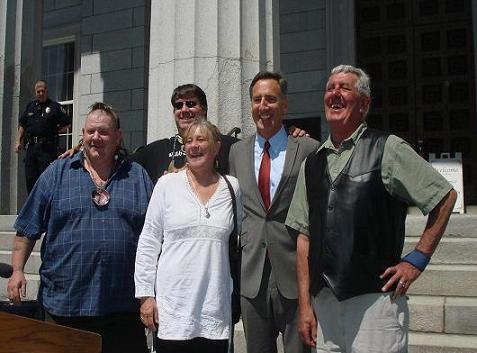
In 2011 and 2012, Abenaki Tribes in Vermont applied to the legislature for State Recognition. Each of the Tribes provided the required archeological, historical, genealogical, and other forms of evidence to prove that their communities continue to exist.
In the article “Tribal Recognition in Vermont: The Role of Federal Standards,” State Representative Kesha Ram explains the careful process that the State of Vermont went through to develop S.222 (Act 107), an act relating to state recognition of Native American Indian tribes in Vermont. Ram notes “the new law sets strong but attainable standards and a fair process for tribes to seek recognition in Vermont (Ram, 2011, p. 8). Act 107 was signed into law in 2010 (Bill Status S.222 (Act 107), 2010).
the Elnu, Koasek, Missisquoi, and Nulhegan Abenaki Tribes proved their communities still exist and were acknowledged by the State of Vermont. (Vermont Commission on Native American Affairs, 2025).(Elnu Abenaki Tribe(Related word: Tribal): A group of families or villages that share the same language, traditions, and ancestors. , 2010; Koasek Traditional BandA small group of Native American people with its leaders, usually part of a larger tribe. of the Koas Abenaki NationPeople living in the same region under its independent government and having a shared history, language, and culture. , 2010; Abenaki Nation of Missisquoi, 2011; Nulhegan Band of the Coosuk-Abenaki Nation, 2010).
The applications for State Recognition submitted by each of the four Tribes documentTo provide evidence of claims with supporting materials. how adaptation and resilienceThe ability of people to recover quickly from a difficulty or to adjust easily to change. aided them in continuing their culture from colonial times(Related words: colonial, colony, colonize) The period of American history between the time period when Europeans settled in North America in the 1500s and when the United States was declared independent in 1776. to the present. A full list of the recognition criteria can be found on pages 7–9 of S.222 (Act 107) (Bill Status S.222 (Act 107), 2010). (Elnu Abenaki Tribe, 2010; Koasek Traditional Band of the Koas Abenaki Nation, 2010; Abenaki Nation of Missisquoi, 2011; Nulhegan Band of the Coosuk-Abenaki Nation, 2010). These recognition applications clearly note that although some people failed to record these people as “Indians,” other historical records show that they were perceived as “others” by their white neighbors, and their existence was documented in local town histories. Abenaki people today have adopted seemingly modern practices (such as living in wood-framed houses, speaking English, and wearing European-style clothing), but they have also continued many traditional ways of living.
The applications for State Recognition submitted by each of the four Tribes document how adaptation and resilience aided them in continuing their culture from colonial times to the present. A full list of the recognition criteria can be found on pages 7–9 of S.222 (Act 107) (Bill Status S.222 (Act 107), 2010). (Elnu Abenaki Tribe, 2010; Koasek Traditional Band of the Koas Abenaki Nation, 2010; Abenaki Nation of Missisquoi, 2011; Nulhegan Band of the Coosuk-Abenaki Nation, 2010). These recognition applications clearly note that although some people failed to record these people as “Indians,” other historical records show that they were perceived as “others” by their white neighbors, and their existence was documented in local town histories. Abenaki people today have adopted seemingly modern practices (such as living in wood-framed houses, speaking English, and wearing European-style clothing), but they have also continued many traditional ways of living.
The Abenaki applications for State Recognition contain substantial information that demonstrates to historians, anthropologists, teachers, and other readers that Abenaki history did not end in 1790 (as some Vermont histories suggest). CommunityA group of people living or working together in a particular area, or people belonging to a cultural group. members shared collective memories that demonstrated the destruction caused by colonization, and showed how each community persevered after the American Revolution, when Vermont became a state in the new nation. These memories also reveal distinct practices that made Abenaki people different from their white neighbors. For example, Abenaki women held leadership roles (at Koasek) during a time when women in mainstream American culture were not held in high regard or allowed to hold public office. Female matriarchs (at Elnu and Missisquoi) continued certain fashion traditions such as ribbonwork and beadwork, even after western-style clothes had been adopted. Abenaki artisans (at Elnu, Koasek, and Nulhegan) continued to make ash-splint woven baskets. Many families retained distinct agricultural practices, such as the use of sucker fish to fertilize their mound-style gardens (at Elnu, Koasek, and Nulhegan). These and other findings inspired a substantial amount of new research and new publications that added to evidence found in the archaeological record.
Many of these practices reflect Abenaki lifewaysThe customary foods, clothing, shelters, and arts of a people. that had emerged generationsGroups of people born around the same time. In one family, children, parents, and grandparents are from different generations. earlier, during the Woodland period. Although Abenaki people in earlier times had gathered into larger settlements, select community members continued to travel seasonally, providing for their communities by hunting, fishing, and gathering. During periods of food scarcity, stormy weather, or warfare, large communities would break up into smaller family bands, retreating to familiar safe places. Even during times of colonial warfare, if a community was attacked and garden fields burned, they could use preserved food caches stored in the ground and forage for survival foods. Traditional Abenaki foodways, past and present, include strategic planning for both lean times and good times, depending upon year-round seasonal cycles of planting, hunting, fishing, harvesting, food preservation, and seed-saving.
By the 1800s, as colonial settlersPeople who come to a new place to live. expanded their land claims in Ndakinna, English towns and farms grew larger. Less land was available for traditional hunting and foraging, and some Abenaki families responded by becoming farmers or settling in towns, often alongside colonial families. The Abenaki, like most Native people in the Northeast, adapted their traditional skills to accommodate new cycles of seasonal activities and a new cash economy. Activities included making baskets in the winter and selling them in the summer, setting up encampments at tourist resorts, making snowshoes, doing beadwork, or working year-round as hunting and fishing guides (Elnu Abenaki Tribe, 2010; Koasek Traditional Band of the Koas Abenaki Nation, 2010; Abenaki Nation of Missisquoi, 2011; Nulhegan Band of the Coosuk-Abenaki Nation, 2010; Wiseman, 2024; Wiseman, 2025a; Wiseman, 2025b). Abenaki people continue to be creative, finding strategic ways to adaptTo make changes to something more suitable for a new purpose. traditional skills to survive in changing times
For More Information
Websites:
Bill Status S.222 (Act 107), Vermont General Assembly 2009–2010 Regular Session, 26 V.S.A. (Title 26: Professions and Occupations) (2010).
Ram, K. (2011). Tribal Recognition in Vermont: By Kesha Ram, Vermont state representative the role of federal standards. Communities and Banking. Federal Reserve Bank of Boston, 22(1), 7–8.
Book:
Wiseman, Frederick M. Something of Value: The Vermont Abenakis, 1790–2020. Abenaki Health and Heritage(Related term: cultural heritage) Something that is inherited from previous generations and passed along to future generations. It includes family identity, cultural practices, values, and traditions. . Book available from Abenaki Health and Heritage.
The above information comes from the “Deep Roots, Strong Branches” traveling exhibition, Vermont Abenaki Artists Association, curated by Vera Longtoe Sheehan (2025e). Printed with permission of the author. Share as much or as little with your students as needed to successfully complete the curriculum activities.
©2025. Vera Longtoe Sheehan. All Rights Reserved.