
| Compelling Question |
|---|
| How have the Abenaki people survived and adapted to their environment for thousands of years? |
Assessment Objective
Students will use what they have learned about Abenaki culture to explain the challenges that the Abenaki have faced and share examples from multiple sources (written narrative, artwork, photographs, etc.) of how the American Abenaki have survived and adapted.
This introductory activity is designed to create student interest in the topic, elicit prior knowledge, and set the trajectory for their learning journey using an inquiry-based Visual Thinking Strategy (VTS). VTS was originally developed by Abigail Housen (cognitive psychologist) and Philip Yenawine (Visual Thinking Strategies, 2025).
By the end of this activity, students should understand the following facts about the American Abenaki people:
- Some Abenaki people live in the State of Vermont. They continue to do some of the same activities as their ancestors (e.g., fishing).
- They are citizens of four State-Recognized Tribes. (Students will learn the names of the Tribes as you progress through the curriculum.)
The staging activity may not give immediate answers to the Compelling Question, but it should create interest.
Guidance for Staging the Compelling Question.
Click + to view activity guidance. Click – to close the box when done.
Visual Thinking Strategy
Share the following image of modern-looking Abenaki people. Have students observe the image closely and ask them the following questions:
- “What is going on in this picture?”
- “What do you see that makes you say that?”
- “What more can we find?” (Saxton, 2025)
Have students share their observations using evidence from the picture to formulate their responses.
For more information, visit Visual Thinking Strategy, Miami Dade College.
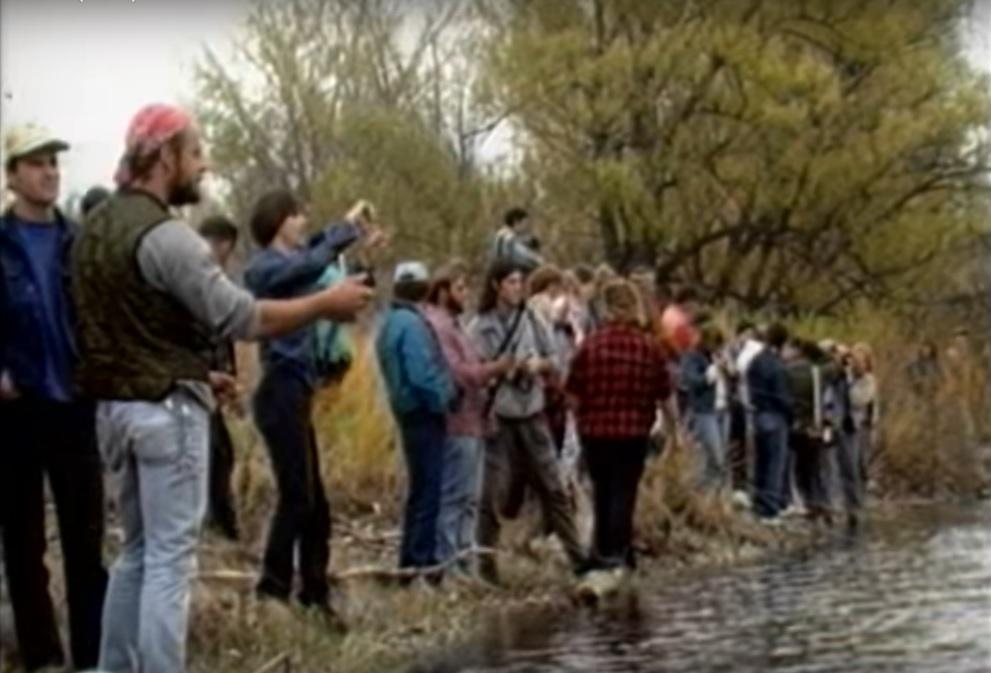
Sample Student Responses
- People are fishing.
- People are taking pictures.
- People are watching.
- People are talking to each other.
- Lots of people are standing by a river. Some of them are very close to the water.
- Most of them look like grown-ups and I cannot see any kids or old people.
Generating Curiosity
After using the initial Visual Thinking Strategy, generate curiosity by encouraging students to ask follow-up questions. Use instructional language you may be familiar with from other content areas, such as “What do you notice?” or “What do you wonder?” Record students’ questions and wonderings so that you can revisit them periodically to see if they can answer the Compelling Question based on their work with the resources, discussions, writing, and other activities. Consider using the Technology Extension suggested below.
The photograph provided may limit what students say, and that is to be expected. Teachers can provide a little more context to invite more meaningful observations and make crafting questions easier. It may also be helpful to have a bank of images, as suggested in the Visual Thinking Extension below, for information you can share with your students, recognizing that it can be tricky to strike a balance and not provide too much content so your students maintain their curiosity.
Students May Wonder
- How did Missisquoi River get its name?
- How did the Missisquoi Tribe get their name?
- Are the Missisquoi people named after the river?
- Are the four State-Recognized Tribes the only ones, or are there more that didn’t get recognized?
- Why are Abenaki people getting tickets for fishing in their homeland?
Technology Extension
Create a Padlet or other digital collaborative document for students to use to share their observations, questions, and other information with each other.
Visual Thinking Extension
You can create a bank of images of fishing licenses, people fishing, peaceful protests, news cameras, and game wardens as supplementary content. In a follow-up session, prompt students to sort the images, share with the class, and explain their thinking.
Historical Context: Compelling Question
The following information comes from the “Deep Roots, Strong Branches” traveling exhibition, Vermont Abenaki Artists Association, curated by Vera Longtoe Sheehan (2025e). Share as much or as little with your students as needed for them to understand the context of the photo below and why it is significant.
Fish-In Protests Along the Missisquoi River
Photo Credit: “The AbenakiHistorically, this name was used by the French to refer to many different Indigenous communities in Vermont, New Hampshire, and Maine. During the colonial wars, some New England Indians moved to southern Canada as war refugees. They were joined by refugees from other tribes and together became known as Abenaki. (Calloway, 1994) of Vermont. 1987” robinbirkw. YouTube. 2009. Photos of the fish-in protest may appear blurry or grainy because of limitations of the photography and video technologies that were used at the event in 1987. In this photo, Abenaki people wearing modern clothing are gathered along the banks of the Missisquoi River in…
Continue Reading Fish-In Protests Along the Missisquoi River