
Overview
Graphic organizers vary in format and purpose. They are often used to help students process their ideas for another task, such as giving a presentation or writing an essay. This activity will prepare learners to answer the question “What is the relationship between the AbenakiHistorically, this name was used by the French to refer to many different Indigenous communities in Vermont, New Hampshire, and Maine. During the colonial wars, some New England Indians moved to southern Canada as war refugees. They were joined by refugees from other tribes and together became known as Abenaki. (Calloway, 1994) and their environmentAll the physical surroundings on Earth, including everything living and nonliving. ?”
Worksheets
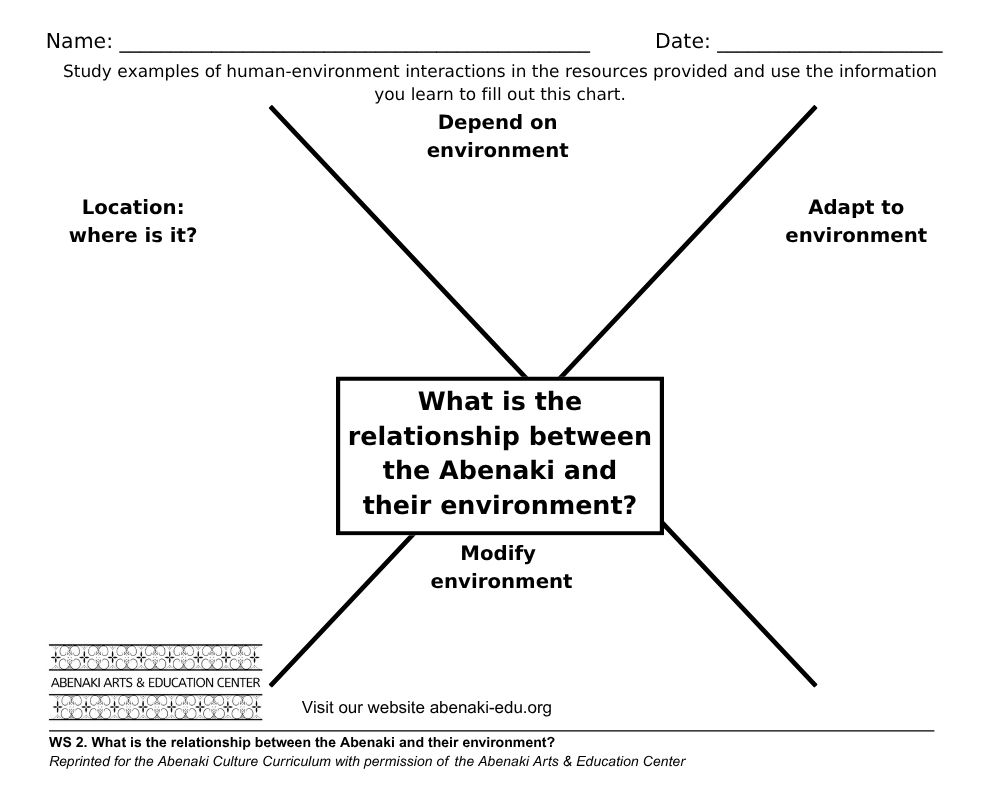
There is a choice of two worksheets, each accompanied by an answer key under Sample Student Responses. (Click the image to download a PDF version.)
Resources:
- Abenaki Cultural Practices, Lifeways, and Natural Resources Card Game [Deck of Cards] (Abenaki Arts & Education Center, 2025b). [Teachers: Email Abenaki Arts & Education Center: abenaki.edu@gmail.com]
- Abenaki History Timeline (Abenaki Arts & Education Center, 2023)
- Abenaki Uses of Natural Resources [Table – Printable PDF] (Abenaki Arts & Education Center, 2025d)
- New England Landforms [Poster] (Abenaki Arts & Education Center, 2024)
- Vermont Topography [Road atlas of USA and Canada] (Vermont Topography Terrain Map Topographic State Large Scale Free Detailed Landscape, 2025) Abenaki Uses of Natural Resources Table (Abenaki Arts & Education Center, 2025r)
Guiding the Inquiry
- Select one of the two graphic organizers provided as worksheets or use another one if you prefer.
- If your students are not familiar with graphic organizers you may need to explain how to complete one.
- Explain to students that they should work in small groups using information from the resources to complete a graphic organizerA visual tool that is used to sort information. Graphic organizers vary in format and purpose. Learners often use them to process information or to prepare for another task, such as writing an essay or giving a presentation. (Also, see storyboard). about the relationship between Abenaki people and their environment.
- If you choose WS 3, have students begin by writing “What is the relationship between the Abenaki and their environment?” in the center box on the mind map.
Sample Student Responses and Categories
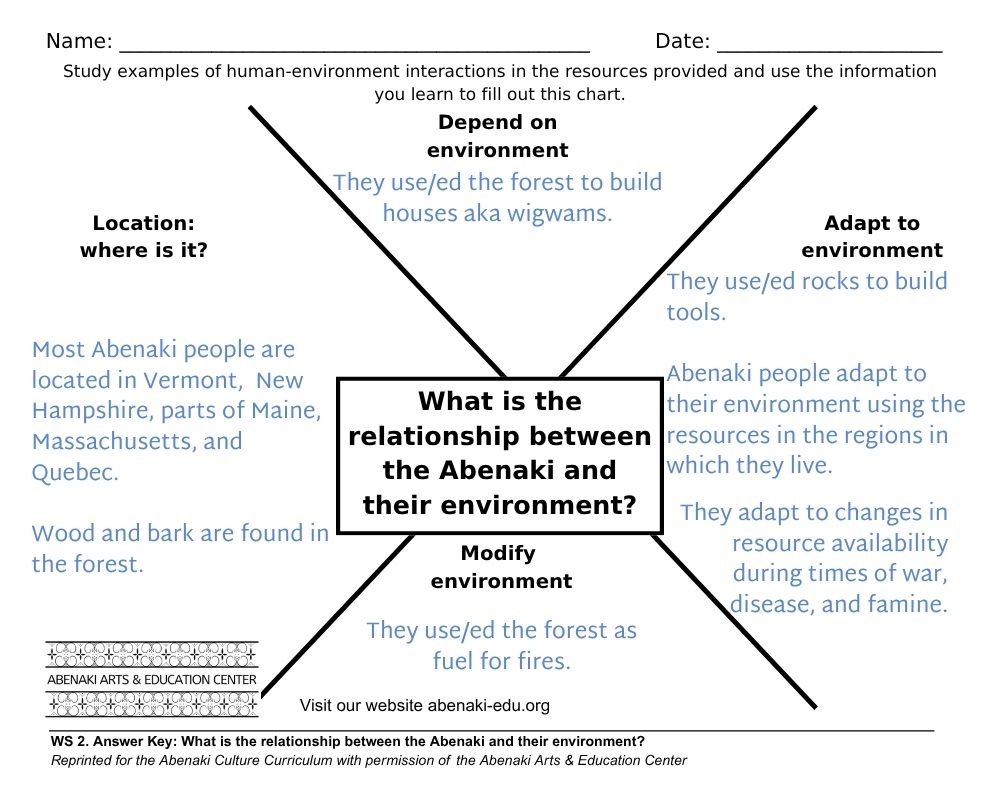
- Top—They use/ed the forest to build houses aka wigwams.
- Bottom—They use/ed the forest as fuel for fires.
- Left—Most Abenaki people are located in Vermont, New Hampshire, parts of Maine, Massachusetts, and Quebec. Wood and bark are found in the forest.
Sample Student Responses
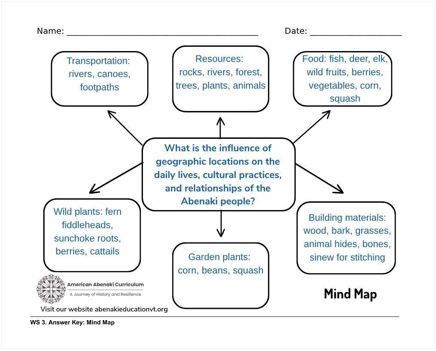
WS 3. Answer Key: Mind Map (see Worksheet section)
- Resources: rocks, rivers, forest, trees, plants, animals;
- Food: fish, deer, elk, wild fruits, berries, vegetables, corn, squash;
- Building materials: wood, bark, grasses, animal hides, bones, sinew for stitching;
- Garden plants: corn, beans, squash;
- Wild plants: fern fiddleheads, sunchoke roots, berries, cattails;
- Transportation: rivers, canoes, footpaths.
See Historical Context essay and Resources for additional potential responses
Standards Alignment
Click + to view Standards Alignment guidance. Click – to close the box when done.
Potential Alignment: English Language Arts Standards
The Creating a Graphic Organizer activity can support the following sampling of standards and serve as a starting point for integrating the Abenaki Culture Curriculum with language arts instruction and assessmentA tool to measure what a student knows and can do..
Grades 3–5 Standards
CCSS.ELA-Literacy.W.3.8. Recall information from experiences or gather information from print and digital sources; take brief notes on sources and sort evidence into provided categories.
CCSS.ELA-Literacy.W.4.7. Conduct short research projects that build knowledge through investigation of different aspects of a topic.
CCSS.ELA-Literacy.W.5.7. Conduct short research projects that use several sources to build knowledge through investigation of different aspects of a topic.
Grades 6–8 Standards
CCSS.ELA-Literacy.RI.6.7. Integrate information presented in different media or formats (e.g., visually, quantitatively) as well as in words to develop a coherent understanding of a topic or issue.
CCSS.ELA-Literacy.W.8.7. Conduct short research projects to answer a question (including a self-generated question), drawing on several sources and generating additional related, focused questions that allow for multiple avenues of exploration.
Grades 9–12 Standards
CCSS.ELA-Literacy.SL.9-10.1. Initiate and participate effectively in a range of collaborative discussions (one-on-one, in groups, and teacher-led) with diverse partners on grades 9-10 topics, texts, and issues, building on others’ ideas and expressing their own clearly and persuasively.