Overview
After a field trip, visiting one or more websites or exhibitions, and possibly using some of the other resources listed, students engage in a matching activity to identify the relationships between AbenakiHistorically, this name was used by the French to refer to many different Indigenous communities in Vermont, New Hampshire, and Maine. During the colonial wars, some New England Indians moved to southern Canada as war refugees. They were joined by refugees from other tribes and together became known as Abenaki. (Calloway, 1994) culture and geographyThe study of places on Earth, their features, and the people who live there. /natural resources.
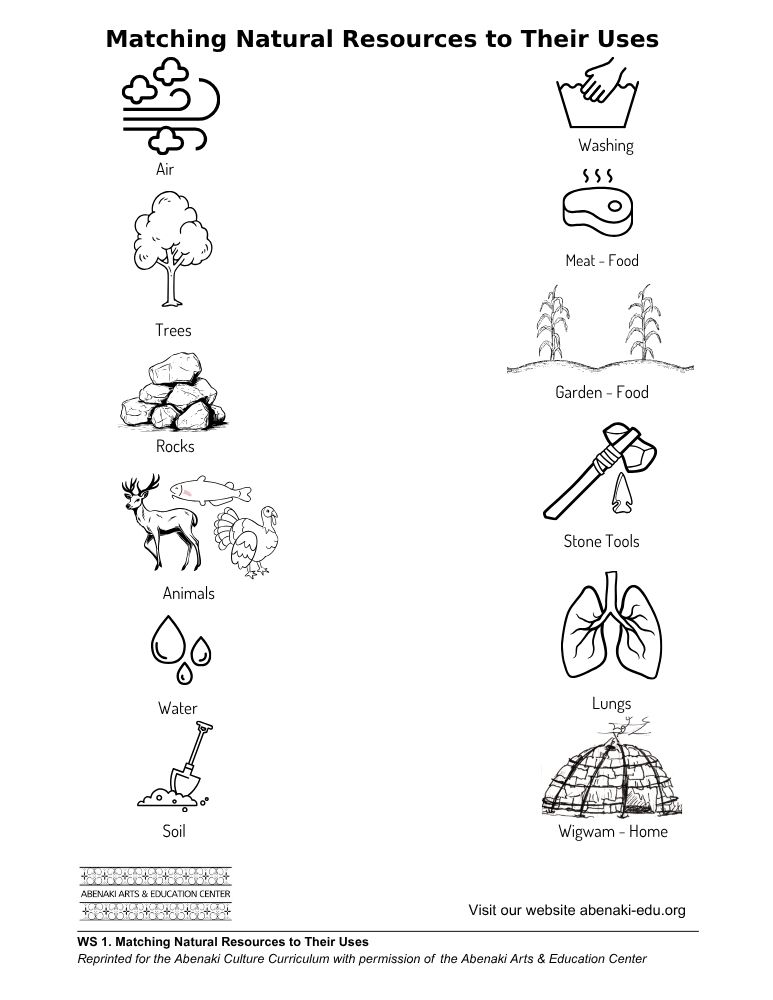
Worksheet
You may obtain PDF versions of the worksheets from the Worksheets page or simply click the worksheet image to download the PDF version.

Resources
- Abenaki Cultural Practices, Lifeways, and Natural Resources Card Game [Deck of Cards] (Abenaki Arts & Education Center, 2025b). [Teachers: Email Abenaki Arts & Education Center: abenaki.edu@gmail.com]
- Abenaki Uses of Natural Resources [Table—Printable PDF] (Abenaki Arts & Education Center, 2025d)
- Field trip to an Abenaki museum exhibit—choose a location from the ResourceA source of information for student learning, such as a website, video, library book, poster, or map. Bank section of this curriculum.
- Maps choices: Vermont Topography [Road atlas of USA and Canada] (Vermont Topography Terrain Map Topographic State Large Scale Free Detailed Landscape, 2025); Native Land Digital [Digital interactive] (Banaszak, 2022); National Geographic Map Maker [Digital interactive] (National Geographic, 2022)
- Natural ResourcesParts of the environment that people use, such as sunlight, air, water, soil, rocks, fossil fuels, and living organisms. , Vermont Agency of Natural Resources website [Online article and photographs] (Department of Environmental Conservation, 2025)
- Vermont Abenaki Artists Association—Look at the Artists’ Galleries on this website. (Vermont Abenaki Artists Association, 2017)
Guiding the Inquiry1. Inquiry is asking questions, seeking knowledge, and investigating information. According to the C3 Framework, inquiry is at the heart of social studies. 2. A comprehensive curricular unit designed for the C3 Framework that includes the key components of questions, tasks, and sources. The inquiry format leads students through the investigation of a compelling question.
- Decide which of the recommended resources are most appropriate for your students.
- Before taking a field trip or reviewing a website, familiarize your class with the Abenaki Uses of Natural Resources [Table—PDF] (Abenaki Arts & Education Center, 2025d) and where these resources may be found on a map.
- Hand out WS 1. Matching Natural Resources to Their Uses (Abenaki Arts & Education Center, 2025e). Have students match culturalRelating to the beliefs, language, traditions, and other ways of living that a group shares. objects to the natural resources from which they are made.
- Discuss where each natural resource might be found and how they might be categorized.
Technology Extension
Topographical maps can be uploaded to your digital collaboration medium of choice so that students can work with them in groups. This supportsStructures and strategies that help a student access content and demonstrate what they know and can do. differentiated learning and allows students to use an overlay, such as Google Translate, to understand the material.