
Worksheets, Resources, and Sample Student Responses
There are two worksheets for Grade 4 and 5, WS 5 and WS 6.
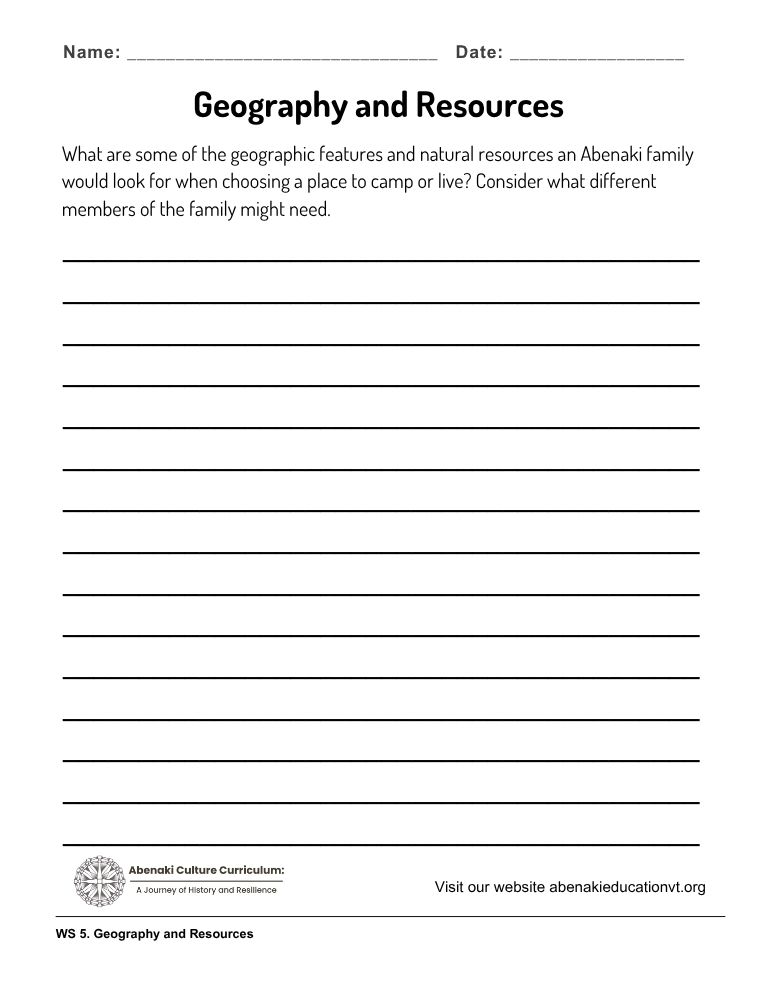
Worksheet WS 5
Prompt: What are some of the geographic features and natural resourcesParts of the environment that people use, such as sunlight, air, water, soil, rocks, fossil fuels, and living organisms. an AbenakiHistorically, this name was used by the French to refer to many different Indigenous communities in Vermont, New Hampshire, and Maine. During the colonial wars, some New England Indians moved to southern Canada as war refugees. They were joined by refugees from other tribes and together became known as Abenaki. (Calloway, 1994) family would look for when choosing a place to camp or live? Consider what different members of the family might need.
Resources
- Abenaki Uses of Natural Resources [Table—Printable PDF] (Abenaki Arts & Education Center, 2025d)
- National Geographic Map Maker [Digital interactive] (National Geographic, 2022)
- New England Landforms [Poster] (Abenaki Arts & Education Center, 2024)
- Vermont Topography [Road atlas of USA and Canada] (Vermont Topography Terrain Map Topographic State Large Scale Free Detailed Landscape, 2025)
Sample Student Responses
- People might choose a place near water—a river, pond, or lake—so they can get water for drinking and cooking. And people of all ages, especially kids, like to swim!
- Many birds and animals, which people can use for food, come to ponds and streams to drink.
- Woods and fields are places to gather plants for food or medicine.
- Hunters can find animals in woods and fields.
- Mountains, hills, lakeshores, and riverbanks have different kinds of rocks and stone that can be used to make tools.
- Everyone needs tools. Children learn from their parents how to make tools from different kinds of stone, wood, bone, and animal sinew or plant fiber.
See Historical Context essay and Resources for possible additional responses.
Worksheet WS 6
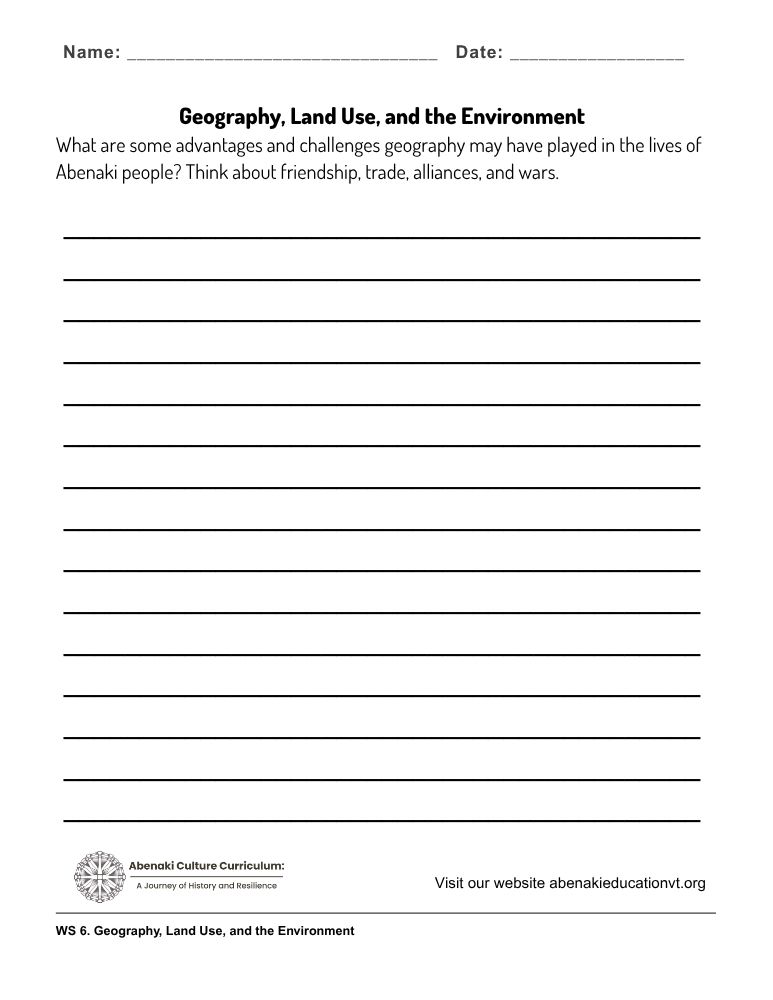
Question: What are some advantages and challenges geographyThe study of places on Earth, their features, and the people who live there. might have played in the lives of Abenaki people? Think about friendship, trade, alliances, and wars.
Worksheet: WS 6 Geography, Land Use, and the EnvironmentAll the physical surroundings on Earth, including everything living and nonliving.
Resources
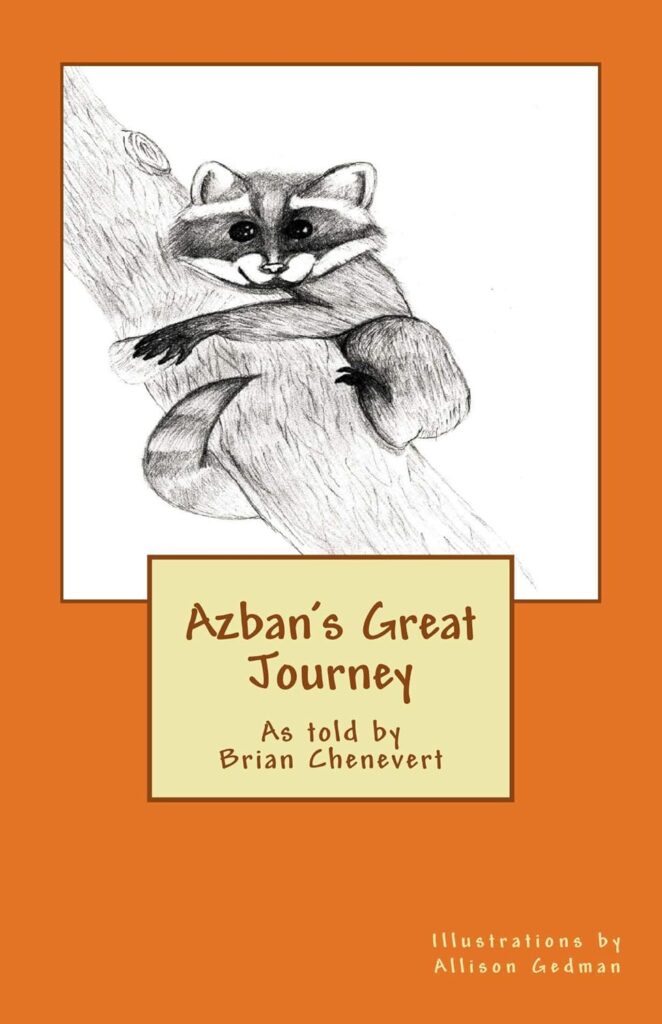
- Azban’s Great Journey [Book—58 pages] (Chenevert, 2014)
- New England Landforms [Poster] (Abenaki Arts & Education Center, 2024)
- Abenaki Uses of Natural Resources [Table—PDF] (Abenaki Arts & Education Center, 2025d)
- The Arrow Over the Door [Book—122 pages. A historical fiction story of goodwill between different cultures during the Revolutionary War.] (Bruchac, 2002)
- Vermont Topography [Road atlas of USA and Canada] (Vermont Topography Terrain Map Topographic State Large Scale Free Detailed Landscape, 2025)
Sample Student Response
- Friendship: Rivers make it easy to travel by canoe to visit family members, friends, and allies. Rapids, waterfalls, and strong currents could be challenges to navigation.
- Trade: Rivers and mountains can shield from invaders, but isolate people from trade partners and other potential allies. Rivers and mountains can sometimes be a barrier.
- Alliances and War: In wartime, people could use rivers to travel quickly by canoe. They also could hide in mountains and wetlands when people wanted to hurt them.
See Historical Context essay and Resources for additional potential responses.

Standards Alignment
Click + to view Standards Alignment guidance. Click – to close the box when done.
Potential Alignment: English Language Arts Standards
The Writing Informational TextWritten nonfiction materials that are intended to inform the reader about a specific topic. Informational text includes biographies, speeches, opinion or argument essays, and history or science explanations. activity can support the following sampling of standards and serve as a starting point for integrating the American AbenakiAbenaki tribes, families, and people who live in the United States. Vermont has four recognized Abenaki tribes; for more information visit Abenaki Alliance. Curriculum with language arts instruction and assessmentA tool to measure what a student knows and can do..
Grades 3–5
CCSS.ELA-Literacy.W.3.2.b. Develop the topic with facts, definitions, and details.
CCSS.ELA-Literacy.W.4.2.d. Use precise language and domain-specific vocabulary to inform about or explain the topic.
CCSS.ELA-Literacy.W.5.2.b. Develop the topic with facts, definitions, concrete details, quotations, or other information and examples related to the topic.
Grades 6–8
CCSS.ELA-Literacy.W.6.1.a. Introduce claim(s) and organize the reasons and evidence clearly.
CCSS.ELA-Literacy.W.7.2.d. Use precise language and domain-specific vocabulary to inform about or explain the topic.
CCSS.ELA-Literacy.W.8.2.b. Develop the topic with relevant, well-chosen facts, definitions, concrete details, quotations, or other information and examples.
Grades 9–12
CCSS.ELA-Literacy.W.9-10.2.e. Establish and maintain a formal style and objective tone while attending to the norms and conventions of the discipline in which they are writing.
CCSS.ELA-Literacy.W.11-12.2.b. Develop the topic thoroughly by selecting the most significant and relevant facts, extended definitions, concrete details, quotations, or other information and examples appropriate to the audience’s knowledge of the topic.