
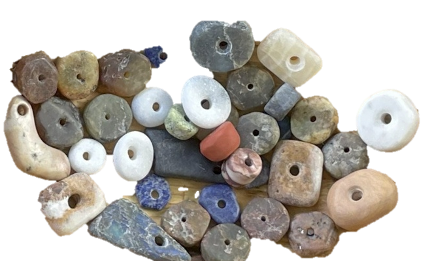
In AbenakiHistorically, this name was used by the French to refer to many different Indigenous communities in Vermont, New Hampshire, and Maine. During the colonial wars, some New England Indians moved to southern Canada as war refugees. They were joined by refugees from other tribes and together became known as Abenaki. (Calloway, 1994), there is no word for art, but aesthetic beauty carries almost as much importance as functionality in crafting materials for tools and adornment. This connection is evident in ancient culturalRelating to the beliefs, language, traditions, and other ways of living that a group shares. objects, such as beads, textiles, and ceramics found at village and burial sites across the Abenaki homelands, as well as in the artwork of living Abenaki artists who pay tribute to their ancestors.
Beads and Textiles
Much of what is known about Abenaki personal adornment comes from burial sites, where Abenaki ancestors were found wearing necklaces of disc-shaped beads carved from stone and marine shell. Copper nuggets, which exhibit antibacterial properties, were also hammered into beads to be strung together or sewn on leather and textile bags (Haviland & Power, 1994). Abenaki ancestors attributed special spiritual qualities to copper that made it a desirable material for adornment.
One category of beads called “wampum” (meaning “white shell”) has both spiritual and political significance. White wampum beads were carved from the inner whorls of whelk, and purple wampum beads were carved from the outer edges of quahog shells, shaped into disks or tubes. When strung together into chains to serve as necklaces or bracelets, wampum beads have both decorative and protective qualities. When woven together into larger objects (bands with multiple rows of varying length, called “belts”), tubular wampum beads can be arranged into shapes that signify relationships and alliances. Strings of wampum beads were also used as messages, as marriage gifts, and as offerings to express condolence. During the colonial era, Native communities throughout the Northeast also used wampum belts to record new alliances with colonial settlersPeople who come to a new place to live. .
During the late 1600s to 1700s, after French and English colonial settlers noticed how popular stone and shell beads were with Native American people in the region, they began importing similar shapes of glass beads from Europe specifically for trading. The Abenaki and other IndigenousThe first people living in any region, distinct from later arrivals. peoples embraced this new product. They sewed the smaller glass trade beads onto their garments and wore larger glass beads on necklaces, in a similar fashion to the ways they had earlier used copper, stone, and shell beads.
During the 1800s and into the 1900s, distinctive beadwork traditions continued in the Abenaki homelands (Wiseman, 2025a). Examples of American AbenakiAbenaki tribes, families, and people who live in the United States. Vermont has four recognized Abenaki tribes; for more information visit Abenaki Alliance. beadwork from these centuries can be viewed in the Research and Exhibition Gallery at the Vermont History Center in Barre.
Living Abenaki artists are carrying these traditions into the future. Their work can be viewed on the Vermont Abenaki Artists Association and in their exhibitions state-wide.

Pottery and Fiber Arts
When European travelers arrived in what is now known as New England, the Indigenous inhabitants were already familiar with textile weaving. Natural fibers from earlier times, such as milkweed and Indian hemp, are rarely preserved in this region as they tend to biodegrade.
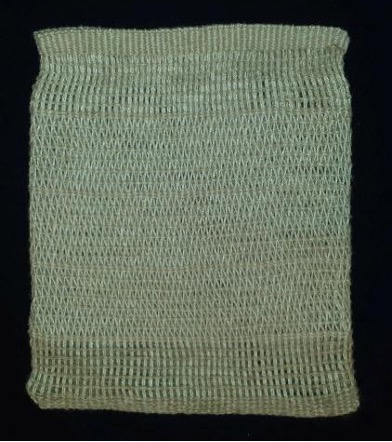
However, early evidence of plant fiber cordage can be found on pottery vessels and shards, especially when woven fibers were used to create decorative impressions in the wet clay. For example, cordage marks are present on pottery vessels found at the Livermore Site along the Pemigewasset River (Doperalski, 2023).
Evidence of the Abenaki textile industry can be found at several Woodland period sites in Vermont. Fiber cord impressions were found at the Isle La Motte Glacial Kame site (Haviland & Power, 1994, p. 106). Cord-wrapped paddle impressions were found at the Warrell Farm Site in Barnet. Signs of cord wrapping were also found at the Colchester Site (Vermont Historic Preservation, n.d.).
Perhaps the most significant fiber cache in the northeastern United States was found in Highgate, Vermont. The Boucher Site is a Late Archaic/Early Woodland period cemetery that was discovered during house construction. The burial ground, which was populated by cremated and non-cremated human remains, contained a multitude of cordage fragments, woven textile bags, and a large burial shroud (Haviland & Power, 1994, pp. 96–126; Petersen, 1996). No images are shown from this site out of respect for the deceased and their descendants.
Generally, milkweed and Indian hemp fibers would disintegrate over time, but the textiles at this site were in close proximity to copper beads, which had a preservative effect on the textiles (Haviland and Power, 1994).
Textile weaving is an unbroken Abenaki tradition
(Related word: traditional): A way of doing things passed down from generation to generation. that continues to the present day, especially among artists of the Elnu Abenaki Tribe(Related word: Tribal): A group of families or villages that share the same language, traditions, and ancestors. in southern Vermont and their apprentices.
For More Information on Beadwork
Haviland, William A. and Marjory W. Power. (1994)The Original Vermonters: Native Inhabitants, Past and Present. (Revised and Expanded Edition). University Press of New England.
Wiseman, F. M. (2024). Beadwork from the American Abenaki region: A first analysis. Vermont Abenaki Artists Association.
Wiseman, F. M. (2006) Reclaiming the Ancestors: Decolonizing a Taken Prehistory of the Far Northeast. University Press of New England.
Wiseman, F. M. (2025a). Something of value: The Vermont Abenakis, 1790–2020. Abenaki health and heritage(Related term: cultural heritage) Something that is inherited from previous generations and passed along to future generations. It includes family identity, cultural practices, values, and traditions. . Abeanki Health and Heritage.
Wiseman, F. M. (2001) The Voice of the Dawn: An Autohistory of the Abenaki NationPeople living in the same region under its independent government and having a shared history, language, and culture. . University Press of New England.
For More Information
Doperalski, M. (2023). Archaeological research in New Hampshire’s state parks. The New Hampshire Archeologist, 63(1).
Haviland, William A. and Marjory W. Power. (1994)The Original Vermonters: Native
Inhabitants, Past and Present. (Revised and Expanded Edition). University Press of New England.
Wiseman, F. M. (2001) The Voice of the Dawn: An Autohistory of the Abenaki Nation. University Press of New England.
Wiseman, F. M. (2006) Reclaiming the Ancestors: Decolonizing a Taken Prehistory of the Far Northeast. University Press of New England.
The above information comes from the “Deep Roots, Strong Branches” traveling exhibition, Vermont Abenaki Artists Association, curated by Vera Longtoe Sheehan (2025e). Printed with permission of the author. Share as much or as little with your students as needed to successfully complete the curriculum activities.
©2025. Vera Longtoe Sheehan. All Rights Reserved.