
For this activity, separate Prompts, Resources, and Sample Student Responses have been provided for grade 3, grades 4–5, middle school, and high school.
Overview
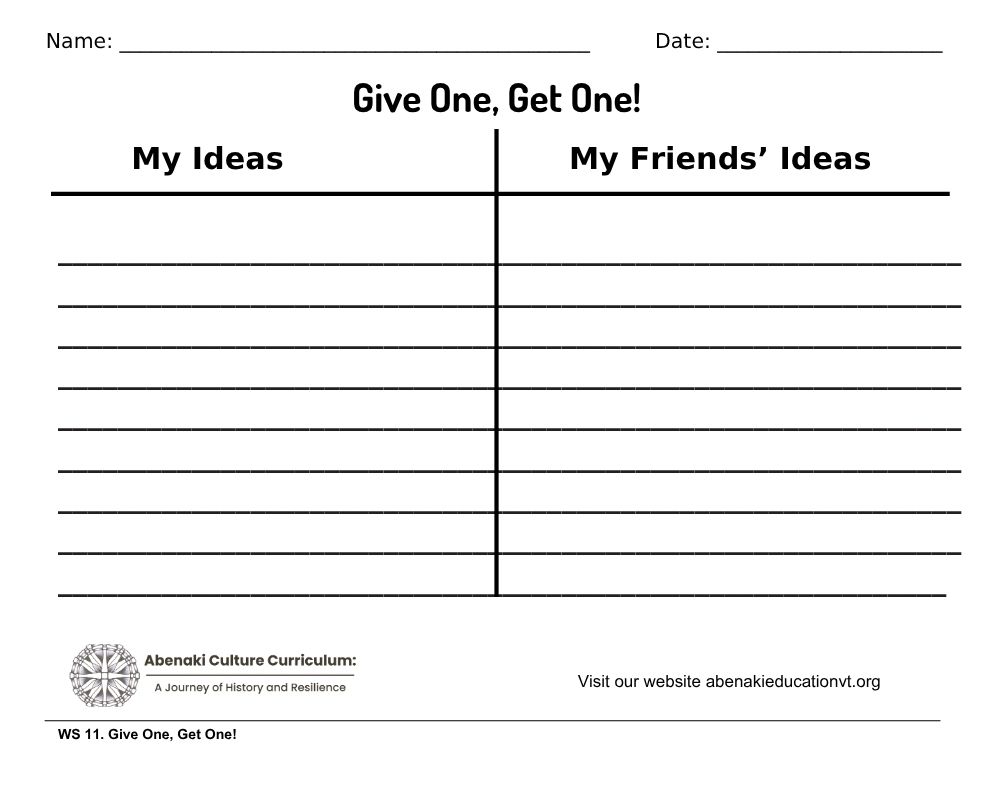
Give One, Get One is a simple collaboration strategy emphasizing the reciprocal nature of learning, where each student both “gives” and “gets” insights about a particular Abenaki lifeway, recording on a graphic organizer worksheet. The concise nature of the activity makes it accessible for students at various proficiency levels.
Materials
- student journals, flip chart pad, or whiteboard, post-it notes or index cards, and markers
- timer
Worksheet
Resources
Resources about Abenaki lifeways (books, articles, posters, online materials) can be found in the Resource Bank section of this curriculum. It contains both Illustrated Resources and Resources by Subject Areas with Grade Levels. Teachers should review the Resources and select those that will be most appropriate for their students.
Guiding the Inquiry
- Depending on the grade level or needs of the students you teach, choose a prompt from the choices that follow. Write it on the board and read it to students.
- Distribute the WS 11. Give One, Get One! worksheet
- Make the resources you have chosen available to your students and have them work independently to complete the “My Ideas” column of the chart about a particular Abenaki lifeway.
- Next, have students move around the room to interact with their peers. Students “Give” their explanations and “Get” explanations and insights from others, recording new information in the “My Friends’ Ideas” column of the chart.
- After the interactive phase of the activity, hold a debriefing session in which you ask students to describe how Abenaki people have adapted to their environment. This can take the form of a class discussion using a whiteboard or a journal writing session.
- Conclude with a summary and reflection that help bring the activity to a meaningful close.
Prompts by Grade Level
SQ2 Give One, Get One: Grade 3
Prompt, Resources, and Sample Student Responses Prompt: List some kinds of food that the AbenakiHistorically, this name was used by the French to refer to many different Indigenous communities in Vermont, New Hampshire, and Maine. During the colonial wars, some New England Indians moved to southern Canada as war refugees. They were joined by refugees from other tribes and together became known as Abenaki. (Calloway, 1994) people eat. Worksheet: WS 11 – Give One, Get One Resources: Seeds of Renewal Project: 2013 Harvest [Poster—Seeds of renewal poster.JPG] (Wiseman, 2013) Abenaki CulturalRelating to the beliefs, language, traditions, and other ways of living that a group shares. Practices, LifewaysThe customary foods, clothing, shelters, and arts of a people. , and Natural ResourcesParts of the environment that people use, such as sunlight, air, water, soil, rocks, fossil fuels, and living organisms. Card Game [Deck of Cards] (Abenaki Arts & Education…
SQ2 Give One, Get One: Grades 4 – 5
Prompt, Resources, and Sample Student Responses Prompt: List materials AbenakiHistorically, this name was used by the French to refer to many different Indigenous communities in Vermont, New Hampshire, and Maine. During the colonial wars, some New England Indians moved to southern Canada as war refugees. They were joined by refugees from other tribes and together became known as Abenaki. (Calloway, 1994) people used to make clothing for different seasons at different times in history. Worksheet WS 11 – Give One, Get One Resources [ResourceA source of information for student learning, such as a website, video, library book, poster, or map. coming soon] Abenaki Clothing [Poster] (Abenaki Arts & Education Center, 2025a) (Under Construction) Abenaki CulturalRelating to the beliefs, language, traditions, and other ways of living that a group shares. Practices, LifewaysThe customary foods, clothing, shelters, and arts of a people. , and Natural ResourcesParts of the environment that people use, such as sunlight, air, water, soil, rocks, fossil fuels, and living organisms. Card Game…
SQ2 Give One, Get One: Middle School
Prompt, Resources, and Sample Student Responses Prompt: List ways the AbenakiHistorically, this name was used by the French to refer to many different Indigenous communities in Vermont, New Hampshire, and Maine. During the colonial wars, some New England Indians moved to southern Canada as war refugees. They were joined by refugees from other tribes and together became known as Abenaki. (Calloway, 1994) people adapted their lifewaysThe customary foods, clothing, shelters, and arts of a people. to their changing environmentAll the physical surroundings on Earth, including everything living and nonliving. . Worksheet WS 11 – Give One, Get One Abenaki History TimelineA graphic representation that shows a chronology of events (in the order they occurred) on a line. [Poster] (Abenaki Arts & Education Center, 2023) [ResourceA source of information for student learning, such as a website, video, library book, poster, or map. coming soon] [Resource coming soon] Aunt Sarah: Woman of the Dawnland: The 108 Winters of an…
SQ2 Give One, Get One: High School
Prompt, Resources, and Sample Student Responses Prompt: Describe how AbenakiHistorically, this name was used by the French to refer to many different Indigenous communities in Vermont, New Hampshire, and Maine. During the colonial wars, some New England Indians moved to southern Canada as war refugees. They were joined by refugees from other tribes and together became known as Abenaki. (Calloway, 1994) maple sugaring traditions demonstrate resilienceThe ability of people to recover quickly from a difficulty or to adjust easily to change. and cultural continuityThe process of people sharing their beliefs, traditions, and other ways of living from one generation to the next. . Worksheet WS 11 – Give One, Get One Resources ‘It’s Everyone’s Thing’: A Tale of Sugar and CommunityA group of people living or working together in a particular area, or people belonging to a cultural group. [Online article in Whetstone Magazine] (Kaiwar, n.d.) Sugaring in Wabanahkik (Land of the Dawn): An Abenaki History of Maple…
Standards Alignment
Click + to view Standards Alignment guidance. Click – to close the box when done.
Potential Alignment: English Language Arts Standards
The Give One, Get One activity can support the following sampling of standards and serve as a starting point for integrating the American Abenaki Curriculum with language arts instruction and assessment.
Grades 3–5
CCSS.ELA-Literacy.SL.3.1.c. Ask questions to check understanding of information presented, stay on topic, and link their comments to the remarks of others.
CCSS.ELA-Literacy.SL.4.1.d. Review the key ideas expressed and explain their own ideas and understanding in light of the discussion.
CCSS.ELA-Literacy.SL.5.1.b. Follow agreed-upon rules for discussions and carry out assigned roles.
Grades 6–8
CCSS.ELA-Literacy.SL.6.1. Engage effectively in a range of collaborative discussions (one-on-one, in groups, and teacher-led) with diverse partners on grade 6 topics, texts, and issues, building on others’ ideas and expressing their own clearly.
CCSS.ELA-Literacy.L.7.3. Use knowledge of language and its conventions when writing, speaking, reading, or listening.
CCSS.ELA-Literacy.W.8.7. Conduct short research projects to answer a question (including a self-generated question), drawing on several sources and generating additional related, focused questions that allow for multiple avenues of exploration.
Grades 9–12
CCSS.ELA-Literacy.W.9-10.9. Draw evidence from literary or informational texts to support analysis, reflection, and research.
CCSS.ELA-Literacy.SL.11-12.4. Present information, findings, and supporting evidence, conveying a clear and distinct perspective, such that listeners can follow the line of reasoning, alternative or opposing perspectives are addressed, and the organization, development, substance, and style are appropriate to purpose, audience, and a range of formal and informal tasks.