
Prompt, Resources, and Sample Student Responses
Prompt:
List some kinds of food that the AbenakiHistorically, this name was used by the French to refer to many different Indigenous communities in Vermont, New Hampshire, and Maine. During the colonial wars, some New England Indians moved to southern Canada as war refugees. They were joined by refugees from other tribes and together became known as Abenaki. (Calloway, 1994) people eat.
Worksheet:
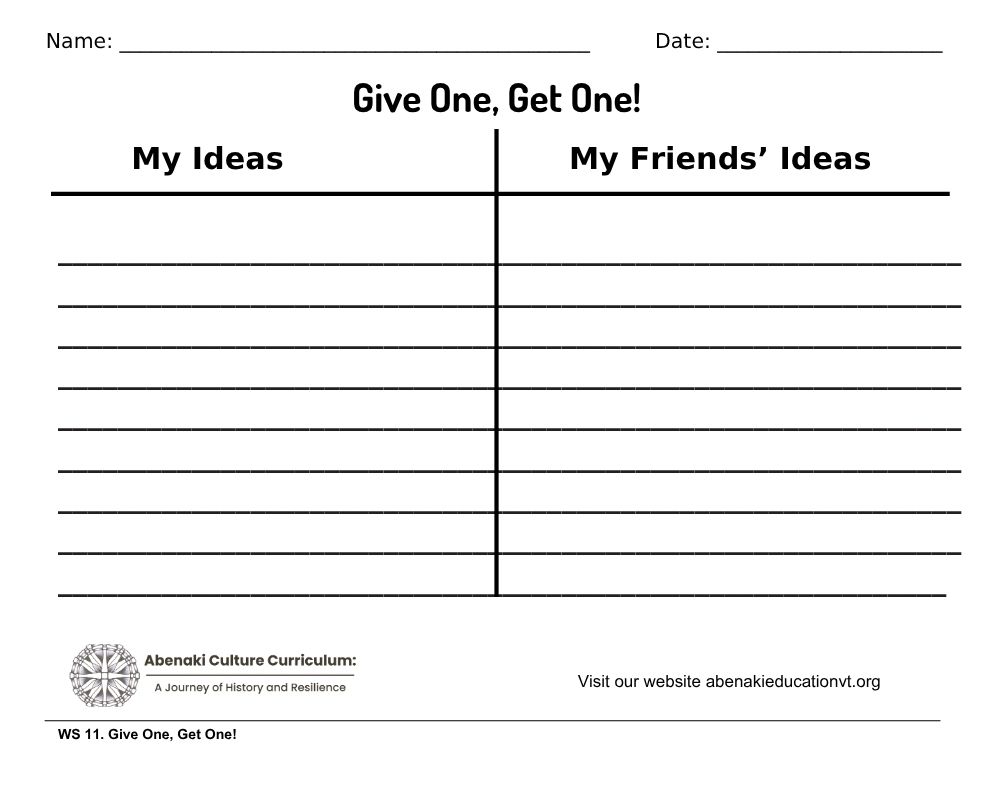
Resources:
- Seeds of Renewal Project: 2013 Harvest [Poster—Seeds of renewal poster.JPG] (Wiseman, 2013)
- Abenaki CulturalRelating to the beliefs, language, traditions, and other ways of living that a group shares. Practices, LifewaysThe customary foods, clothing, shelters, and arts of a people. , and Natural ResourcesParts of the environment that people use, such as sunlight, air, water, soil, rocks, fossil fuels, and living organisms. Card Game [Deck of Cards] (Abenaki Arts & Education Center, 2025b), available by email request to abenaki.education@gmail.com from the Abenaki Arts & Education Center
- Abenaki Lifeways Mural [Digital Image—muralscenesVHS.jpg] (Sylvester, 2004)
Sample Student Responses
- corn, beans, and squash
- Koas corn
- Gaspe corn
- Calais corn
- Abenaki Rose corn
- Jacob’s cattle beans
- Vermont cranberry beans
- skunk beans
- true cranberry beans
- Penobscot pumpkin
- Algonquin squash
- Morrisville sunflower
- ground cherries
- pumpkin
- strawberries
- cranberries
- berries
- wild onions
- deer
- rabbits
- fish
See Historical Context essay and Resources for possible additional responses.
Standards Alignment
Click +to view Standards Alignment guidance. Click – to close the box when done.
Potential Alignment: English Language Arts Standards
The Give One, Get One activity can support the following sampling of standards and serve as a starting point for integrating the American AbenakiAbenaki tribes, families, and people who live in the United States. Vermont has four recognized Abenaki tribes; for more information visit Abenaki Alliance. Curriculum with language arts instruction and assessmentA tool to measure what a student knows and can do..
Grades 3–5
CCSS.ELA-Literacy.SL.3.1.c. Ask questions to check understanding of information presented, stay on topic, and link their comments to the remarks of others.
CCSS.ELA-Literacy.SL.4.1.d. Review the key ideas expressed and explain their own ideas and understanding in light of the discussion.
CCSS.ELA-Literacy.SL.5.1.b. Follow agreed-upon rules for discussions and carry out assigned roles.
Grades 6–8
CCSS.ELA-Literacy.SL.6.1. Engage effectively in a range of collaborative discussions (one-on-one, in groups, and teacher-led) with diverse partners on grade 6 topics, texts, and issues, building on others’ ideas and expressing their own clearly.
CCSS.ELA-Literacy.L.7.3. Use knowledge of language and its conventions when writing, speaking, reading, or listening.
CCSS.ELA-Literacy.W.8.7. Conduct short research projects to answer a question (including a self-generated question), drawing on several sources and generating additional related, focused questions that allow for multiple avenues of exploration.
Grades 9–12
CCSS.ELA-Literacy.W.9-10.9. Draw evidence from literary or informational texts to support analysis, reflection, and research.
CCSS.ELA-Literacy.SL.11-12.4. Present information, findings, and supporting evidence, conveying a clear and distinct perspective, such that listeners can follow the line of reasoning, alternative or opposing perspectives are addressed, and the organization, development, substance, and style are appropriate to purpose, audience, and a range of formal and informal tasks.