
Worksheets, Resources, and Sample Student Responses
Worksheet: WS 12 – Draw and Describe Abenaki Food
Prompt:
What kinds of food did the AbenakiHistorically, this name was used by the French to refer to many different Indigenous communities in Vermont, New Hampshire, and Maine. During the colonial wars, some New England Indians moved to southern Canada as war refugees. They were joined by refugees from other tribes and together became known as Abenaki. (Calloway, 1994) people eat? Draw and describe some examples of foods they might have enjoyed.
Resources
- Abenaki CulturalRelating to the beliefs, language, traditions, and other ways of living that a group shares. Practices, LifewaysThe customary foods, clothing, shelters, and arts of a people. , and Natural ResourcesParts of the environment that people use, such as sunlight, air, water, soil, rocks, fossil fuels, and living organisms. Card Game [Deck of Cards] (Abenaki Arts & Education Center, 2025b). [Teachers: Email Abenaki Arts & Education Center for purchase details at: abenaki.edu@gmail.com]
- Abenaki Animals Coloring Book [Book] (Chenevert & Jones, n.d.) [Teachers: Email Nicole St. Onge for purchase details at: nicolestonge@myfairpoint.net or Title VI Indian Education Coordinator Lucy Cannon-Neel at Nulhegannecc@gmail.com]
- Abenaki Lifeways Mural [Digital Image—muralscenesVHS.jpg] (Sylvester, 2004)
- Abenaki Uses of Natural Resources [Table—PDF] (Abenaki Arts & Education Center, 2025d)
- Seeds of Renewal Project: 2013 Harvest [Poster—Seeds of renewal poster.JPG] (Wiseman, 2013)
Sample Student Responses
Students’ drawing and writing should include some of the following foods Abenaki people eat:
- corn
- beans
- squash
- pumpkin
- sunflower seeds
- strawberries
- cranberries
- blueberries
- maple syrup
- acorns
- walnuts
- fiddleheads
- wild onions
- deer
- rabbit
- beaver
- fish
- mussels
See Historical Context essay and Resources for possible additional responses.
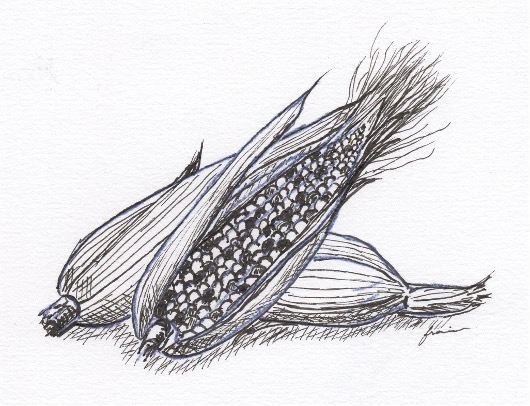
Courtesy of Hopkinton Historical Society. Jones, F. P. (n.d.). Abenaki Flint Corn from New Hampshire Cookbook [Digital Image].
Worksheet: WS 13 – Draw and Describe Abenaki Homes
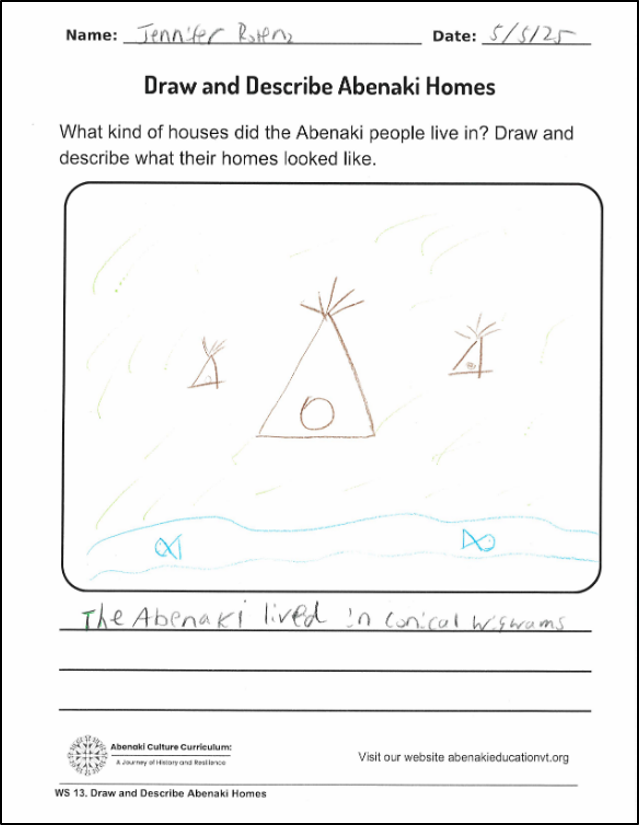
Prompt: What kind of houses did the Abenaki people live in? Draw and describe what their homes looked like.
Worksheet: WS 13. Draw and Describe Abenaki Homes
Resources
- Abenaki Homes and Structures [Poster] (Abenaki Arts & Education Center, 2025c)
- Abenaki Uses of Natural Resources [Table—PDF] (Abenaki Arts & Education Center, 2025d)
- Building a Traditional IndigenousThe first people living in any region, distinct from later arrivals. Peoples’ Wigwam at Strawbery Banke [Video—7:30 min.] (Strawbery Banke Museum, 2021)
Sample Student Response

Standards Alignment
Click + to view Standards Alignment guidance. Click – to close the box when done.
Potential Alignment: English Language Arts Standards
The Writing Informational TextWritten nonfiction materials that are intended to inform the reader about a specific topic. Informational text includes biographies, speeches, opinion or argument essays, and history or science explanations. activities can support the following sampling of standards and serve as a starting point for integrating the American AbenakiAbenaki tribes, families, and people who live in the United States. Vermont has four recognized Abenaki tribes; for more information visit Abenaki Alliance. Curriculum with language arts instruction and assessmentA tool to measure what a student knows and can do..
Grades 3–5
CCSS.ELA-Literacy.W.3.2.b. Develop the topic with facts, definitions, and details.
CCSS.ELA-Literacy.W.4.2.d. Use precise language and domain-specific vocabulary to inform about or explain the topic.
CCSS.ELA-Literacy.W.5.2.c. Link ideas within and across categories of information using words, phrases, and clauses (e.g., in contrast, especially).
Grade 6–8
CCSS.ELA-Literacy.W.6.1.a. Introduce claim(s) and organize the reasons and evidence clearly.
CCSS.ELA-Literacy.W.7.1.b. Support claim(s) with logical reasoning and relevant evidence, using accurate, credible sources and demonstrating an understanding of the topic or text.
CCSS.ELA-Literacy.W.8.1.c. Use words, phrases, and clauses to create cohesion and clarify the relationships among claim(s), counterclaims, reasons, and evidence.
Grade 9–12
CCSS.ELA-Literacy.W.9-10.1. Write arguments to support claims in an analysis of substantive topics or texts, using valid reasoning and relevant and sufficient evidence.
CCSS.ELA-Literacy.W.11-12.1.d. Establish and maintain a formal style and objective tone while attending to the norms and conventions of the discipline in which they are writing.