
Worksheet, Resources, and Sample Student Responses
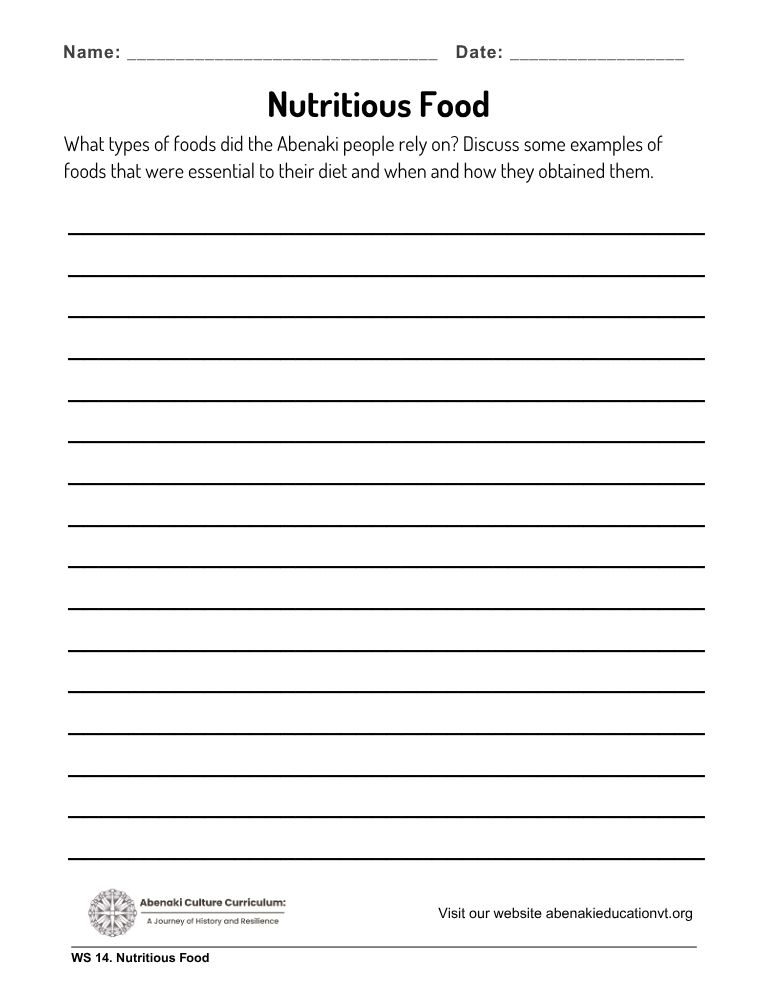
Worksheet: WS 14. Nutritious Food
Prompt:
What types of foods did the AbenakiHistorically, this name was used by the French to refer to many different Indigenous communities in Vermont, New Hampshire, and Maine. During the colonial wars, some New England Indians moved to southern Canada as war refugees. They were joined by refugees from other tribes and together became known as Abenaki. (Calloway, 1994) people rely on? Discuss some examples of foods that were essential to their diet and when and how they obtained them.
Resources
- Abenaki Food Systems [Video—13 min.] (Wild Foods, 2023)
- Abenaki LifewaysThe customary foods, clothing, shelters, and arts of a people. Mural [Digital Image—muralscenesVHS.jpg] (Sylvester, 2004)
- Daily Life of the Koasek Abenaki from A Brief History: From Koasek Meadows to You Today [Booklet—see pages 7-10] (Koasek Traditional BandA small group of Native American people with its leaders, usually part of a larger tribe. of the Koas Abenaki NationPeople living in the same region under its independent government and having a shared history, language, and culture. , n.d.-a)
- Fiddleheads: A Spring Favorite [Online article with recipes] (Sheehan, 2023)
- Food video (under construction)
- Seeds of Renewal Project: 2013 Harvest [Poster—Seeds of renewal poster.JPG] (Wiseman, 2013)
- Stories of ResilienceThe ability of people to recover quickly from a difficulty or to adjust easily to change. : Abenaki Tribal Garden [Video—2:47 min.] (NOFA-VT, 2022)
Sample Student Responses
Gardening
- corn (summer, fall, dried for winter)
- beans (summer, dried for winter)
- Penobscot pumpkin (fall)
- Algonquin squash
- Morrisville sunflower (summer)
Gathering/Foraging
- strawberries (summer)
- cranberries (fall)
- berries (summer)
- wild onions (spring)
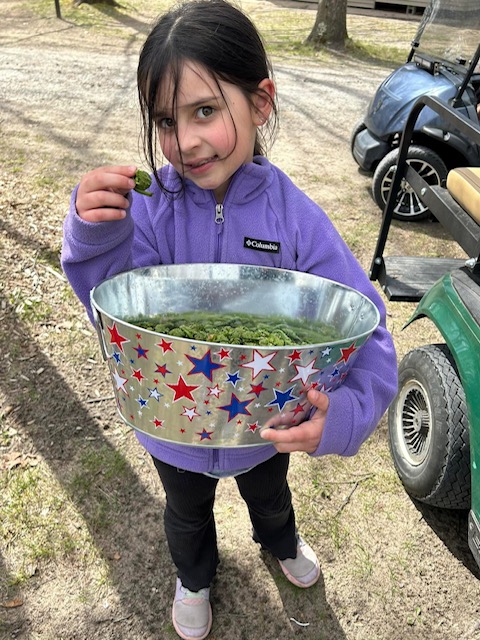
- fiddleheadThe coiled sprout of a developing fern, sometimes collected to cook and eat. ferns (spring)
- acorns (fall)
- butternuts (fall)
- walnuts (fall)
- hazelnuts (fall)
Hunting and Fishing
- deer, rabbits (all year)
- fish (spring, summer, fall, ice fishing for winter; smoked/dried for off-season use)
- eels (spring, summer; smoked/dried for off-season use)
Colonial Era Trade items
- wheat flour
- bread
- salted pork
Today
- Abenaki people eat most of the same foods as me.
- Some special foods Abenaki people enjoy are . . .
See Historical Context essay and Resources for possible additional responses.
Standards Alignment
Click + to view Standards Alignment guidance. Click – to close the box when done.
Potential Alignment: English Language Arts Standards
The Writing Informational TextWritten nonfiction materials that are intended to inform the reader about a specific topic. Informational text includes biographies, speeches, opinion or argument essays, and history or science explanations. activities can support the following sampling of standards and serve as a starting point for integrating the American AbenakiAbenaki tribes, families, and people who live in the United States. Vermont has four recognized Abenaki tribes; for more information visit Abenaki Alliance. Curriculum with language arts instruction and assessmentA tool to measure what a student knows and can do..
Grades 3–5
CCSS.ELA-Literacy.W.3.2.b. Develop the topic with facts, definitions, and details.
CCSS.ELA-Literacy.W.4.2.d. Use precise language and domain-specific vocabulary to inform about or explain the topic.
CCSS.ELA-Literacy.W.5.2.c. Link ideas within and across categories of information using words, phrases, and clauses (e.g., in contrast, especially).
Grade 6–8
CCSS.ELA-Literacy.W.6.1.a. Introduce claim(s) and organize the reasons and evidence clearly.
CCSS.ELA-Literacy.W.7.1.b. Support claim(s) with logical reasoning and relevant evidence, using accurate, credible sources and demonstrating an understanding of the topic or text.
CCSS.ELA-Literacy.W.8.1.c. Use words, phrases, and clauses to create cohesion and clarify the relationships among claim(s), counterclaims, reasons, and evidence.
Grade 9–12
CCSS.ELA-Literacy.W.9-10.1. Write arguments to support claims in an analysis of substantive topics or texts, using valid reasoning and relevant and sufficient evidence.
CCSS.ELA-Literacy.W.11-12.1.d. Establish and maintain a formal style and objective tone while attending to the norms and conventions of the discipline in which they are writing.