
Prompts and Resources
There are two writing prompts available for middle school students.
Materials
There are no materials needed for this activity.
Worksheet
WS 21. Lined Paper can be used at any stage of the writing process.
Prompt 1:
Compare and contrast the AbenakiHistorically, this name was used by the French to refer to many different Indigenous communities in Vermont, New Hampshire, and Maine. During the colonial wars, some New England Indians moved to southern Canada as war refugees. They were joined by refugees from other tribes and together became known as Abenaki. (Calloway, 1994) culture of the past and the present. Use resources to research, if needed, and then write a draft and then a final response including at least three elements of Abenaki culture that have been retained as the culture has adapted over time. Describe the ways Abenaki people have continued certain practices, and how others have changed over time. Discuss the reasons for these changes. Share each of your drafts with a peer, discuss ways to improve it, and use these ideas as a guide for writing your final response.
Resources
History
- Abenaki History in Vermont [Video—7 min.] (StuckinVermont, 2020)
- Abenaki History TimelineA graphic representation that shows a chronology of events (in the order they occurred) on a line. [Poster] (Abenaki Arts & Education Center, 2023)
Food
- Maple syruping video (in production)
- Seeds of Renewal Project: 2013 Harvest [Poster—Seeds of renewal poster.JPG] (Wiseman, 2013)
- Stories of ResilienceThe ability of people to recover quickly from a difficulty or to adjust easily to change. : Abenaki Tribal Garden [Video—2:47 min.] (NOFA-VT, 2022)
Language
- Indigenous Expressions Film Series: Melody of Language[Video—9:36 min.] (ECHO Leahy Center for Lake Champlain, 2017b)
- MiniCourse Song: Awani Na, Na Awani? [Video—5:14 min.] (Abenaki Online, 2023)
- N’Dakinna An illustrated Dictionary for Schools or “Vermont Educators and Students CollaborateTo work with one or more other people on a project, sharing ideas, knowledge, and skills to reach a common objective. on a New Dictionary” by Pamela Polston. ” (Polston,2020)
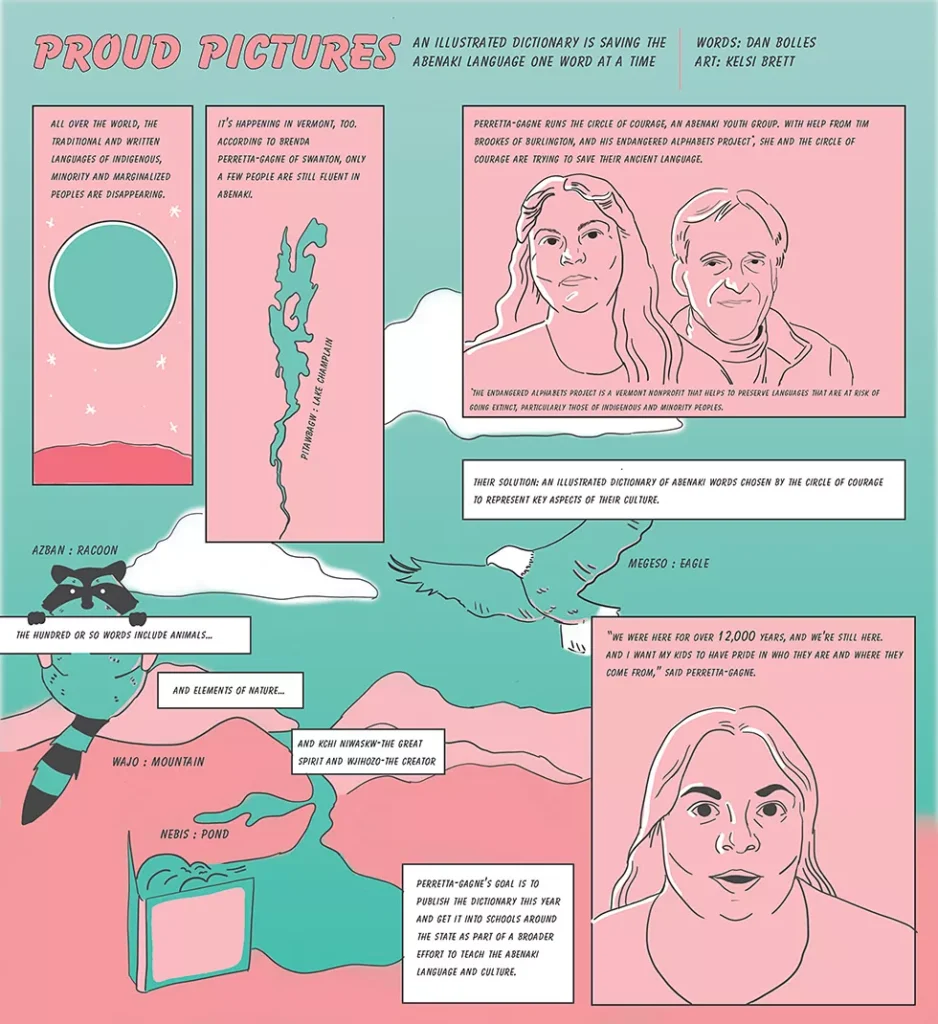
- Proud Pictures [Poster] (Bolles & Brett, 2019)
Art
- Abenaki Pottery Featuring Vicki Blanchard [Video—2:19 min.] (Abenaki Arts & Education, 2021)
- IndigenousThe first people living in any region, distinct from later arrivals. Expressions Film Series: Ash to Baskets [Video—7 min.] (ECHO Leahy Center for Lake Champlain, 2017a)
Cultural Practices
- From Calumet to Crisis and Back—Part 1 [Video—6:13 min.] (Circle of Courage, 2009a) [Teachers: Please review before screening for your students. This video examines the sacred uses and the misuses of tobacco.]
- From Calumet to Crisis and Back—Part 2 [Video—9:18 min.] (Circle of Courage, 2009b)[Teachers: Please review before screening for your students. This video examines the sacred uses and the misuses of tobacco.]
Sample Student Responses
Because students are doing independent research, there are no sample student responses for this activity.
Prompt 2:
Reflect on the resourcefulnessThe ability to find ways to deal with problems quickly and with imagination. of the Abenaki people in adapting their lifewaysThe customary foods, clothing, shelters, and arts of a people. to their environmentAll the physical surroundings on Earth, including everything living and nonliving. . How did their ability to adaptTo make changes to something more suitable for a new purpose. contribute to their survival and success?
Materials
There are no materials needed for this activity.
Worksheet
WS 21. Lined Paper can be used at any stage of the writing process.
Resources
History
- Abenaki History in Vermont [Video—7 min.] (StuckinVermont, 2020)
- Abenaki History Timeline [Poster] (Abenaki Arts & Education Center, 2023)
Food
- Maple syruping video (in production)
- Seeds of Renewal Project: 2013 Harvest [Poster—Seeds of renewal poster.JPG] (Wiseman, 2013)
- Stories of Resilience: Abenaki Tribal Garden [Video—2:47 min.] (NOFA-VT, 2022)
Language
- Indigenous Expressions Film Series: Melody of Language [Video—9:36 min.] (ECHO Leahy Center for Lake Champlain, 2017b)
- MiniCourse Song: Awani Na, Na Awani? [Video—5:14 min.] (Abenaki Online, 2023)
- N’Dakinna: An illustrated Dictionary for Schools [Book—email for purchase details: circleofcourage@comcast.net.] (Circle of Courage, 2019)
- Vermont Educators and Students Collaborate on a New Dictionary [News Article] (Polston,2020)
- Proud Pictures [Poster] (Bolles & Brett, 2019)
Art
- Abenaki Pottery Featuring Vicki Blanchard [Video—2:19 min.] (Abenaki Arts & Education, 2021)
- Indigenous Expressions Film Series: Ash to Baskets [Video—7 min.] (ECHO Leahy Center for Lake Champlain, 2017a)
Cultural Practices
- From Calumet to Crisis and Back—Part 1 [Video—6:13 min.] (Circle of Courage, 2009a) [Teachers: Please review before screening for your students. This video examines the sacred uses and the misuses of tobacco.]
- From Calumet to Crisis and Back—Part 2 [Video—9:18 min.] (Circle of Courage, 2009b)[Teachers: Please review before screening for your students. This video examines the sacred uses and the misuses of tobacco.]
Sample Student Responses
- If the Abenaki had not been innovative, they would not have been able to survive colonization. These innovations allowed them to be present today.
- Abenaki people intermarried with European neighbors and adopted European children.
- Abenaki people taught European newcomers culturalRelating to the beliefs, language, traditions, and other ways of living that a group shares. practices to survive.
- Abenaki people traded for newly available tools and textiles that made their tasks easier.
See Historical Context essay and Resources for possible additional responses.
Standards Alignment
Click + to view Standards Alignment guidance. Click – to close the box when done.
Potential Alignment: English Language Arts Standards
The Peer Review Partners activity can support the following sampling of standards and serve as a starting point for integrating the American AbenakiAbenaki tribes, families, and people who live in the United States. Vermont has four recognized Abenaki tribes; for more information visit Abenaki Alliance. Curriculum with language arts instruction and assessmentA tool to measure what a student knows and can do..
Grades 3–5
CCSS.ELA-Literacy.W.3.5. With guidance and support from peers and adults, develop and strengthen writing as needed by planning, revising, and editing.
CCSS.ELA-Literacy.W.4.4. Produce clear and coherent writing in which the development and organization are appropriate to task, purpose, and audience.
CCSS.ELA-Literacy.W.5.5. With guidance and support from peers and adults, develop and strengthen writing as needed by planning, revising, editing, rewriting, or trying a new approach.
Grades 6–8
CCSS.ELA-Literacy.W.6.2. Write informative/explanatory texts to examine a topic and convey ideas, concepts, and information through the selection, organization, and analysis of relevant content.
CCSS.ELA-Literacy.SL.7.1.d. Acknowledge new information expressed by others and, when warranted, modify their own views.
CCSS.ELA-Literacy.SL.8.1.b. Follow rules for collegial discussions and decision-making, track progress toward specific goals and deadlines, and define individual roles as needed.
Grades 9–12
CCSS.ELA-Literacy.SL.9-10.1. Initiate and participate effectively in a range of collaborative discussions (one-on-one, in groups, and teacher-led) with diverse partners on grades 9–10 topics, texts, and issues, building on others’ ideas and expressing their own clearly and persuasively.
CCSS.ELA-Literacy.W.11-12.1. Write arguments to support claims in an analysis of substantive topics or texts, using valid reasoning and relevant and sufficient evidence.
Potential Alignment: American Association of School Librarians (AASL) Standards
Learners
VI.B.2. Learners use valid information and reasoned conclusions to make ethical decisions in the creation of knowledge by: Acknowledging authorship and demonstrating respect for the intellectual property of others.
School Librarians
I.C.1 School librarians guide learners to maintain focus throughout the inquiry1. Inquiry is asking questions, seeking knowledge, and investigating information. According to the C3 Framework, inquiry is at the heart of social studies. 2. A comprehensive curricular unit designed for the C3 Framework that includes the key components of questions, tasks, and sources. The inquiry format leads students through the investigation of a compelling question. process by:Assisting in assessing the inquiry-based research process.
School Libraries
I.D.2. The school library ensures an inquiry based process for learners by: Reinforcing the role of the school library, information and technology resources in maximizing learning and institutional effectiveness.
Potential Alignment: International Society for Technology in Education (ISTE) Standards
Students
1.6.a. Choose the appropriate platforms and digital tools for meeting the desired objectives of their creation or communication.
Educators
2.6.a. Foster a culture where students take ownership of their learning goals and outcomes in both independent and group settings.
Educational Leaders3.2.e. Share lessons learned, best practices, challenges and the impact of learning with technology with other education leaders who want to learn from this work.
Potential Alignment: English Language Arts Standards
Potential Alignment: English Language Arts Standards