
Prompt, Resources, and Sample Student Responses
Decide if your students’ writing product will be the labeled Venn diagram or if they will use the information in their Venn diagrams as a guide for writing informative/explanatory text in paragraphs.
Prompt:
Compare and contrast the AbenakiHistorically, this name was used by the French to refer to many different Indigenous communities in Vermont, New Hampshire, and Maine. During the colonial wars, some New England Indians moved to southern Canada as war refugees. They were joined by refugees from other tribes and together became known as Abenaki. (Calloway, 1994) culture of the past and the present. Use resources to research, if needed, and create a Venn diagram to show at least two activities Abenaki people did only in the past, two activities they do only in the present, and at least three activities in which their culture has remained the same.
Worksheet
Resources
- Abenaki Food Systems [Video—13 min.] (Wild Foods, 2023)
- Abenaki History TimelineA graphic representation that shows a chronology of events (in the order they occurred) on a line. [Poster] (Abenaki Arts & Education Center, 2023)
- Indigenous Expressions Film Series: Ash to Baskets [Video—7 min.] (ECHO Leahy Center for Lake Champlain, 2017a)
- Proud Pictures [Poster] (Bolles & Brett, 2019)
- Seeds of Renewal Project: 2013 Harvest [Poster—Seeds of renewal poster.JPG] (Wiseman, 2013)
- Stories of ResilienceThe ability of people to recover quickly from a difficulty or to adjust easily to change. : Abenaki Tribal Garden [Video—2:47 min.] (NOFA-VT, 2022)
Sample Student Response
Below is a sample Venn diagram focusing on Abenaki culture. The student labeled the left circle “Past” and the right circle “Present.” In the “Past” circle the student incorporated their prior knowledge about Milpa (growing corn, beans, and squash together) and chemicals in food systems. In the intersection of the two circles, the student wrote how the Abenaki culture has remained the same.
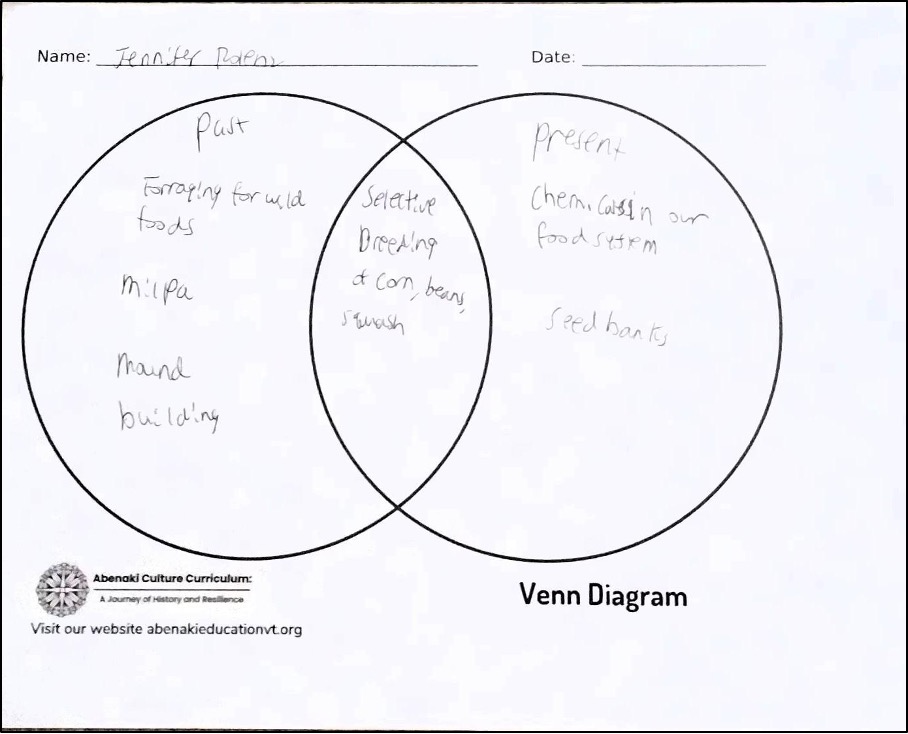
Past
- foraging for wild foods
- Milpa [example of student prior knowledge]
- mound building
Present
- chemicals in our food systems
- seed banks
Overlap
- selective breeding of corn, beans, and squash
See Historical Context essay and Resources for possible additional responses.
Standards Alignment
Click + to view Standards Alignment guidance. Click – to close the box when done.
Potential Alignment: English Language Arts Standards
The Peer Review Partners activity can support the following sampling of standards and serve as a starting point for integrating the American AbenakiAbenaki tribes, families, and people who live in the United States. Vermont has four recognized Abenaki tribes; for more information visit Abenaki Alliance. Curriculum with language arts instruction and assessmentA tool to measure what a student knows and can do..
Grades 3–5
CCSS.ELA-Literacy.W.3.5. With guidance and support from peers and adults, develop and strengthen writing as needed by planning, revising, and editing.
CCSS.ELA-Literacy.W.4.4. Produce clear and coherent writing in which the development and organization are appropriate to task, purpose, and audience.
CCSS.ELA-Literacy.W.5.5. With guidance and support from peers and adults, develop and strengthen writing as needed by planning, revising, editing, rewriting, or trying a new approach.
Grades 6–8
CCSS.ELA-Literacy.W.6.2. Write informative/explanatory texts to examine a topic and convey ideas, concepts, and information through the selection, organization, and analysis of relevant content.
CCSS.ELA-Literacy.SL.7.1.d. Acknowledge new information expressed by others and, when warranted, modify their own views.
CCSS.ELA-Literacy.SL.8.1.b. Follow rules for collegial discussions and decision-making, track progress toward specific goals and deadlines, and define individual roles as needed.
Grades 9–12
CCSS.ELA-Literacy.SL.9-10.1. Initiate and participate effectively in a range of collaborative discussions (one-on-one, in groups, and teacher-led) with diverse partners on grades 9–10 topics, texts, and issues, building on others’ ideas and expressing their own clearly and persuasively.
CCSS.ELA-Literacy.W.11-12.1. Write arguments to support claims in an analysis of substantive topics or texts, using valid reasoning and relevant and sufficient evidence.
Potential Alignment: American Association of School Librarians (AASL) Standards
Learners
VI.B.2. Learners use valid information and reasoned conclusions to make ethical decisions in the creation of knowledge by: Acknowledging authorship and demonstrating respect for the intellectual property of others.
School Librarians
I.C.1 School librarians guide learners to maintain focus throughout the inquiry1. Inquiry is asking questions, seeking knowledge, and investigating information. According to the C3 Framework, inquiry is at the heart of social studies. 2. A comprehensive curricular unit designed for the C3 Framework that includes the key components of questions, tasks, and sources. The inquiry format leads students through the investigation of a compelling question. process by:Assisting in assessing the inquiry-based research process.
School Libraries
I.D.2. The school library ensures an inquiry based process for learners by: Reinforcing the role of the school library, information and technology resources in maximizing learning and institutional effectiveness.
Potential Alignment: International Society for Technology in Education (ISTE) Standards
Students
1.6.a. Choose the appropriate platforms and digital tools for meeting the desired objectives of their creation or communication.
Educators
2.6.a. Foster a culture where students take ownership of their learning goals and outcomes in both independent and group settings.
Educational Leaders3.2.e. Share lessons learned, best practices, challenges and the impact of learning with technology with other education leaders who want to learn from this work.
Potential Alignment: English Language Arts Standards
Potential Alignment: English Language Arts Standards