
Overview
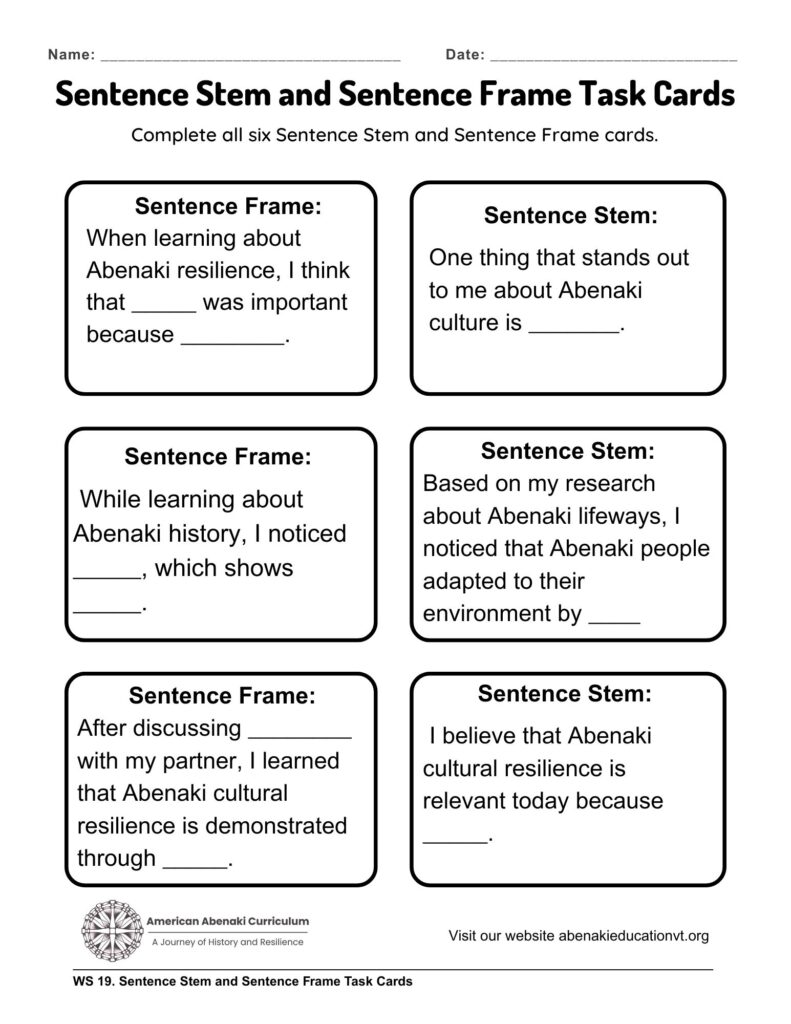
Sentence stems are the beginning parts of sentences for students to complete. Sentence frames are complete sentences with words and terms missing that a student will fill in. Both can serve as a structured starting point for thoughtful student discussions, reflections, and responses and are especially helpful to ENL students who are in the early production stage of learning. The sentence stems and frames provided on the worksheet help students’ articulate their insights about AbenakiHistorically, this name was used by the French to refer to many different Indigenous communities in Vermont, New Hampshire, and Maine. During the colonial wars, some New England Indians moved to southern Canada as war refugees. They were joined by refugees from other tribes and together became known as Abenaki. (Calloway, 1994) culture, resilienceThe ability of people to recover quickly from a difficulty or to adjust easily to change. , and historical contexts. They also aid in comprehension, critical thinkingA set of skills that requires one to inquire, analyze, interpret, synthesize, and reflect on information to form a comprehensive response., and the development of language skills.
Materials
There are no materials needed for this activity.
Worksheet
Resources
No new resources should be required for this activity.
Guiding the Inquiry1. Inquiry is asking questions, seeking knowledge, and investigating information. According to the C3 Framework, inquiry is at the heart of social studies. 2. A comprehensive curricular unit designed for the C3 Framework that includes the key components of questions, tasks, and sources. The inquiry format leads students through the investigation of a compelling question.
- Explain to students that sentence stems and sentence frames are tools that can help them say or write what they are thinking.
- Hand out the Sentence StemThe start of a sentence that the learner completes with their thoughts. Sentence stems are a type of scaffold that is often used to help students participate in discussions. and Sentence FrameA type of fill-in-the-blank structure that includes portions of a sentence and expects the learner to complete the sentence with content that they have learned. A sentence frame is a type of scaffold. Task Cards worksheet.
- Have students read each sentence stem or sentence frame carefully and, before completing the sentence, think about how they can use it to answer Supporting QuestionFrom the Inquiry Design Model (IDM) At a Glance: “Supporting questions are intended to contribute knowledge and insights to the inquiry behind a compelling question. Supporting questions focus on descriptions, definitions, and processes about which there is general agreement within the social studies disciplines, which will assist students to construct explanations that advance the inquiry. Typically, there are 3–4 supporting questions that help to scaffold the compelling question. Example: What were the political changes that resulted from the American Revolution?” (Grant et al., 2014) 3. Encourage them to turn and talk to a partner before recording their responses.
- Tell students to feel free to support their responses by adding details, examples, or personal experiences.
- Hold a class discussion in which students share their completed sentences and cite evidence based on prior research using resources
Sample Student Responses
- When learning about Abenaki resilience, I think that land was important because it allowed them to hide when needed. Land was their lifeline to food, water, shelterA place or structure that protects people from the weather. , and medicine.
- One thing that stands out to me about Abenaki culture is that the Abenaki people are still here today.
- While learning about Abenaki history, I noticed they had everything they needed, which shows me that they figured out how to use the resources where they live.
- Based on my research of Abenaki lifewaysThe customary foods, clothing, shelters, and arts of a people. , I noticed that Abenaki people adapted to their environmentAll the physical surroundings on Earth, including everything living and nonliving. by taking only what they needed and leaving what they didn’t need.
- After discussing Abenaki food with my partner, I learned that Abenaki culturalRelating to the beliefs, language, traditions, and other ways of living that a group shares. resilience is demonstrated through the fact that they still eat the same things they did thousands of years ago.
- I believe that Abenaki cultural resilience is relevant today because the Abenaki people continue to live on their traditional homelands and adaptTo make changes to something more suitable for a new purpose. to new ones.