Worksheets, Resources, and Sample Student Responses
Worksheet: WS 16. Architectural Styles
Prompt:
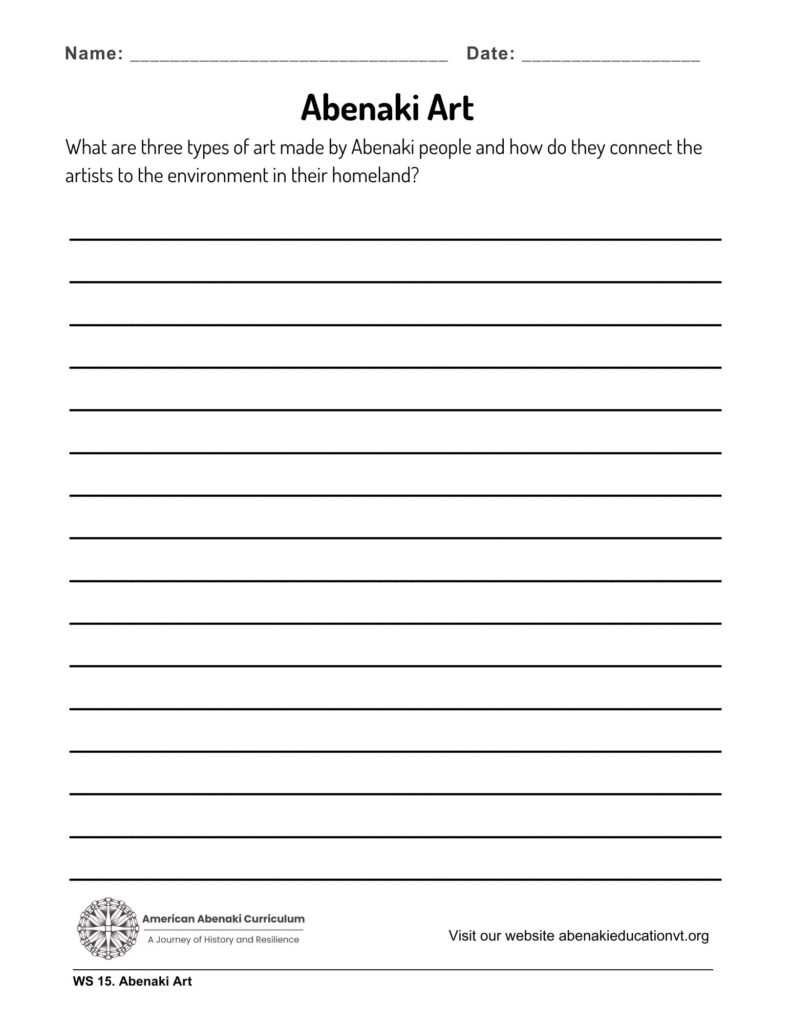
Analyze the architectural styles of Abenaki shelters. How did these structures accommodate their builders’ lifestyles while providing essential protection and comfort?
Resources
- Abenaki Homes and Structures [Poster] (Abenaki Arts & Education Center, 2025c)
- Building a Traditional Indigenous Peoples’ Wigwam at Strawbery Banke [Video—7:30 min.] (Strawbery Banke Museum, 2021)
- Daily Life of the Koasek Abenaki from A Brief History: From Koasek Meadows to You Today [Booklet—see pages 7-10] (Koasek Traditional Band of the Koas Abenaki Nation, n.d.-a)
Sample Student Responses
- A wigwam or conical wigwam is a great mobile home for when you need to follow the seasons.
- A longhouse means that you can still be warm and protected from the elements due to the bark outside. However, it is not mobile and is good for more permanent settlements.
- Wigwam and longhouse outsides protect you and keep you warm.
- Smoke can go up the top and out through the smokehole of the wigwam or longhouse.
See Historical Context essay and Resources for possible additional responses.
Standards Alignment
Click + to view Standards Alignment guidance. Click – to close the box when done.
Potential Alignment: English Language Arts Standards
The Writing Informational Text activities can support the following sampling of standards and serve as a starting point for integrating the American Abenaki Curriculum with language arts instruction and assessment.
Grades 3–5
CCSS.ELA-Literacy.W.3.2.b. Develop the topic with facts, definitions, and details.
CCSS.ELA-Literacy.W.4.2.d. Use precise language and domain-specific vocabulary to inform about or explain the topic.
CCSS.ELA-Literacy.W.5.2.c. Link ideas within and across categories of information using words, phrases, and clauses (e.g., in contrast, especially).
Grade 6–8
CCSS.ELA-Literacy.W.6.1.a. Introduce claim(s) and organize the reasons and evidence clearly.
CCSS.ELA-Literacy.W.7.1.b. Support claim(s) with logical reasoning and relevant evidence, using accurate, credible sources and demonstrating an understanding of the topic or text.
CCSS.ELA-Literacy.W.8.1.c. Use words, phrases, and clauses to create cohesion and clarify the relationships among claim(s), counterclaims, reasons, and evidence.
Grade 9–12
CCSS.ELA-Literacy.W.9-10.1. Write arguments to support claims in an analysis of substantive topics or texts, using valid reasoning and relevant and sufficient evidence.
CCSS.ELA-Literacy.W.11-12.1.d. Establish and maintain a formal style and objective tone while attending to the norms and conventions of the discipline in which they are writing.