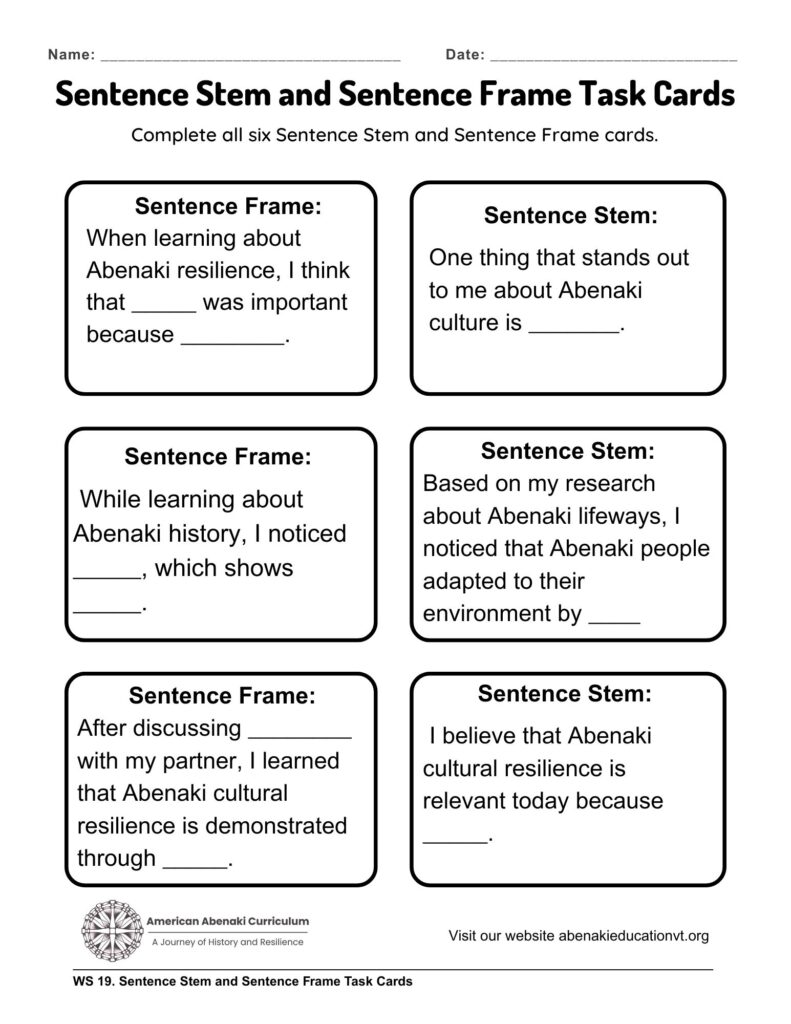
This page provides all of the worksheets in one place for your convenience. The worksheets below are grouped to align with the supporting questions and tasks of the curriculum.
Click on a worksheet in order to obtain a PDF version of it suitable for printing.
Supporting Question 1
What is the influence of geographic locations on the daily lives, cultural practices, and relationships of the Abenaki people?
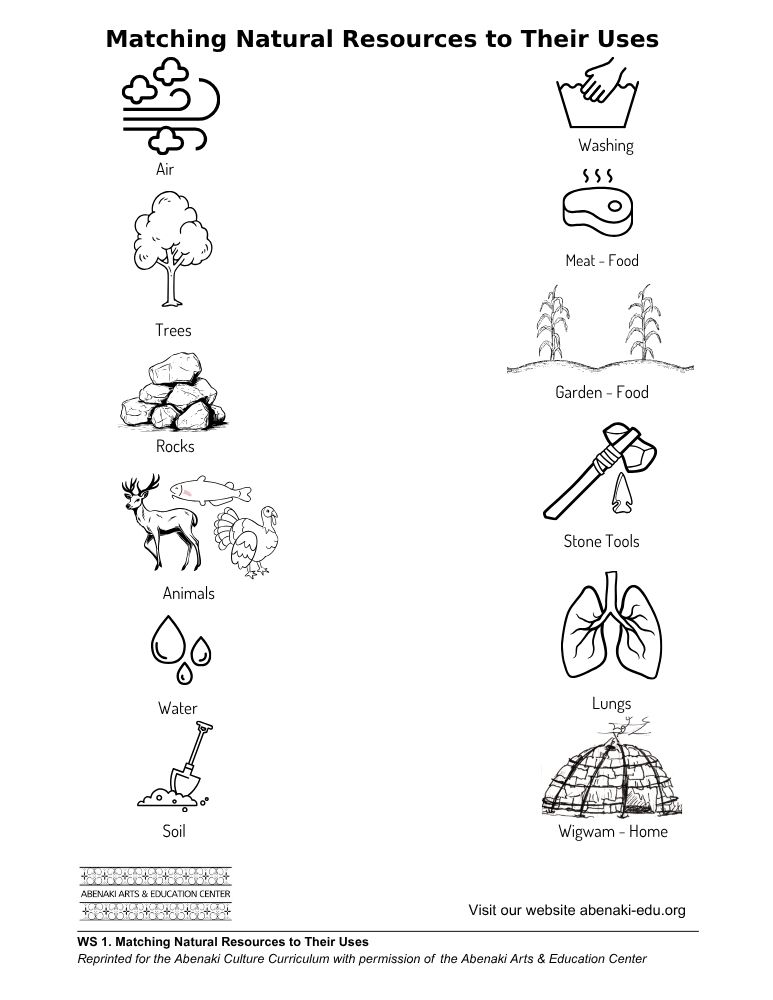
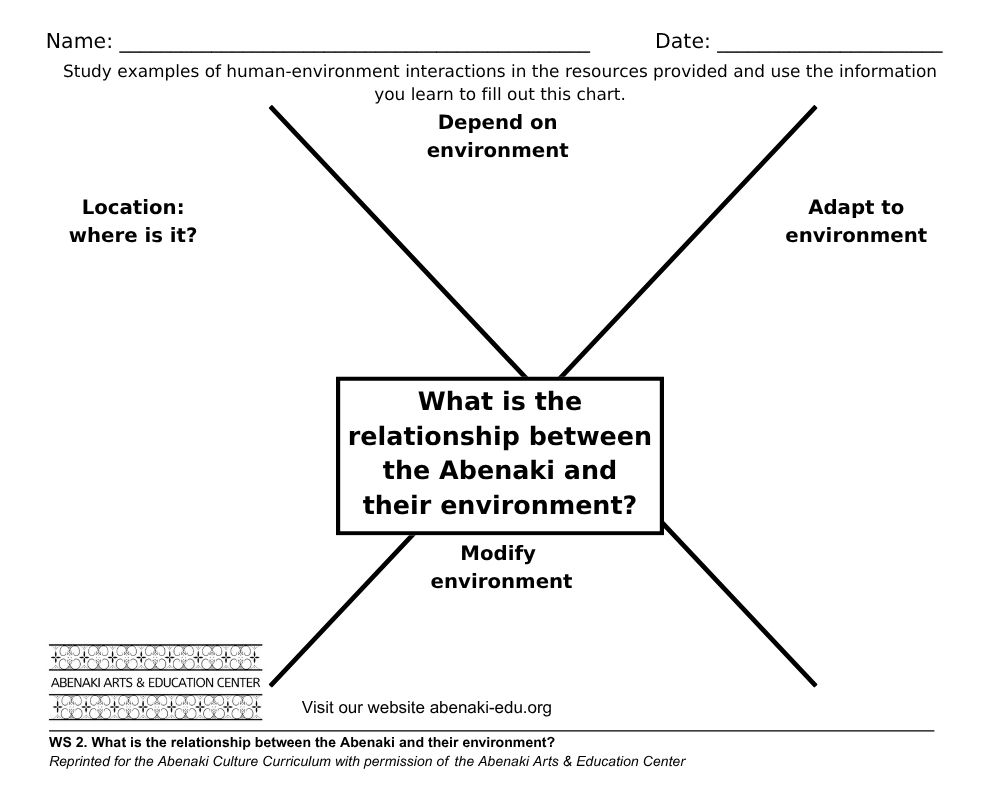
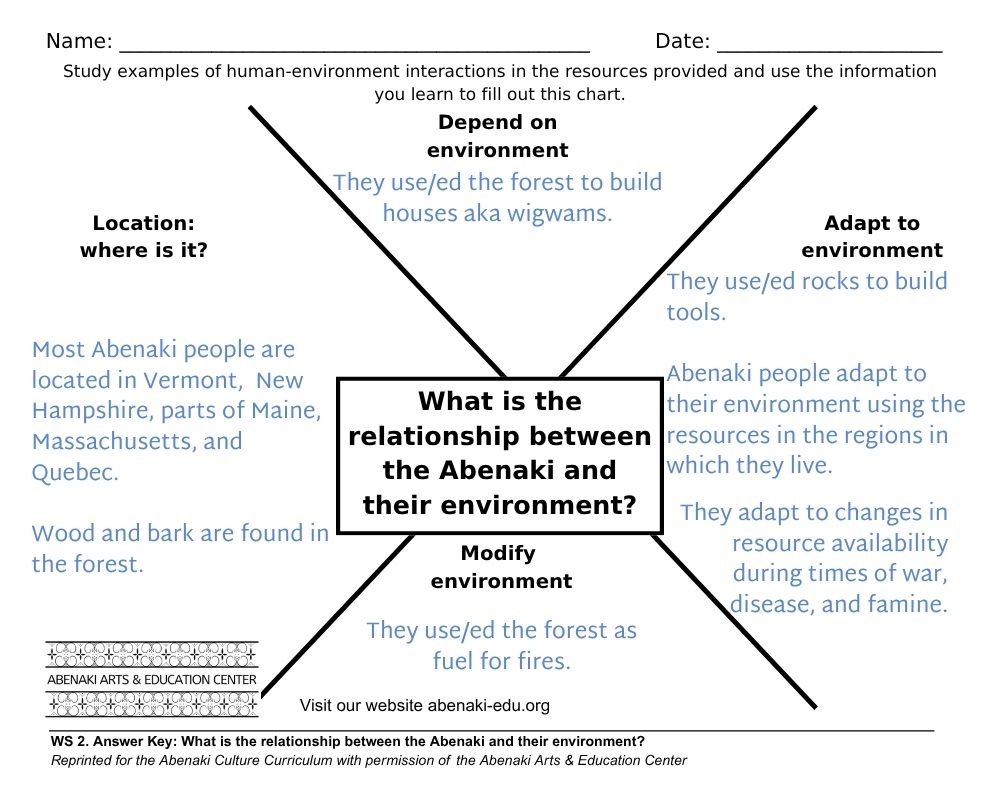
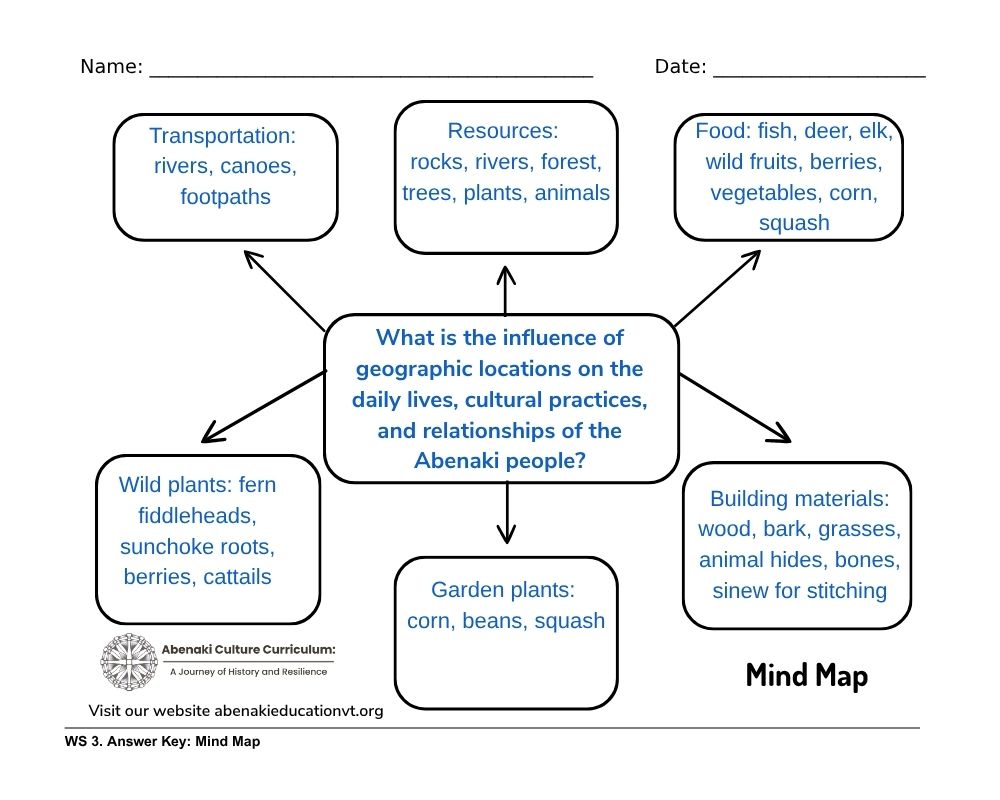
Matching Natural Resources worksheet.Answer key for Matching Natural Resources worksheet.Supporting Question Number 1 worksheetWS 2 – Sample Answer Key for Relationship between Abenaki and EnvironmentMind map worksheet for Supporting Question 1Sample Answer Key for Mind map worksheet for Supporting Question 1WS 4 – Draw and Describe Resources and LandformsWS 5 – Geography and ResourcesWS 6 – Geography, Land Use, and the EnvironmentWS 7 – Geography and Sustainable PracticesWS 8 – Familiarity with GeographyWS 9 – My Research WorksheetWS 10a – Track My Research and Notes, side 1WS 10b – Track My Research and Notes, side 2
Supporting Question 2
What are some significant Abenaki lifeways (food, clothing, art, and shelter), and how did the Abenaki people adapt these lifeways to their environment?
WS 11 – Give One, Get OneWS 12 – Draw and Describe Abenaki FoodWS 13 – Draw and Describe Abenaki HomesWS 14 – Nutritious FoodWS 15 – Abenaki ArtWS 16 – Adapting LifewaysWS 17 – Storyboard 3 PanelWS 18 – Storyboard 6 PanelWS 9 – My Research WorksheetWS 10a – Track My Research and Notes, side 1WS 10b – Track My Research and Notes, side 2
Supporting Question 3
How have the Abenaki people demonstrated resilience and resourcefulness in maintaining their cultural identity from colonial times to today?
WS 19 – Sentence Stems and FramesWS 20 – Venn DiagramWS 21 – Lined PaperWS 9 – My Research WorksheetWS 10a – Track My Research and Notes, side 1WS 10b – Track My Research and Notes, side 2
Taking Informed Action is essential to the Inquiry Design Model (IDM) as it supports students in transferring their new learning to civic engagement in their local communities. It “Includes three steps: Understand the Issue, Assess Possible Solutions or Approaches, and Act to Make a Difference.” (Swan et al., n.d.)
Overview
Taking Informed Action empowers students to apply the knowledge they have gained to a project that preserves or adapts their school or local community culture.
Annual Donut Sale youth volunteers make donuts, package and cash out orders all day. The money raised goes toward scholarships for Abenaki high school seniors, youth trips, and families in need. Photo by Stacey Gould. Courtesy, Circle of Courage (Gould, n.d.c)
Students will develop Community Action Proposals that outline tangible ways to support resilience, cultural preservation, or belonging in their school or local community. Proposals may include organizing events, developing awareness campaigns, or collaborating with local cultural organizations.
Using the three-step process (Understand the Issue, Assess Possible Solutions or Approaches, and Act to Make a Difference), students draw meaningful connections between historical and present-day challenges that deepen their understanding of adaptation and resilience, while developing feelings of empathy and social responsibility. Students will learn they can make a real and lasting impact in their school or local community.
Begin with a class discussion about the meaning of culture, resilience, and adapting. Have students share examples of resilience they learned about in class and through their research.
Ask students to identify connections between Abenaki resilience and cultural preservation. Next, have them think about the connections between Abenaki resilience and cultural preservation. Then, discuss the issues or challenges related to culture and resilience in your school or your own community.
Share and discuss the following definition from NYSED.gov: “School culture is the set of common values, beliefs, and traditions that influence how people in the school community act and interact with each other. It shapes the unwritten rules for how things are done and what behaviors are expected.” (NYSED, n.d.)
Ask students the following school culture guiding questions:
How do staff, teachers, and students treat each other in our school?
Does our school have any traditions?
What are our school’s values?
Assess Possible Solutions and Approaches
Have students brainstorm ways to improve or preserve your school or community culture. Determine whether the entire class will choose one solution to carry out or if students will work in small groups on several solutions.
With your students, discuss the pros and cons of each idea and then choose an action plan solution that is most likely to be effective. Or students may choose from the list below under Ideas for Action Plan Solutions.
Guide students to develop a detailed plan for their chosen solution that identifies the audience they wish to reach or a need they wish to address. Have them determine the steps to take and a timeline for each step.
Discuss the potential impact of the plan. Ask: “What is the larger context of the problem or challenge you want to address?” “Why is it important?” “How will your action plan impact your school or local community?”
Students can frame their solutions as an argument (with a claim, multiple points of evidence, and their own reasoning).
Act to Make a Difference
Have students carry out the steps in their action plan based on the agreed upon timeline.
Conclude with a group reflection that helps bring the activity to a meaningful conclusion.
Ideas for Action Plan Solutions
Morning Announcements—Students write brief statements about the importance of resilience that can be read over the school PA system during homeroom or morning meetings.
Resilience Reading List—Students work with the school librarian or community representative (for example, a local Historical Society or museum) to curate a list of resources on topics such as resilience, cultural awareness, or cultural preservation.
New Students Greeting—Students develop a plan for greeting new students and helping them feel like they belong at their new school.
Food Drive–Students develop a plan to collect non-perishable food items to be donated to an Abenaki food shelf.
The Summative Performance Task is the final opportunity in the Inquiry Design Model for you to assess what a student knows and can do at the end of an instructional unit.
Students will make an argument that answers the Compelling Question “How have the Abenaki people survived and adapted to their environment for thousands of years?” Arguments should include a claim, multiple points of evidence, and their own reasoning.
Each of the two summative performance tasks aligns with C3 Framework for Social Studies standards D4.6.3-5 and D3.3.3-5, the Compelling Question for the Inquiry, and the accompanying learning scales. Teachers may have all students complete the same assessment option or provide them with a choice.
Assessment Objective
Students will use what they have learned about Abenaki culture to explain challenges the Abenaki have faced and share examples from multiple sources (written narrative, artwork, photographs, etc.) of how the American Abenaki have survived and adapted.
Standards Alignment
The following C3 standard aligns with all activities for Supporting Question 2 (SQ2). See “Section 4: Standards Alignment” for further details.
Click + to view Standards Alignment guidance. Click – to close the box when done.
C3 Framework for Social Studies
Standards Assessed for Grades 3–5
D4.6.3-5. Draw on disciplinary concepts to explain the challenges people have faced and opportunities they have created, in addressing local, regional, and global problems at various times and places.
Beginning
Progressing
Proficient
Proficient with Distinction
I can share what I have learned about the American Abenaki people.
I can use what I have learned about the American Abenaki to explain the challenges that they have faced.
I can use what I have learned about the American Abenaki to explain the challenges that they have faced and how they have survived and adapted.
I can use what I have learned about the American Abenaki to explain, with specific examples, the challenges that they have faced and how they have survived and adapted.
D3.3.3-5. Identify evidence that draws information from multiple sources in response to compelling questions.
Beginning
Progressing
Proficient
Proficient with Distinction
I can share examples from one source to explain how the American Abenaki people have survived and adapted.
I can share examples from two different sources to explain how the American Abenaki have survived and adapted.
I can share examples from three different sources to explain how the American Abenaki have survived and adapted.
I can share examples from more than three different sources to explain how the American Abenaki have survived and adapted.
The Summative Assessment can be connected to the following sampling of standards that can serve as a starting point for integrating the American Abenaki Curriculum with other content areas and grade levels.
Potential C3 Standards for Other Grade Bands
Grades K-2
D4.6.K-2. Identify and explain a range of local, regional, and global problems, and some ways in which people are trying to address these problems.
Grades 6-8
D4.6.6-8. Draw on multiple disciplinary lenses to analyze how a specific problem can manifest itself at local, regional, and global levels over time, identifying its characteristics and causes, and the challenges and opportunities faced by those trying to address the problem.
Grades 9-12 D4.6.9-12. Use disciplinary and interdisciplinary lenses to understand the characteristics and causes of local, regional, and global problems; instances of such problems in multiple contexts; and challenges and opportunities faced by those trying to address these problems over time and place.
Standards Alignment
Potential Alignment: American Association of School Librarians (AASL) Standards
Learners
VI.B.2. Learners use valid information and reasoned conclusions to make ethical decisions in the creation of knowledge by: Acknowledging authorship and demonstrating respect for the intellectual property of others.
School Librarians
II.D.2. School librarians explicitly lead learners to demonstrate empathy and equity in knowledge building within the global community by: Initiating opportunities that allow learners to demonstrate interest in other perspectives.
School Libraries
II.D.2. The school library builds empathy and equity within the global learning community by: Enabling equitable access to learning opportunities, academic and social support, and other resources necessary for learners’ success.
Potential Alignment: International Society for Technology in Education (ISTE) Standards
Students
1.6.a. Choose the appropriate platforms and digital tools for meeting the desired objectives of their creation or communication.
Educators
2.6.a. Foster a culture where students take ownership of their learning goals and outcomes in both independent and group settings.
Educational Leaders
3.2.e. Share lessons learned, best practices, challenges and the impact of learning with technology with other education leaders who want to learn from this work.
Portfolio
Decide whether students will develop a Portfolio or an Oral Presentation with Poster to present their arguments, or allow students to choose. Consider giving students a self-assessment checklist of “I can. . . ” statements based on the learning scale tables provided for both standards.
Overview
Students compile a portfolio of evidence to support their claim about how Abenaki people survived and adapted over thousands of years until today. Their evidence should include findings about Abenaki history, lifeways, or the challenges that Abenaki people have faced in the past or present. Developing a portfolio is a flexible activity. It can include artwork, maps, photographs, and student writing. Portfolios can be submitted to the teacher, shared with the entire class, or presented to the school during an assembly program.
Materials
Possible materials may include
manila folders
binders
tape or glue sticks
sticky notes
Worksheet
There are no worksheets required for this activity.
Resources
No new resources are required for this activity.
Guiding the Inquiry
Explain the concept of a portfolio to your students and inform them of the due date.
Provide them with a list of the types of research findings they may include in their portfolio.
Show students how they will store their research findings (for example, in a cardboard folder, binder, or electronic folder).
If you wish students to write a brief explanation of how each finding helps answer the Compelling Question, model the process with one item. For example, you might have students write on sticky notes and affix them to the artwork, maps, and photographs.
Explain how you will evaluate the portfolio and how it might be shared.
Provide your students with feedback after reviewing their portfolio or portfolio presentation.Click + to view
Click + to view Standards Alignment guidance. Click – to close the box when done.
Potential Alignment: English Language Arts Standards
The Portfolio activity activity can support the following sampling of standards and serve as a starting point for integrating the American Abenaki Curriculum with language arts instruction and assessment.
Grades 3–5
CCSS.ELA-Literacy.W.3.8. Recall information from experiences or gather information from print and digital sources; take brief notes on sources and sort evidence into provided categories.
CCSS.ELA-Literacy.W.4.7. Conduct short research projects that build knowledge through investigation of different aspects of a topic.
CCSS.ELA-Literacy.W.5.7. Conduct short research projects that use several sources to build knowledge through investigation of different aspects of a topic.
Grades 6–8
CCSS.ELA-Literacy.W.6.1.b. Support claim(s) with clear reasons and relevant evidence, using credible sources and demonstrating an understanding of the topic or text.
CCSS.ELA-Literacy.RI.6.7. Integrate information presented in different media or formats (e.g., visually, quantitatively) as well as in words to develop a coherent understanding of a topic or issue.
CCSS.ELA-Literacy.W.7.1.b. Support claim(s) with logical reasoning and relevant evidence, using accurate, credible sources and demonstrating an understanding of the topic or text.
CCSS.ELA-Literacy.W.8.1. Write arguments to support claims with clear reasons and relevant evidence.
Grades 9–12
CCSS.ELA-Literacy.W.9-10.1. Write arguments to support claims in an analysis of substantive topics or texts, using valid reasoning and relevant and sufficient evidence.
CCSS.ELA-Literacy.W.11-12.1. Write arguments to support claims in an analysis of substantive topics or texts, using valid reasoning and relevant and sufficient evidence.
Oral Presentation with Poster
Overview
Students develop an argument supported with evidence to answer the Compelling Question, presenting it through a combined verbal and illustrated presentation. They share examples from their research and activities to explain how the Abenaki have survived and adapted to their environment for thousands of years.
Materials
poster boards
markers and other art supplies
color printer and paper to produce text and images
supplies for displaying posters (easels, bulletin boards and tacks, tape loops)
Worksheet
There are no worksheets required for this activity.
Resources
No new resources are required for this activity.
Guiding the Inquiry
Design the poster presentations to meet the needs of your students and school. Consider the audience—posters can be shared in your classroom, at another classroom, or at a school-wide event. Decide how long each student should prepare to speak about their poster, for example 60-seconds.
Explain to students your expectations for the presentation, including due dates for you to review the posters, the date and time of the presentations, and other assignment details.
Give students time to create a poster that illustrates their response to the Compelling Question “How have the Abenaki people survived and adapted to their environment for thousands of years?”
Allow time for them to rehearse their poster presentations.
After the conclusion of the presentations, provide students constructive feedback about what they did right and how they can improve.
Standards Alignment
Click +to view Standards Alignment guidance. Click – to close the box when done.
Potential Alignment to English Language Arts Standards
The Oral Presentation with Poster activity activity can support the following sampling of standards and serve as a starting point for integrating the American Abenaki Curriculum with language arts instruction and assessment.
Grades 3–5
CCSS.ELA-Literacy.SL.3.1. Engage effectively in a range of collaborative discussions (one-on-one, in groups, and teacher-led) with diverse partners on grade 3 topics and texts, building on others’ ideas and expressing their own clearly.
CCSS.ELA-Literacy.SL.3.6. Speak in complete sentences when appropriate to task and situation in order to provide requested detail or clarification.
CCSS.ELA-Literacy.SL.4.4. Report on a topic or text, tell a story, or recount an experience in an organized manner, using appropriate facts and relevant, descriptive details to support main ideas or themes; speak clearly at an understandable pace.
CCSS.ELA-Literacy.SL.5.5. Include multimedia components (e.g., graphics, sound) and visual displays in presentations when appropriate to enhance the development of main ideas or themes.
Grades 6–8
CCSS.ELA-Literacy.SL.6.2. Interpret information presented in diverse media and formats (e.g., visually, quantitatively, orally) and explain how it contributes to a topic, text, or issue under study.
CCSS.ELA-Literacy.SL.7.6. Adapt speech to a variety of contexts and tasks, demonstrating command of formal English when indicated or appropriate.
CCSS.ELA-Literacy.SL.8.4. Present claims and findings, emphasizing salient points in a focused, coherent manner with relevant evidence, sound valid reasoning, and well-chosen details; use appropriate eye contact, adequate volume, and clear pronunciation.
Grades 9–12
CCSS.ELA-Literacy.SL.9-10.2. Integrate multiple sources of information presented in diverse media or formats (e.g., visually, quantitatively, orally) evaluating the credibility and accuracy of each source.
CCSS.ELA-Literacy.SL.11-12.4. Present information, findings, and supporting evidence, conveying a clear and distinct perspective, such that listeners can follow the line of reasoning, alternative or opposing perspectives are addressed, and the organization, development, substance, and style are appropriate to purpose, audience, and a range of formal and informal tasks.
In Supporting Question 2 activities, students examined some significant adaptations of Abenaki lifeways in response to physical and social environmental factors in their world—with a focus on food, clothing, shelter, and art-making.
Supporting Question 3 focuses students’ discussions and writing on what they have learned and are learning about American Abenaki cultural preservation and cultural identity. Resilience, adaptation, and cultural values are some of the many ways local Abenaki people have maintained their cultural identity from colonial times to today.
Supporting Question 3
How have the American Abenaki people demonstrated resilience and resourcefulness in maintaining their culture from colonial times to today?
Supporting Question 1 presented material about Abenaki relationships with the environment, natural resources, and their neighbors.
Assessment Objective
Students can ask and answer informed questions and write about how the American Abenaki people have maintained their cultural identity.
Standards Alignment
The following C3 standard aligns with all activities for Supporting Question 3 (SQ3). See “ Standards Alignment” for further details.
Click +to view Standards Alignment guidance. Click – to close the box when done.
Standards Alignment
The following C3 standard aligns with the activities for Supporting Question 3 (SQ3). See “Section 4: Standards Alignment” for further details.
C3 Framework for Social Studies
Standard Assessed for Grades 3–5
D2.His.3.3-5. Generate questions about individuals and groups who have shaped significant historical changes and continuities.
Beginning
Progressing
Proficient
Proficient with Distinction
I can create and ask an informed question about the American Abenaki people.
I can create and ask an informed question about how the American Abenaki have maintained their cultural identity over time.
I can create and ask an informed question about how the American Abenaki have maintained their cultural identity over time. I can accurately answer a question about how the American Abenaki have maintained their culture over time.
I can create and ask informed questions about how the American Abenaki have maintained their cultural identity over time. I can accurately answer questions about how the American Abenaki have maintained their culture over time.
Supporting Question 3 can also be aligned to the following sampling of standards and guide educators when integrating the American Abenaki Curriculum with other content areas and grade levels. In addition, you will find Common Core English Languages Arts standards alignment for each activity under SQ3.
Potential C3 Standards for Other Grade Bands
Grades K–2
D2.His.3.K-2. Generate questions about individuals and groups who have shaped a significant historical change.
Grades 6–8
D2.His.3.6-8. Use questions generated about individuals and groups to analyze why they, and the developments they shaped, are seen as historically significant.
Grades 9–12
D2.His.3.9-12.Use questions generated about individuals and groups to assess how the significance of their actions changes over time and is shaped by the historical context.
Potential Alignment: American Association of School Librarians (AASL) Standards
Learners
I.D.1. Enacting new understanding through real-world connections.
V.A.3. Engaging in inquiry-based processes for personal growth.
VI.B.2. Acknowledging authorship and demonstrating respect for the intellectual property of others.
School Librarians
VI.D.3. School librarians support learners’ engagement with information to extend personal learning by: Championing and modeling safe, responsible, ethical, and legal information behaviors.
School Libraries
VI.A.1. The school serves as a context in which the school librarian ensures that the school community is aware of the guidelines for safe, ethical, and legal use of information by: Educating the school community on the ethical use of information and the intellectual property of others.
Potential Alignment: International Society for Technology in Education (ISTE) Standards
Students
1.3.b. Evaluate the accuracy, validity, bias, origin, and relevance of digital content.
1.6.a. Choose the appropriate platforms and digital tools for meeting the desired objectives of their creation or communication.
Educators
2.3.a. Create experiences for learners to make positive, socially responsible contributions and build inclusive communities online.
2.5.c. Apply evidence-based instructional design principles to create innovative and equitable digital learning environments that support learning.
2.6.a. Foster a culture where students take ownership of their learning goals and outcomes in both independent and group settings.
Educational Leaders
3.1.c. Model the use of technology in inclusive, healthy ways to solve problems and strengthen community.
3.2.c. Evaluate progress on the strategic plan, make course corrections, measure impact and scale effective approaches for using technology to transform learning.
3.2.e. Share lessons learned, best practices, challenges and the impact of learning with technology with other education leaders who want to learn from this work.
Historical Context: Supporting Question 3
The following information comes from the “Deep Roots, Strong Branches” traveling exhibition, Vermont Abenaki Artists Association, curated by Vera Longtoe Sheehan (2025e). Share as much or as little with your students needed to successfully complete the activities that follow.
“We arrived at this point because of so many people that frankly persevered in light of defeat time and time again.” — Gov. Peter Shumlin, upon signing the Vermont State-Recognition bills for the Elnu and Nulhegan Abenaki Tribes. April 22, 2011 Abenaki State-Recognition Day for Koasek and Missisquoi, May 7th, 2012. (Left to right—Elnu Chief…
Abena Songbird Mural Event Unveiling. “Nd’ôlemôwzibna” (“We Continue to Live”) presents a timeless seasonal cycle of traditional activities, including maple sugaring, gardening, canoeing, basketmaking, snow snake game, and in the center, a drumming circle. (Gould, 2023) “The center of the Abenaki experience is not ourselves, it is each other…” For the Abenaki, the Seven Generations…
Four generations of Elnu Abenaki Tribe citizens gather at the Tribal Headquarters for the annual Spring Thaw social. Courtesy of Melody Mackin. (Mackin, 2025)
Formative Performance Tasks
Students will address Supporting Question 3 in two parts. In Part 1 they will practice asking informed questions about the American Abenaki people. Students may need scaffolds or support to generate informed questions. In Part 2, they will use what they have learned to answer questions about how the American Abenaki have maintained their culture. To do so, they may need to conduct additional research or they can rely on previously recorded notes compiled on their research tracker worksheets, worksheets from the “Writing Informational Text” activity, “Give One, Get One!” worksheets, graphic organizers, and feedback from their Peer Review Partners.
This is the only activity in Part 1 and it is required for successful completion of the Inquiry Design Model. Overview Students will use what they have learned from Supporting Questions 1 and 2 to craft informed questions about how the American Abenaki have maintained their culture. An informed question is based on factual evidence…
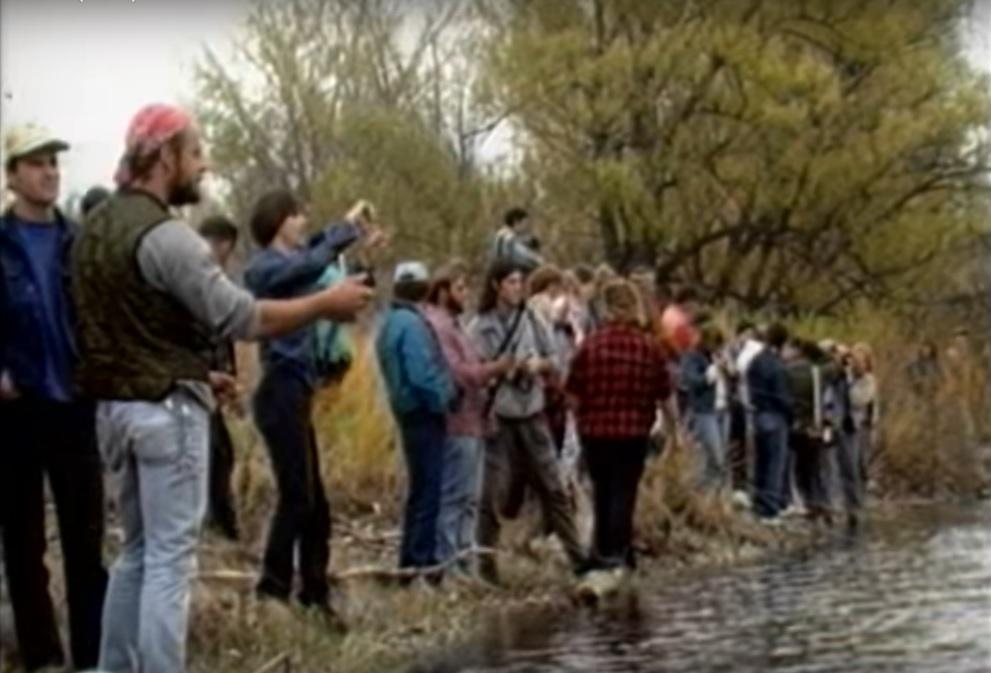
Revisit Students’ Questions Revisit students’ questions from Generating Curiosity under Staging the Compelling Question. Have them now try to answer those questions using evidence from the original image of the “Fish-In” and what they have learned in the Supporting Question 2 activities to explain their thinking. Use Research Tracker Sheets Throughout this learning journey, students…
Older students can use PowerPoint or Google Slides to create a visual presentation that addresses the answer to the prompt they are answering. You can also upload the documents to a digital collaboration platform so your students can work together.
The goal of Part 2 is to have students answer questions about how Abenaki people have maintained their culture over time. Choose at least one of the following activities, all designed to contribute to assessing Supporting Question 3:
Overview Sentence stems are the beginning parts of sentences for students to complete. Sentence frames are complete sentences with words and terms missing that a student will fill in. Both can serve as a structured starting point for thoughtful student discussions, reflections, and responses and are especially helpful to ENL students who are in the…
Overview The goal of Peer Review Partners is to create a feedback loop in which students offer each other advice, revise their written materials, and overcome obstacles. This approach can be especially helpful for writing assignments requiring students to create several drafts. Take into consideration that allowing students to work with partners will require several…
Overview Throughout this curriculum, students have conducted research and recorded evidence about their findings on either the My Research or the Track My Research and Notes worksheets. For this activity, they will prepare for the discussion by gathering and reviewing their evidence and tracking their citations. Then the teacher will facilitate a whole-class debriefing and…
Supporting Question 1 presented material about Abenaki relationships with the environment, natural resources, and their relationships with their neighbors. Supporting Question 2 builds on Supporting Question 1. Now students will examine some significant adaptations of Abenaki lifeways that may have occurred in response to physical and social environmental factors in their world. More specifically, students will learn about food, clothing, shelter, and art-making.
Supporting Question 2
What are some examples of significant Abenaki lifeways (food, clothing, shelter, and arts), and how have the Abenaki people adapted these lifeways to their environment?
Assessment Objective:
Students can explain how Abenaki lifeways are adapted to their environment, can document their learning in a variety of ways, and communicate observations in written or spoken form.
Note: Students may need scaffolds to aid in their research (see Research Tracker sheets)
Standards Alignment
The following C3 standard aligns with all activities for Supporting Question 2 (SQ2). See “Standards Alignment” for further details.
Click + to view Standards Alignment guidance. Click – to close the box when done.
C3 Framework for Social Studies
Standard Assessed for Grades 3–5
D2.Geo.4.3-5. Explain how culture influences the way people modify and adapt to their environments.
Beginning
Progressing
Proficient
Proficient with Distinction
I can describe Abenaki lifeways (food, shelter, arts, and clothing).
I can explain how Abenaki lifeways (food, shelter, arts, or clothing) show how the Abenaki people have adapted to their environment.
I can explain how Abenaki lifeways (food, shelter, arts, and clothing) show how the Abenaki people have adapted to their environment.
I can explain, with specific examples, how Abenaki lifeways (food, shelter, arts, and clothing) show how the Abenaki people have adapted to their environment.
Supporting Question 2 (SQ2) can also be aligned to the following sampling of standards and guide educators when integrating the American Abenaki Curriculum with other content areas and grade levels. In addition, you will find Common Core English Languages Arts standards alignment for each activity under SQ2.
Potential C3 Standards for Other Grade Bands
For Grades K–2
D2.Geo.4.K-2. Explain how weather, climate, and other environmental characteristics affect people’s lives in a place or region.
For Grades 6–8
D2.Geo.4.6-8. Explain how cultural patterns and economic decisions influence environments and the daily lives of people in both nearby and distant places.
For Grades 9–12
D2.Geo.4.9-12. Analyze relationships and interactions within and between human and physical systems to explain reciprocal influences that occur among them.
Potential Alignment: International Society for Technology in Education (ITSE) Standards
Students
1.3.d. Build knowledge by actively exploring real world issues and problems, developing ideas and theories and pursuing answers and solutions.
Educators
2.2.c. Model for colleagues the identification, experimentation, evaluation, curation and adoption of new digital resources and tools for learning.
Education Leaders
3.1.d. Model the safe, ethical, and legal use of technology and the critical examination of digital content.
Potential Alignment: American Association of School Librarians (AASL) Standards
Learners
VI.D.2. Learners engage with information to extend personal learning by: Reflecting on the process of ethical generation of knowledge.
School Librarians
IV.D.2. School librarians show learners how to select and organize information for a variety of audiences by: Formulating tasks that help learners to integrate and depict in a conceptual knowledge network learners’ understanding gained from resources.
School Libraries
IV.D.4. The school library engages the learning community in exploring resources by: Using local and external data to inform ongoing adjustments to the scope of the resource collection, and its audiences, formats, and applications.
Historical Context: Supporting Question 2
The following information comes from the “Deep Roots, Strong Branches” traveling exhibition, Vermont Abenaki Artists Association, curated by Vera Longtoe Sheehan (2025e). Share as much or as little with your students as needed to successfully complete the activities that follow.
Timeline showing 13,000 years. Courtesy of Abenaki Arts & Education Center(Abenaki Arts & Education Center, 2023). “The end of the glacial period in North America . . . brought with it momentous changes. . . Many of the animals on which Paleoindians had depended for food, clothing, and shelter were no longer available to them.”…
Stone carved beads by Patrick Lamphere (Missisquoi Abenaki). Vermont Abenaki Artists Association Collection (Lamphere, n.d.) In Abenaki, there is no word for art, but aesthetic beauty carries almost as much importance as functionality in crafting materials for tools and adornment. This connection is evident in ancient cultural objects, such as beads, textiles, and ceramics found…
Overview This activity is an adaptation of The Jigsaw Classroom (Social Psychology Network, 2025) learning technique described on Dr. Elliot Aronson’s website about his methods http//www.jigsaw.org/. This variation takes a holistic approach to learning about Abenaki lifeways and honors Abenaki culture bearers, their ways of knowing, and their values. If you are familiar with the…
For this activity, separate Prompts, Resources, and Sample Student Responses have been provided for grade 3, grades 4–5, middle school, and high school. Overview Give One, Get One is a simple collaboration strategy emphasizing the reciprocal nature of learning, where each student both “gives” and “gets” insights about a particular Abenaki lifeway, recording on a…
For this activity, separate Worksheets, Resources, and Sample Student Responses have been provided for grade 3, grades 4–5, middle school, and high school. Overview Writing informational text helps students share what they are learning, reflect on their understanding of a nonfiction topic, and meet the “proficient” statement for the Assessment Objective. In this activity, students…
Overview Hands-on visual arts activities are a good way for students to engage with content about Abenaki culture while enhancing comprehension and retention of the material. Integrating art into the American Abenaki Curriculum fosters a deeper understanding of complex regional history This activity focuses on drawing Abenaki lifeways (food, clothing, and shelter). Students will create…
Revisit Students’ Questions Revisit students’ questions from Generating Curiosity under Staging the Compelling Question. Have them now try to answer those questions using evidence from the original image of the “Fish-In” and what they have learned in the Supporting Question 2 activities to explain their thinking. Use Research Tracker Sheets Throughout this learning journey, students…
Supporting Question 1 presents material about Abenaki relationships with the environment, natural resources, and their relationships with their neighbors.
Supporting Question 1
How do geographic features and the environment affect the daily lives, cultural practices, and relationships of the Abenaki people?
Assessment Objective:
Students can explain how geography impacts the cultural practices of the Abenaki and can document their learning in a variety of ways.
Standards Alignment
The following C3 standard aligns with all activities for Supporting Question 1 (SQ1). See “Section 4: Standards Alignment” for further details.
Click +to view Standards Alignment guidance. Click – to close the box when done.
C3 Framework for Social Studies
Standard Assessed for Grades 3–5
D2.Geo.8.3-5. Explain how human settlements and movements relate to the locations and use of various natural resources.
Beginning
Progressing
Proficient
Proficient with Distinction
I can describe some of the cultural practices of the Abenaki of Vermont.
I can explain how the cultural practices of the Abenaki in Vermont are impacted by geography or its natural resources.
I can explain how the cultural practices of the Abenaki in Vermont are impacted by geography and its natural resources.
I can explain, with specific examples, how the cultural practices of the Abenaki in Vermont are impacted by geography and its natural resources.
Potential C3 Standards for Other Grade Bands
For Grades K–2
D2.Geo.8.K-2. Compare how people in different types of communities use local and distant environments to meet their daily needs.
For Grades 6–8
D2.Geo.8.6-8. Analyze how relationships between humans and environments extend or contract spatial patterns of settlement and movement.
For Grades 9–12D2.Geo.8.9-12. Evaluate the impact of economic activities and political decisions on spatial patterns within and among urban, suburban, and rural regions.
International Society for Technology in Education (ISTE)
Students
1.2.b. Demonstrate empathetic, inclusive interactions online and use technology to responsibly contribute to their communities.
Educators
2.4.d. Demonstrate cultural competency when communicating with students, parents and colleagues and interact with them as co-collaborators in student learning.
Education Leaders 3.5.d. Develop the skills needed to lead and navigate change, advance systems and promote a mindset of continuous improvement for how technology can improve learning.
American Association of School Librarians (AASL)
Learners
V.A.2 Learners develop and satisfy personal curiosity by: Reflecting and questioning assumptions and possible misconceptions.
School Librarians
V.C.2 School librarians prepare learners to engage with the learning community by: assisting learners to co-construct innovative means of investigation.
School Libraries V.B.3 The school library facilitates construction of new knowledge by: Establishing and maintaining a learning environment conducive to independent and collaborative exploration and problem solving.
National Core Arts Standards for Visual Arts Potential Alignment
Grades 3–5 Standards
VA:Cr2.2.5a. Demonstrate quality craftsmanship through care for and use of materials, tools, and equipment.
VA:Cr2.3.3a. Individually or collaboratively construct representations, diagrams, or maps of places that are part of everyday life.
VA:Cr2.3.4a. Document, describe, and represent regional constructed environments.
Historical Context: Supporting Question 1
The following information comes from the “Deep Roots, Strong Branches” traveling exhibition, Vermont Abenaki Artists Association, curated by Vera Longtoe Sheehan (Sheehan, 2025e). Share as much or as little with your students as needed to successfully complete the activities that follow.
Abenaki History Timeline. (Abenaki Arts & Education Center, 2023) After living in the same region for thousands of years, Abenaki people were experts in using renewable resources and sustainable practices. The “Abenaki History Timeline” poster (Abenaki Arts & Education Center, 2023) and the “Summary of 12,000 Years of Abenaki History” (Sheehan, 2025k) provide clues about…
Travelers in Abenaki territory followed an intricate network of foot trails and waterways. Rivers enabled people in canoes to travel faster than people on foot, making it easier to visit family, friends, and allies. Rivers also made it easier for other people (strangers and newcomers) to travel into the territory. In some areas, strong river…
The Great Peace of Montreal, 2001 Canadian postage stamp (Tessier, 2001) Historically, it was common for Northeastern tribal groups to respect each other’s individual hunting territories, and to come together at shared resource-gathering sites, without the need to draw fixed lines on a map. Sometimes, neighboring communities supported each other, but at other times (especially…
The Compelling Question activity created student interest in the topic, elicited prior knowledge, and set the trajectory for their learning journey using an inquiry-based Visual Thinking Strategy (VTS). Now, to explore Supporting Question 1, choose at least one of the following activities.
Overview After a field trip, visiting one or more websites or exhibitions, and possibly using some of the other resources listed, students engage in a matching activity to identify the relationships between Abenaki culture and geography/natural resources. Worksheet You may obtain PDF versions of the worksheets from the Worksheets page or simply click the worksheet…
Overview Graphic organizers vary in format and purpose. They are often used to help students process their ideas for another task, such as giving a presentation or writing an essay. This activity will prepare learners to answer the question “What is the relationship between the Abenaki and their environment?” Worksheets There is a choice of…
For this activity, separate discussion Prompts, Resources, and Sample Student Responses have been provided for grade 3, grades 4–5, middle school, and high school. Overview Students participate in a Turn-and-Talk discussion in which they explain the relationship between geography, natural resources, and the culture of the Abenaki. This peer-to-peer strategy helps students improve their communication…
For this activity, separate Worksheets, Resources, and Sample Student Responses have been provided for grade 3, grades 4–5, middle school, and high school. Overview The writing prompts on the worksheets for this activity give students an opportunity to organize information, share their ideas, and reflect on their understanding. We encourage you to adapt these worksheets…
This activity can be adapted for all grade bands. Overview Hands-on visual art activities are a good way for students to engage with the content about Abenaki culture while enhancing comprehension and retention of the material. Integrating art into the American Abenaki Curriculum fosters a deeper understanding of complex regional history. During this activity, students…
Revisit Students’ Questions Revisit students’ questions from Generating Curiosity under Staging the Compelling Question. Have them now try to answer those questions using evidence from the original image of the “Fish-In” and what they have learned in the Supporting Question 2 activities to explain their thinking. Use Research Tracker Sheets Throughout this learning journey, students…
Topographical maps can be uploaded to your digital collaboration medium of choice so that students can work with them in groups. This supports differentiated learning and allows students to use an overlay, such as Google Earth, to understand the material. Upload the Vermont Topography [Road atlas of USA and Canada] (Vermont Topography Terrain Map Topographic…
This section of the American Abenaki Curriculum describes all of the questions, student tasks, resources, standards alignment, and other notes to educators that are needed to thoroughly investigate and assess the compelling question.
To navigate the Comprehensive Inquiry use the Bubble Menu on the right. Click the Information icon on the mid-right edge of the webpage to open a Bubble menu. Hover over each icon to enable a short description of the content. Then click on the icon to choose content to view.
Students will use what they have learned about Abenaki culture to explain the challenges that the Abenaki have faced and share examples from multiple sources (written narrative, artwork, photographs, etc.) of how the American Abenaki have survived and adapted.
Standards Alignment for the Compelling Question
Click + to view Standards Alignment guidance. Click – to close the box when done.
C3 Framework for Social Studies
Standards Assessed for Grades 3-5
D4.6.3-5. Draw on disciplinary concepts to explain the challenges people have faced and opportunities they have created, in addressing local, regional, and global problems at various times and places.
D3.3.3-5. Identify evidence that draws information from multiple sources in response to compelling questions.
Potential C3 Standards for Other Grade Bands
For Grades K-2
D4.6.K-2. Identify and explain a range of local, regional, and global problems, and some ways in which people are trying to address these problems.
For Grades 6–8
D3.3.6-8. Identify evidence that draws information from multiple sources to support claims, noting evidentiary limitations.
D4.6.6-8. Draw on multiple disciplinary lenses to analyze how a specific problem can manifest itself at local, regional, and global levels over time, identifying its characteristics and causes, and the challenges and opportunities faced by those trying to address the problem.
For Grades 9–12
D3.3.9-12. Identify evidence that draws information directly and substantively from multiple sources to detect inconsistencies in evidence in order to revise or strengthen claims.
D4.6.9-12. Use disciplinary and interdisciplinary lenses to understand the characteristics and causes of local, regional, and global problems; instances of such problems in multiple contexts; and challenges and opportunities faced by those trying to address these problems over time and place.
International Society for Technology in Education (ISTE)
Students
1.1.b. Build networks and customize their learning environments in ways that support the learning process.
Educators
2.1.c. Stay current with research that supports improved student learning outcomes, including findings from the learning sciences.
Education Leaders
3.3.d. Support educators in using technology to advance learning that meets the diverse learning, cultural, and social-emotional needs of individual students.
American Association of School Libraries (AASL)
D.1.1. Learners participate in an ongoing inquiry-based process by: Continually seeking knowledge.
Staging the Compelling Question
Details regarding setting the stage for the compelling question are on this page.
Supporting Questions
Click on the links below for the full details of each Supporting Question (SQ).
This section provides teachers with a bird’s-eye view of the materials available in the Abenaki Culture Curriculum. Full details, activities, and instructions are found in the Comprehensive Inquiry.
Staging the Compelling Question
How have the Abenaki people survived and adapted to their environment for thousands of years?
Visual Thinking Strategy:
Share an image of Abenaki people in their modern environment and ask students what they see. Students should provide an answer using evidence from the image to formulate their response.
Record questions about the image that students ask. Revisit the questions periodically as students take part in subsequent activities to see if they can answer them and if this process helps them answer the Compelling Question.
Supporting Questions
Supporting Question 1
How do geographic features and the environment affect the daily lives, cultural practices, and relationships of the Abenaki people? Read More…
Supporting Question 2
What are some examples of significant Abenaki lifeways (food, clothing, shelter, and arts), and how have the Abenaki people adapted these lifeways to their environment? Read More…
Supporting Question 3
How have the American Abenaki people demonstrated resilience and resourcefulness in maintaining their culture from colonial times to today? Read More…
Question 1 Formative Performance Task
Assessment Objective:
Students can explain how geography impacts the cultural practices of the Abenaki and can document their learning in a variety of ways.
Question 2 Formative Performance Task
Assessment Objective:
Students can explain how Abenaki lifeways are adapted to their environment, can document their learning in a variety of ways, and communicate observations in written or spoken form.
Question 3 Formative Performance Task
Assessment Objective:
Students can ask and answer informed questions and write about how the American Abenaki people have maintained their cultural identity.
Activities for Supporting Question 1
Matching Natural Resources to Their Uses(Grade 3) Students engage in a matching activity in which they identify the relationship between Abenaki culture and geography/natural resources.
Students are assigned different lifeways about which to gain knowledge. They meet in mixed groups to share what they have learned and then craft statements about how the Abenaki have adapted to their environment. (Social Psychology Network, 2025)
This Part 1 activity is required for successful completion of the Inquiry Design Model. The class brainstorms informed questions about how American Abenaki people have maintained their culture and identifies those questions they need to learn more about.
PART 2: Using Evidence to Construct Answers (ACTIVITY OPTIONS)
Creating a Graphic Organizer (Grades 5 and up) Students complete a graphic organizer demonstrating the relationship between Abenaki culture and geography/natural resources.
Give One, Get One (Grades 3 through 12) Students complete one section of a Give One, Get One chart about a particular Abenaki lifeway. Then, they move around the room to interact with their peers. Students “Give” their explanation and “Get” explanations from others until their chart is complete.
Turn-and-Talk Discussions (Grades 3 through 12) Students participate in a discussion in which they explain the relationship between geography/natural resources and the culture of the Abenaki.
Writing Informational Text (Grades 3 through 12) Students use worksheets with writing prompts in the form of guiding questions.
Using Peer Review Partners (Grades 3 through 12) Students respond to prompts about how American Abenaki people have maintained their culture over time. They draft Venn diagrams or write essays and get feedback from peers to revise their work.
Writing Informational Text (Grades 3 through 12) Students use worksheets with writing prompts in the form of guiding questions.
Class Debrief and Record (Grades 3 through 12) Students do research and share claims and evidence about how American Abenaki have maintained their cultural identity. They assemble a class record to share resources they found particularly helpful.
The Summative Performance Task is an assessment opportunity at the conclusion of students’ unit of study. The task aligns with C3 standards D4.6.3-5 and D3.3.3-5, the Compelling Question for the Inquiry, and the accompanying learning scales. Teachers may decide to have all students complete the same assessment option or allow students to choose.
Assessment Objective
Students will use what they have learned about Abenaki culture to explain the challenges the Abenaki have faced and share examples from multiple sources (written narrative, artwork, photographs, etc.) of how the American Abenaki have survived and adapted.
Task Options:
Portfolio
Students compile a portfolio of evidence using materials they developed during the Formative Performance Tasks to support their claim about how Abenaki people survived and adapted over thousands of years until today.
Oral Presentation With Poster
Students develop a claim about how Abenaki people survived and adapted over thousands of years until today, support it with evidence, and share it through a combined verbal and illustrated presentation.
Taking Informed Action
Taking Informed Action is essential to the Inquiry Design Model (IDM) because it supports transferring students’ new learning to civic engagement in their communities.
Community Action Proposal
Students develop Community Action Proposals that outline tangible ways to support their school or local community. Proposals may include organizing relevant morning announcements, a resilience reading list, an exhibition, or a new students greeting.