Continuity in the Arts

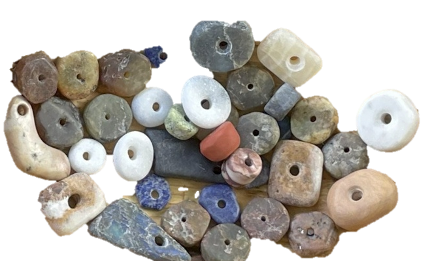
Stone carved beads by Patrick Lamphere (Missisquoi Abenaki). Vermont Abenaki Artists Association Collection (Lamphere, n.d.)

In Abenaki, there is no word for art, but aesthetic beauty carries almost as much importance as functionality in crafting materials for tools and adornment. This connection is evident in ancient cultural objects, such as beads, textiles, and ceramics found at village and burial sites across the Abenaki homelands, as well as in the artwork of living Abenaki artists who pay tribute to their ancestors.

Beads and Textiles

Much of what is known about Abenaki personal adornment comes from burial sites, where Abenaki ancestors were found wearing necklaces of disc-shaped beads carved from stone and marine shell. Copper nuggets, which exhibit antibacterial properties, were also hammered into beads to be strung together or sewn on leather and textile bags (Haviland & Power, 1994). Abenaki ancestors attributed special spiritual qualities to copper that made it a desirable material for adornment.

One category of beads called “wampum” (meaning “white shell”) has both spiritual and political significance. White wampum beads were carved from the inner whorls of whelk, and purple wampum beads were carved from the outer edges of quahog shells, shaped into disks or tubes. When strung together into chains to serve as necklaces or bracelets, wampum beads have both decorative and protective qualities. When woven together into larger objects (bands with multiple rows of varying length, called “belts”), tubular wampum beads can be arranged into shapes that signify relationships and alliances. Strings of wampum beads were also used as messages, as marriage gifts, and as offerings to express condolence. During the colonial era, Native communities throughout the Northeast also used wampum belts to record new alliances with colonial settlers.

During the late 1600s to 1700s, after French and English colonial settlers noticed how popular stone and shell beads were with Native American people in the region, they began importing similar shapes of glass beads from Europe specifically for trading. The Abenaki and other Indigenous peoples embraced this new product. They sewed the smaller glass trade beads onto their garments and wore larger glass beads on necklaces, in a similar fashion to the ways they had earlier used copper, stone, and shell beads.

During the 1800s and into the 1900s, distinctive beadwork traditions continued in the Abenaki homelands (Wiseman, 2025a). Examples of American Abenaki beadwork from these centuries can be viewed in the Research and Exhibition Gallery at the Vermont History Center in Barre.

Living Abenaki artists are carrying these traditions into the future. Their work can be viewed on the Vermont Abenaki Artists Association and in their exhibitions state-wide.

Beaded Moccasin Cuff from Swanton, VT, ca. 1810–1830. Abenaki Cultural Conservancy Collection, on view at Vermont History Center, Barre, VT. Photo courtesy of Vermont Abenaki Artists Association. (Vermont Abenaki Artists A

Pottery and Fiber Arts

When European travelers arrived in what is now known as New England, the Indigenous inhabitants were already familiar with textile weaving. Natural fibers from earlier times, such as milkweed and Indian hemp, are rarely preserved in this region as they tend to biodegrade.
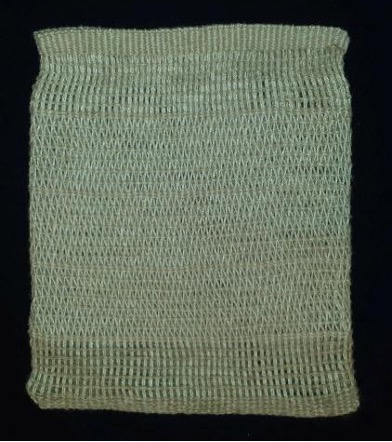
Plant Fiber Woven Bag
Late Archaic/Early Woodland style plant fiber woven bag by Elnu Abenaki Tribe artist. Courtesy, Elnu Abenaki Tribe. (Elnu Abenaki Tribe Artist, n.d.)

However, early evidence of plant fiber cordage can be found on pottery vessels and shards, especially when woven fibers were used to create decorative impressions in the wet clay. For example, cordage marks are present on pottery vessels found at the Livermore Site along the Pemigewasset River (Doperalski, 2023).

Evidence of the Abenaki textile industry can be found at several Woodland period sites in Vermont. Fiber cord impressions were found at the Isle La Motte Glacial Kame site (Haviland & Power, 1994, p. 106). Cord-wrapped paddle impressions were found at the Warrell Farm Site in Barnet. Signs of cord wrapping were also found at the Colchester Site (Vermont Historic Preservation, n.d.).

Perhaps the most significant fiber cache in the northeastern United States was found in Highgate, Vermont. The Boucher Site is a Late Archaic/Early Woodland period cemetery that was discovered during house construction. The burial ground, which was populated by cremated and non-cremated human remains, contained a multitude of cordage fragments, woven textile bags, and a large burial shroud (Haviland & Power, 1994, pp. 96–126; Petersen, 1996). No images are shown from this site out of respect for the deceased and their descendants.

Generally, milkweed and Indian hemp fibers would disintegrate over time, but the textiles at this site were in close proximity to copper beads, which had a preservative effect on the textiles (Haviland and Power, 1994).

Textile weaving is an unbroken Abenaki tradition that continues to the present day, especially among artists of the Elnu Abenaki Tribe in southern Vermont and their apprentices.

For More Information on Beadwork

Haviland, William A. and Marjory W. Power. (1994)The Original Vermonters: Native Inhabitants, Past and Present. (Revised and Expanded Edition). University Press of New England. 

Wiseman, F. M. (2024). Beadwork from the American Abenaki region: A first analysis. Vermont Abenaki Artists Association.

Wiseman, F. M. (2006) Reclaiming the Ancestors: Decolonizing a Taken Prehistory of the Far Northeast. University Press of New England.

Wiseman, F. M. (2025a). Something of value: The Vermont Abenakis, 1790–2020. Abenaki health and heritage. Abeanki Health and Heritage.

Wiseman, F. M. (2001) The Voice of the Dawn: An Autohistory of the Abenaki Nation. University Press of New England.

For More Information

Doperalski, M. (2023). Archaeological research in New Hampshire’s state parks. The New Hampshire Archeologist, 63(1). 

Haviland, William A. and Marjory W. Power. (1994)The Original Vermonters: Native 

Inhabitants, Past and Present. (Revised and Expanded Edition). University Press of New England. 

Wiseman, F. M. (2001) The Voice of the Dawn: An Autohistory of the Abenaki Nation. University Press of New England.

Wiseman, F. M. (2006) Reclaiming the Ancestors: Decolonizing a Taken Prehistory of the Far Northeast. University Press of New England.

The above information comes from the “Deep Roots, Strong Branches” traveling exhibition, Vermont Abenaki Artists Association, curated by Vera Longtoe Sheehan (2025e). Printed with permission of the author. Share as much or as little with your students as needed to successfully complete the curriculum activities.

©2025. Vera Longtoe Sheehan. All Rights Reserved.
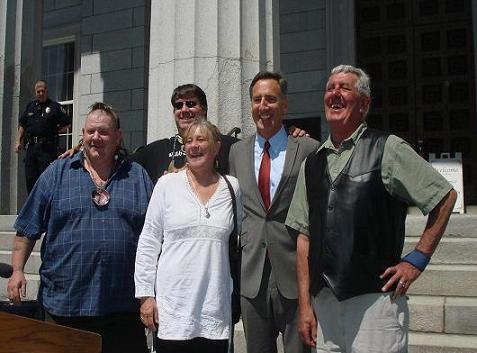
State-Recognition Sheds Light on Cultural Preservation

“We arrived at this point because of so many people that frankly persevered in light of defeat time and time again.”

— Gov. Peter Shumlin, upon signing the Vermont State-Recognition bills for the Elnu and Nulhegan Abenaki Tribes. April 22, 2011

Koasek and Missisquoi Recognition Day - May 7, 2012
Abenaki State-Recognition Day for Koasek and Missisquoi, May 7th, 2012. (Left to right—Elnu Chief Roger Longtoe Sheehan; Nulhegan Chief Don Stevens; Koasek Chief Nancy Doucet; Governor Peter Shumlin; Missisquoi Acting Chief John Churchill). (Koasek Traditional Band of the Koas Abenaki Nation, 2012)

In 2011 and 2012, Abenaki Tribes in Vermont applied to the legislature for State Recognition. Each of the Tribes provided the required archeological, historical, genealogical, and other forms of evidence to prove that their communities continue to exist.

In the article “Tribal Recognition in Vermont: The Role of Federal Standards,” State Representative Kesha Ram explains the careful process that the State of Vermont went through to develop S.222 (Act 107), an act relating to state recognition of Native American Indian tribes in Vermont. Ram notes “the new law sets strong but attainable standards and a fair process for tribes to seek recognition in Vermont (Ram, 2011, p. 8). Act 107 was signed into law in 2010 (Bill Status S.222 (Act 107), 2010).

the Elnu, Koasek, Missisquoi, and Nulhegan Abenaki Tribes proved their communities still exist and were acknowledged by the State of Vermont. (Vermont Commission on Native American Affairs, 2025).(Elnu Abenaki Tribe, 2010; Koasek Traditional Band of the Koas Abenaki Nation, 2010; Abenaki Nation of Missisquoi, 2011; Nulhegan Band of the Coosuk-Abenaki Nation, 2010).

The applications for State Recognition submitted by each of the four Tribes document how adaptation and resilience aided them in continuing their culture from colonial times to the present. A full list of the recognition criteria can be found on pages 7–9 of S.222 (Act 107) (Bill Status S.222 (Act 107), 2010). (Elnu Abenaki Tribe, 2010; Koasek Traditional Band of the Koas Abenaki Nation, 2010; Abenaki Nation of Missisquoi, 2011; Nulhegan Band of the Coosuk-Abenaki Nation, 2010). These recognition applications clearly note that although some people failed to record these people as “Indians,” other historical records show that they were perceived as “others” by their white neighbors, and their existence was documented in local town histories. Abenaki people today have adopted seemingly modern practices (such as living in wood-framed houses, speaking English, and wearing European-style clothing), but they have also continued many traditional ways of living.

The applications for State Recognition submitted by each of the four Tribes document how adaptation and resilience aided them in continuing their culture from colonial times to the present. A full list of the recognition criteria can be found on pages 7–9 of S.222 (Act 107) (Bill Status S.222 (Act 107), 2010). (Elnu Abenaki Tribe, 2010; Koasek Traditional Band of the Koas Abenaki Nation, 2010; Abenaki Nation of Missisquoi, 2011; Nulhegan Band of the Coosuk-Abenaki Nation, 2010). These recognition applications clearly note that although some people failed to record these people as “Indians,” other historical records show that they were perceived as “others” by their white neighbors, and their existence was documented in local town histories. Abenaki people today have adopted seemingly modern practices (such as living in wood-framed houses, speaking English, and wearing European-style clothing), but they have also continued many traditional ways of living.

The Abenaki applications for State Recognition contain substantial information that demonstrates to historians, anthropologists, teachers, and other readers that Abenaki history did not end in 1790 (as some Vermont histories suggest). Community members shared collective memories that demonstrated the destruction caused by colonization, and showed how each community persevered after the American Revolution, when Vermont became a state in the new nation. These memories also reveal distinct practices that made Abenaki people different from their white neighbors. For example, Abenaki women held leadership roles (at Koasek) during a time when women in mainstream American culture were not held in high regard or allowed to hold public office. Female matriarchs (at Elnu and Missisquoi) continued certain fashion traditions such as ribbonwork and beadwork, even after western-style clothes had been adopted. Abenaki artisans (at Elnu, Koasek, and Nulhegan) continued to make ash-splint woven baskets. Many families retained distinct agricultural practices, such as the use of sucker fish to fertilize their mound-style gardens (at Elnu, Koasek, and Nulhegan). These and other findings inspired a substantial amount of new research and new publications that added to evidence found in the archaeological record.

Many of these practices reflect Abenaki lifeways that had emerged generations earlier, during the Woodland period. Although Abenaki people in earlier times had gathered into larger settlements, select community members continued to travel seasonally, providing for their communities by hunting, fishing, and gathering. During periods of food scarcity, stormy weather, or warfare, large communities would break up into smaller family bands, retreating to familiar safe places. Even during times of colonial warfare, if a community was attacked and garden fields burned, they could use preserved food caches stored in the ground and forage for survival foods. Traditional Abenaki foodways, past and present, include strategic planning for both lean times and good times, depending upon year-round seasonal cycles of planting, hunting, fishing, harvesting, food preservation, and seed-saving.

By the 1800s, as colonial settlers expanded their land claims in Ndakinna, English towns and farms grew larger. Less land was available for traditional hunting and foraging, and some Abenaki families responded by becoming farmers or settling in towns, often alongside colonial families. The Abenaki, like most Native people in the Northeast, adapted their traditional skills to accommodate new cycles of seasonal activities and a new cash economy. Activities included making baskets in the winter and selling them in the summer, setting up encampments at tourist resorts, making snowshoes, doing beadwork, or working year-round as hunting and fishing guides (Elnu Abenaki Tribe, 2010; Koasek Traditional Band of the Koas Abenaki Nation, 2010; Abenaki Nation of Missisquoi, 2011; Nulhegan Band of the Coosuk-Abenaki Nation, 2010; Wiseman, 2024; Wiseman, 2025a; Wiseman, 2025b). Abenaki people continue to be creative, finding strategic ways to adapt traditional skills to survive in changing times

For More Information

Websites:

Bill Status S.222 (Act 107), Vermont General Assembly 2009–2010 Regular Session, 26 V.S.A. (Title 26: Professions and Occupations) (2010).

Ram, K. (2011). Tribal Recognition in Vermont: By Kesha Ram, Vermont state representative the role of federal standards. Communities and Banking. Federal Reserve Bank of Boston, 22(1), 7–8.

Book:

Wiseman, Frederick M. Something of Value: The Vermont Abenakis, 1790–2020. Abenaki Health and Heritage. Book available from Abenaki Health and Heritage.

The above information comes from the “Deep Roots, Strong Branches” traveling exhibition, Vermont Abenaki Artists Association, curated by Vera Longtoe Sheehan (2025e). Printed with permission of the author. Share as much or as little with your students as needed to successfully complete the curriculum activities.

©2025. Vera Longtoe Sheehan. All Rights Reserved.

Cultural Values as a Means of Cultural Preservation

Abena Songbird Mural Event Unveiling. “Nd’ôlemôwzibna” (“We Continue to Live”) presents a timeless seasonal cycle of traditional activities, including maple sugaring, gardening, canoeing, basketmaking, snow snake game, and in the center, a drumming circle. (Gould, 2023)

“The center of the Abenaki experience is not ourselves, it is each other…” For the Abenaki, the Seven Generations are all of the generations and “…you could possibly know from your great-grandparents to your great-grandchildren.

Perseverance over hundreds or thousands of years requires more than resilience; it needs a road map or guiding star. Cultural values that serve as shared beliefs within a community can help to guide the way forward.

The 1934 book Economy of Abundance challenges the modern economic model based on scarcity and proposes a society where everyone’s basic needs are met (Chase, 1934). Prior to colonization, Abenaki people had access to an abundance of resources. Basic needs for food, clothing, shelter were met, not only through hunting, but also through mutual support within extended families, and through gifts and trade among families, friends, and community members. A person could simply trade for what they needed and there was no set price for goods. Even after lands were slowly stolen, access restricted, and resources depleted by colonial settlers, American Abenaki people never forgot the importance of shared generosity and reciprocity.

Continued examples of sharing happen today through simple acts, such as sharing hand-me-downs, helping neighbors, and upcycling to make gifts. These activities were very apparent during the COVID pandemic (2020–23) when offers of assistance were made, and when Abenaki people gave to their neighbors whatever was needed (especially if their neighbors were more in need). We see these values reflected in the generosity of children’s groups, such as the “Circle of Courage”, who use donations they receive during the year to make holiday food baskets. Sharing can also be seen in the food banks and pantries of the Koasek, Missisquoi, and Nulhegan Abenaki tribes who feed anyone (even their white neighbors) who happens to be in need.

Sustainable practices are especially embodied in the traditional Indigenous concept known as “Seven Generations”. In her TEDx Talk, “Weaving A Thread through the 7 Generations” (TEDx Talks, 2018), Melody Walker Brook notes, “The center of the Abenaki experience is not ourselves, it is each other…” For the Abenaki, the concept of Seven Generations encompasses all of the generations that “you could possibly know, from your great-grandparents to your great-grandchildren,” with yourself at the center. “When we make a decision we not only have to make a decision for our children but we have to bring our ancestors on our journey with us.” Hopefully, by considering what our great grandparents, grandparents, and parents might advise, and by considering the needs of our children, grandchildren, and great-grandchildren, we can all make better decisions. Some of those decisions might be about how we want others to remember us in the future: how we care for the world, resources, and how “all of my relations” will impact future generations.

“All of my relations” is a phrase used by many Native American communities to refer to the many beings who share the world around us—all people, the land, water, animals, and all things. By considering and respecting all life as being on a par with human life, we are able to think more sustainably about how our needs affect the world around us.

The concept of noninterference is another Native American cultural belief held by many traditional people, including the American Abenaki. In the article “Native American Non-Interference”, Jimm G. Good Tracks explains noninterference to social workers, noting “the less assimilated and acculturated the individual, the more important this principle is to him.” (Good Tracks, 1973) Although his reference was to the field of social work, it can be more broadly applied to education and community relations. From a young age, American Abenaki youth are taught to be respectful and to have consideration for other people. People should be allowed to make their own way in the world without interference. But if you see someone needs help, you should lend a hand so they don’t have to ask for help.

American Abenaki youth also learn how to react to coercion from outside sources, so they do not provoke undue attention from other people or draw them into fights. This may also mean not responding when someone else starts a fight with them. Unfortunately, the practice of noninterference can lead to cross cultural misunderstandings; people from the dominant culture might not understand why American Abenaki people don’t fight back when provoked. Their apparent lack of response reflects a general belief that responding to conflict potentially gives more energy to conflict.Here, it’s important to note that not all Abenaki people are the same. Abenaki people living in different regions or in other countries may have different perspectives about how they remember the past, how they reckon their kinship relations, and how they maintain their cultural identities and practices over time. Like many Indigenous people, traditional Abenaki people believe in the concepts of sovereignty and autonomy. Each individual, each family, and each tribal community is free to govern themselves as they wish, so long as they do not interfere with any other community, or limit anyone else’s freedom.

One of the most repetitive themes in Vermont Abenaki cultural beliefs is that people place a high value on children, because they are our future. Children are one of the most important reasons American Abenaki culture has survived. Many children begin their cultural education almost as soon as they are born. From their parents and grandparents they hear oral traditions. When their parents bring them to cultural events, they learn more from the community around them. Eventually these children will grow up to become parents, grandparents, and possibly Elders. They will be the ones entrusted with preserving cultural traditions and passing them on to future generations.

The above information comes from the “Deep Roots, Strong Branches” traveling exhibition, Vermont Abenaki Artists Association, curated by Vera Longtoe Sheehan (2025e). Printed with permission of the author. Share as much or as little with your students as needed to successfully complete the curriculum activities.

©2025. Vera Longtoe Sheehan. All Rights Reserved.

SQ1 Visual Arts Integration: Make a Map

This activity can be adapted for all grade bands.

Overview

Hands-on visual art activities are a good way for students to engage with the content about Abenaki culture while enhancing comprehension and retention of the material. Integrating art into the American Abenaki Curriculum fosters a deeper understanding of complex regional history. 

During this activity, students will examine a topographical map and a map of the Abenaki homelands. Then they will draw their own maps of the Abenaki homeland and how it has changed over time. In the process, students will gain map making skills and learn about historical connections, relationships, and geographic influences within the context of Abenaki tribes.

Materials

  • drawing paper or you may find a printed outline of the state online
  • colored pencils or markers

Worksheets

There are no worksheets needed for this activity.

Resources:

Guiding the Inquiry

  • Warm up the class with a discussion to ensure students understand the words relationships, geography, and landforms.
  • Explain that they will make maps to show Abenaki relationships in the Abenaki homelands.
  • Hand out map-making materials. Provide younger students with a map outline. Older students can draw their own outlines.
  • Using Vermont Topography as a reference, have students add landforms and natural features to their maps. Challenge them to consider where the Abenaki people might live and how they might interact with each other and other neighbors based on the geography.
  • Have students add a compass rose showing the four cardinal directions.
  • Introduce the concept of a map key and guide students to use shapes, colors, and symbols to represent various features.
  • Consider having students draw lines to show where tribes may have traveled for trade.
  • Use your classroom routines to determine how students share their maps with others.

Sample Student Responses and Categories

Example of map made by a student
Example of topographic map
Example of topographic map created by a third grade student
Example of topographic map
Example of topographic map created by a fourth grade student
Example of a topographic map by a student

See Historical Context essay and Resources for additional potential responses

Standards Alignment

Click + to view Standards Alignment guidance. Click to close the box when done.

Potential Alignment: National Core Arts Standards for Visual Arts

The Visual Arts Integration—Make a Map activity can support the following sampling of standards and serve as a starting point for integrating the American Abenaki Curriculum with visual arts instruction and assessment.

Grades 3–5 

VA:Cr2.3.3a. Individually or collaboratively construct representations, diagrams, or maps of places that are part of everyday life.

VA:Cr2.3.4a. Document, describe, and represent regional constructed environments.

VA:Cr2.2.5a. Demonstrate quality craftsmanship through care for and use of materials, tools, and equipment.

Middle School 

VA:CR2.1.6a. Demonstrate openness in trying new ideas, materials, methods, and approaches in making works of art and design.

VA:CR2.3.7a. Apply visual organizational strategies to design and produce a work of art, design, or media that clearly communicates information or ideas.

VA:CR3.1.8a. Apply relevant criteria to examine, reflect on, and plan revisions for a work of art or design in progress.

High School (Proficient level)

VA:Cr1.1.Ia. Use multiple approaches to begin creative endeavors.

VA:Re.7.2.Ia. Analyze how one’s understanding of the world is affected by experiencing visual imagery.

SQ3 Using Peer Review Partners

Overview

The goal of Peer Review Partners is to create a feedback loop in which students offer each other advice, revise their written materials, and overcome obstacles. This approach can be especially helpful for writing assignments requiring students to create several drafts. Take into consideration that allowing students to work with partners will require several meetings.

Materials

There are no materials needed for this activity.

Resources

Recommended resources are listed below separately for grade 3, grades 4–5, middle school, and high school.

Guiding the Inquiry

  • Preview the prompt for your students and decide how many drafts you wish them to develop using peer review.
  • Use regular classroom routines to assign peer partners and assign the prompt. Be sure students understand they are responsible for providing feedback about their partner work, incorporating partner feedback into their own work, and handing in several drafts of the assignment.
  • Have students discuss the prompt with their partner and decide if they already have enough information to answer it or if they will need to conduct further research. If further research is needed, provide students with the resources listed under each prompt.

Prompts Listed by Grade

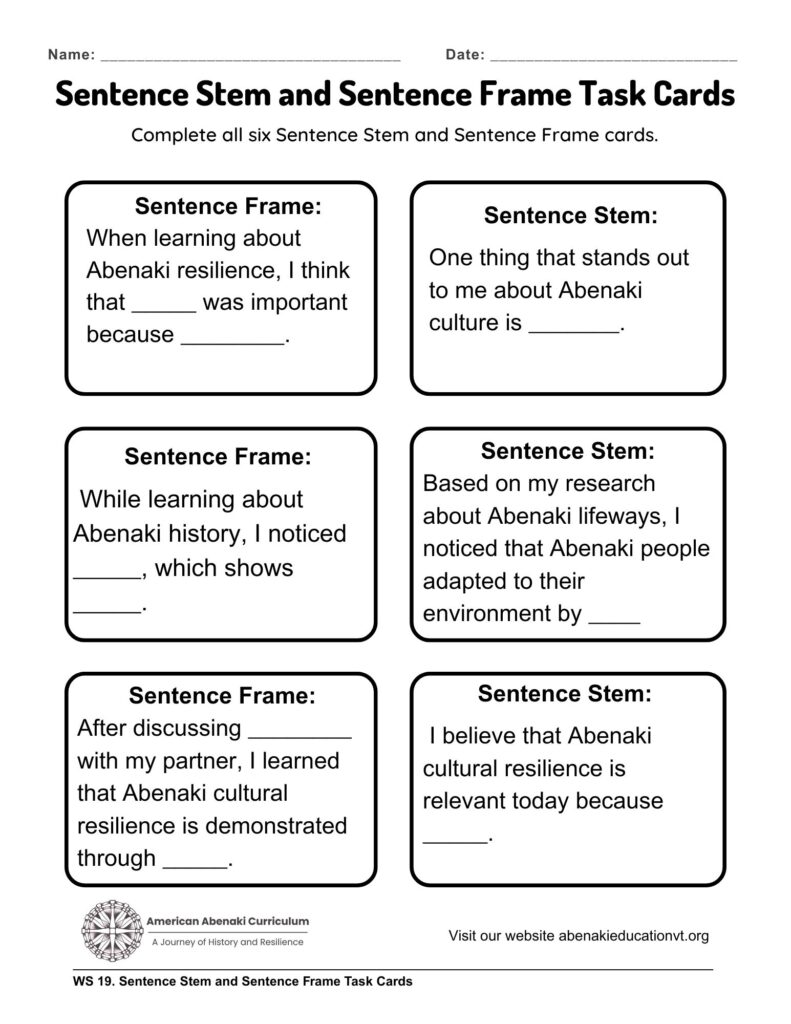
SQ3 Using Sentence Stems and Frames

Overview

Sentence stems are the beginning parts of sentences for students to complete. Sentence frames are complete sentences with words and terms missing that a student will fill in. Both can serve as a structured starting point for thoughtful student discussions, reflections, and responses and are especially helpful to ENL students who are in the early production stage of learning. The sentence stems and frames provided on the worksheet help students’ articulate their insights about Abenaki culture, resilience, and historical contexts. They also aid in comprehension, critical thinking, and the development of language skills.

Materials

There are no materials needed for this activity.

Worksheet

WS 19 – Sentence Stems and Frames

Resources

No new resources should be required for this activity.

Guiding the Inquiry

  • Explain to students that sentence stems and sentence frames are tools that can help them say or write what they are thinking.
  • Hand out the Sentence Stem and Sentence Frame Task Cards worksheet.
  • Have students read each sentence stem or sentence frame carefully and, before completing the sentence, think about how they can use it to answer Supporting Question 3. Encourage them to turn and talk to a partner before recording their responses.
  • Tell students to feel free to support their responses by adding details, examples, or personal experiences.
  • Hold a class discussion in which students share their completed sentences and cite evidence based on prior research using resources

Sample Student Responses

  • When learning about Abenaki resilience, I think that land was important because it allowed them to hide when needed. Land was their lifeline to food, water, shelter, and medicine.
  • One thing that stands out to me about Abenaki culture is that the Abenaki people are still here today.
  • While learning about Abenaki history, I noticed they had everything they needed, which shows me that they figured out how to use the resources where they live.
  • Based on my research of Abenaki lifeways, I noticed that Abenaki people adapted to their environment by taking only what they needed and leaving what they didn’t need.
  • After discussing Abenaki food with my partner, I learned that Abenaki cultural resilience is demonstrated through the fact that they still eat the same things they did thousands of years ago.
  • I believe that Abenaki cultural resilience is relevant today because the Abenaki people continue to live on their traditional homelands and adapt to new ones.

SQ3 Asking Informed Questions

This is the only activity in Part 1 and it is required for successful completion of the Inquiry Design Model.

Overview

Students will use what they have learned from Supporting Questions 1 and 2 to craft informed questions about how the American Abenaki have maintained their culture. An informed question is based on factual evidence demonstrating understanding about a topic about which one wants to learn more. Asking good, informed questions empowers students to become better researchers and writers. Added bonus: ELA and social studies teachers can collaborate on developing informed questions for research papers.

The time allotted for a brainstorming session with grades 3–5 students can vary. For a large class, you may want to allow at least 50–60 minutes so everyone has a chance to participate.

Materials

There are no materials needed for this activity.

Worksheet(s)

There are no new worksheets needed for this activity.

Resources

No new resources should be needed to ask informed questions.

Guiding the Inquiry

  • Explain to students that an informed question uses prior knowledge and requires additional research to find the answer.
  • Introduce your brainstorming session ground rules, for example, to accept all ideas, build on the ideas of others, generate many ideas, and allow everyone to participate.
  • Review basic question words with your students—who, what, where, why, and how.
  • Ask students what informed questions they can ask to learn about how the American Abenaki have maintained their culture.
  • If students hesitate, provide them with new facts and challenge them to develop informed questions to learn more about these facts. Invite them to formulate scenario-based questions based on context.
  • Record their questions on a whiteboard or on sticky notes.
  • When the brainstorming is completed, proceed with a discussion of the recorded questions. Have students code questions they can already answer and those they need to learn more about.

Sample Student Responses

  • Who are the Abenaki?
  • What do the Abenaki eat? How is that the same or different than before?
  • Do Abenaki people still wear deerskin clothes?
  • What traditions do the Abenaki still practice today?
  • What is different about Abenaki now from 50 years ago? 100 years ago? 200 years ago?

Standards Alignment

Click + to view Standards Alignment guidance. Click to close the box when done.

Potential Alignment: English Language Arts Standards

The Asking Informed Questions activity can support the following sampling of standards and serve as a starting point for integrating the American Abenaki Curriculum with language arts instruction and assessment.

Grades 3–5

CCSS.ELA-Literacy.SL.3.1.b. Follow agreed-upon rules for discussions (e.g., gaining the floor in respectful ways, listening to others with care, speaking one at a time about the topics and texts under discussion).

CCSS.ELA-Literacy.SL.4.1.c. Pose and respond to specific questions to clarify or follow up on information, and make comments that contribute to the discussion and link to the remarks of others.

CCSS.ELA-Literacy.SL.5.6. Adapt speech to a variety of contexts and tasks, using formal English when appropriate to task and situation.

Grades 6–8

CCSS.ELA-Literacy.SL.6.1.b. Follow rules for collegial discussions, set specific goals and deadlines, and define individual roles as needed.

CCSS.ELA-Literacy.SL.7.6. Adapt speech to a variety of contexts and tasks, demonstrating command of formal English when indicated or appropriate.

Grades 9–12

CCSS.ELA-Literacy.SL.9-10.1.c. Propel conversations by posing and responding to questions that relate the current discussion to broader themes or larger ideas; actively incorporate others into the discussion; and clarify, verify, or challenge ideas and conclusions.

CCSS.ELA-Literacy.SL.11-12.1.a. Come to discussions prepared, having read and researched material under study; explicitly draw on that preparation by referring to evidence from texts and other research on the topic or issue to stimulate a thoughtful, well-reasoned exchange of ideas.

SQ2 Extension Activities

Revisit Students’ Questions

Revisit students’ questions from Generating Curiosity under Staging the Compelling Question. Have them now try to answer those questions using evidence from the original image of the “Fish-In” and what they have learned in the Supporting Question 2 activities to explain their thinking.


Use Research Tracker Sheets

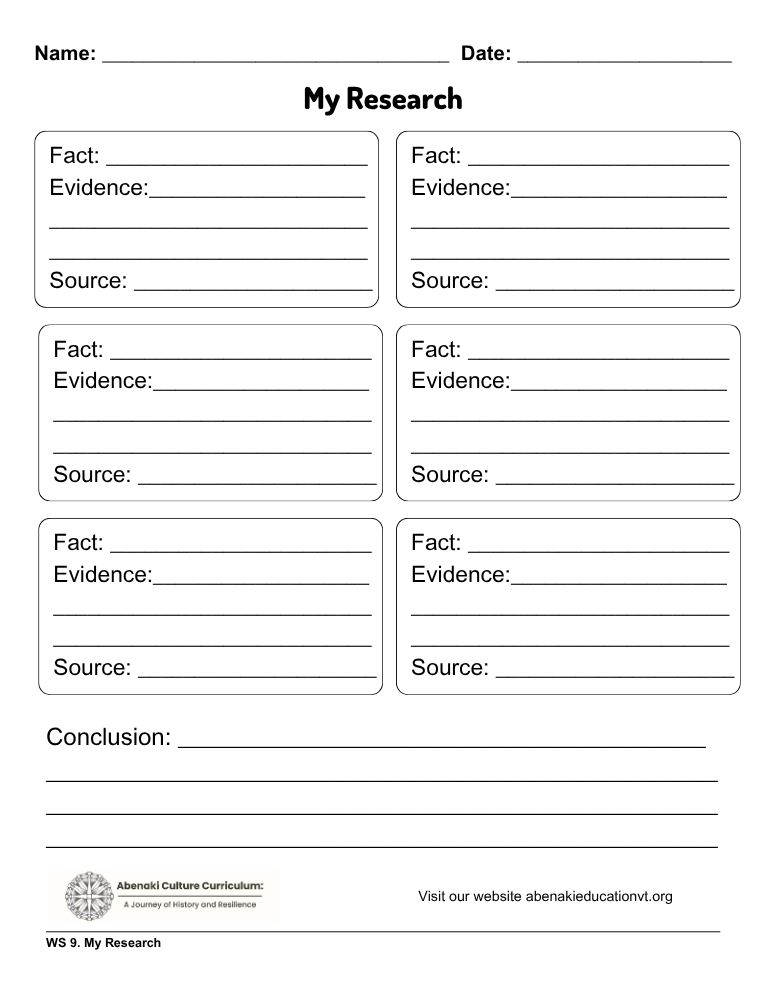
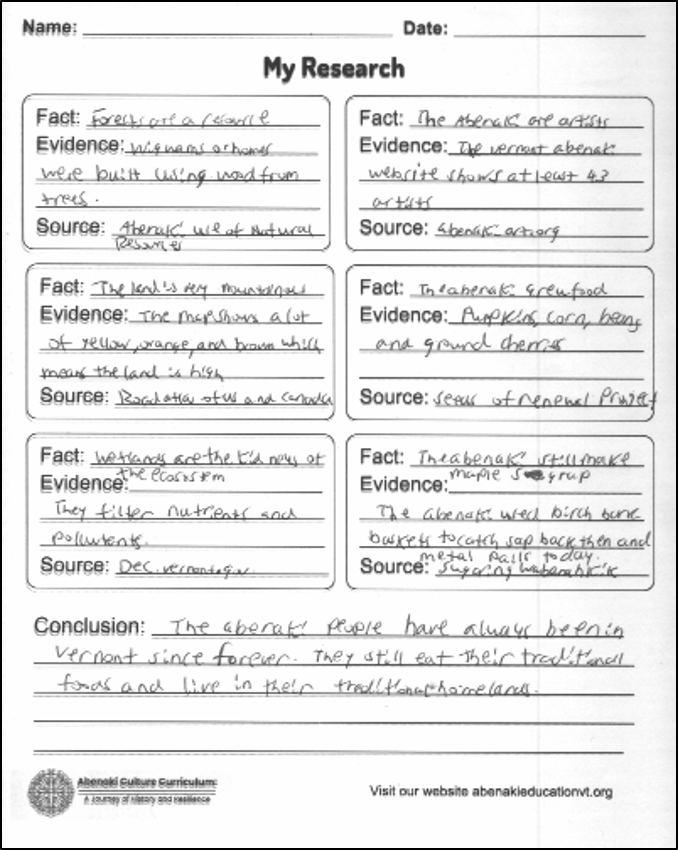
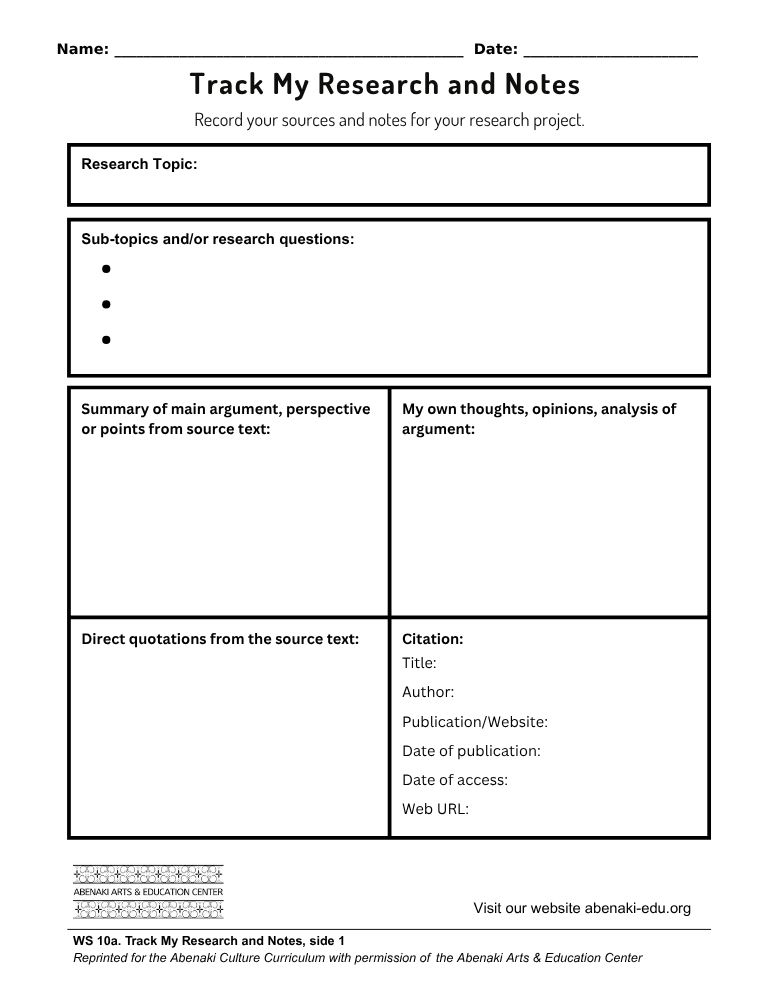
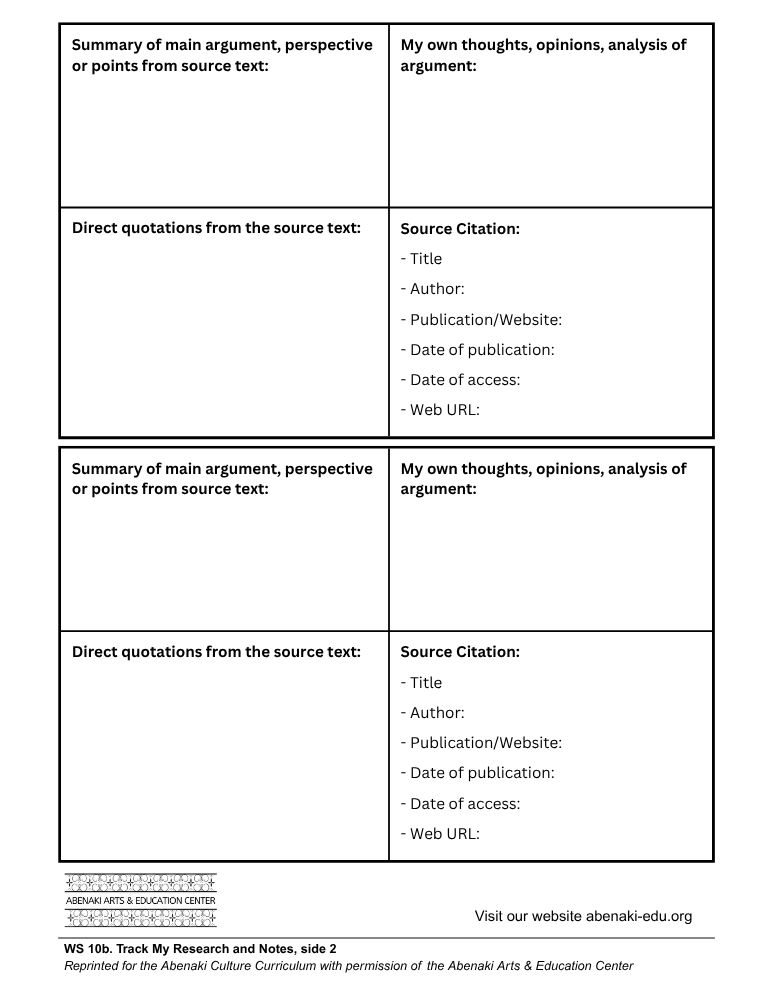
Throughout this learning journey, students conduct research and record evidence about their findings on either the WS 9. My Research or the WS 10a–b. Track My Research and Notes worksheets, which provide students with a structured way to document their research and aid in using citations.

Worksheets

WS 9 – My Research Worksheet
Sample completed WS 9. My Research

Worksheets

WS 10a – Track My Research and Notes, side 1
WS 10b – Track My Research and Notes, side 2

SQ2 Visual Arts Integration: Drawing with Color

Overview

Hands-on visual arts activities are a good way for students to engage with content about Abenaki culture while enhancing comprehension and retention of the material. Integrating art into the American Abenaki Curriculum fosters a deeper understanding of complex regional history

This activity focuses on drawing Abenaki lifeways (food, clothing, and shelter). Students will create visual representations of the Abenaki homeland and show how it has changed over time.

The activity can be adapted for different grades or abilities. Adaptations can include simplifying instructions, printing an outline of the state for younger students, adding additional instructions, or having students make more complicated drawings.

Materials

  • drawing paper or a printout with an outline of the state
  • colored pencils or markers
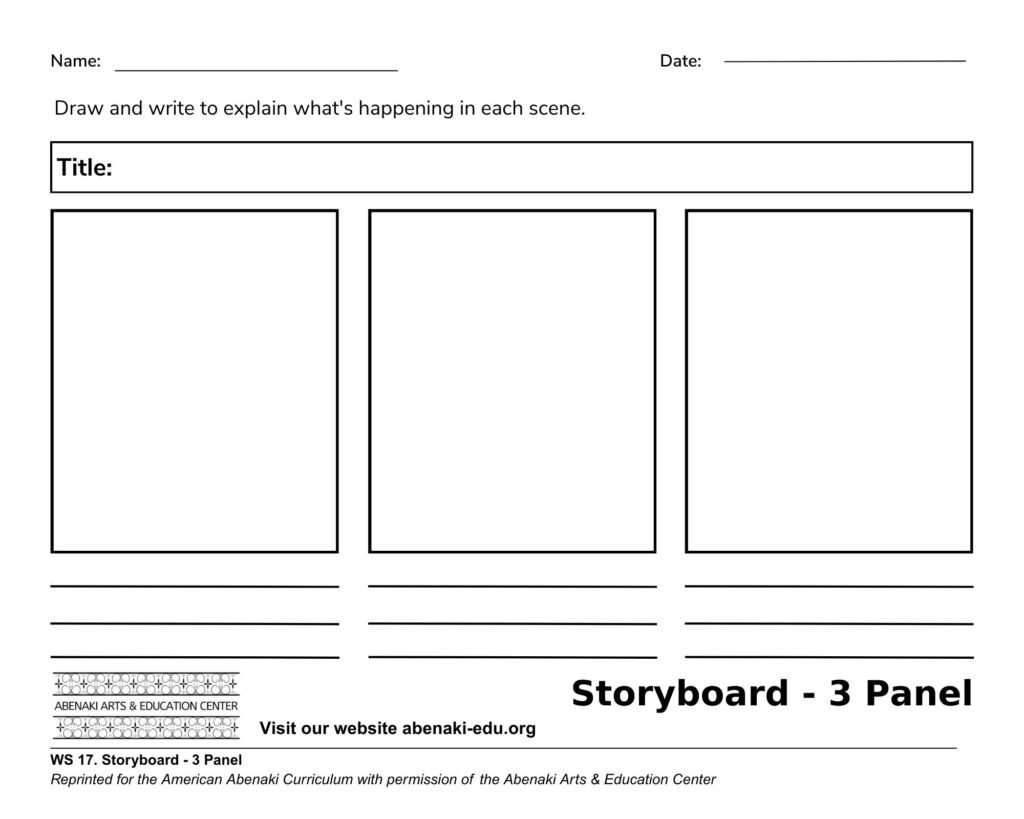
WS 17 – Storyboard 3 Panel
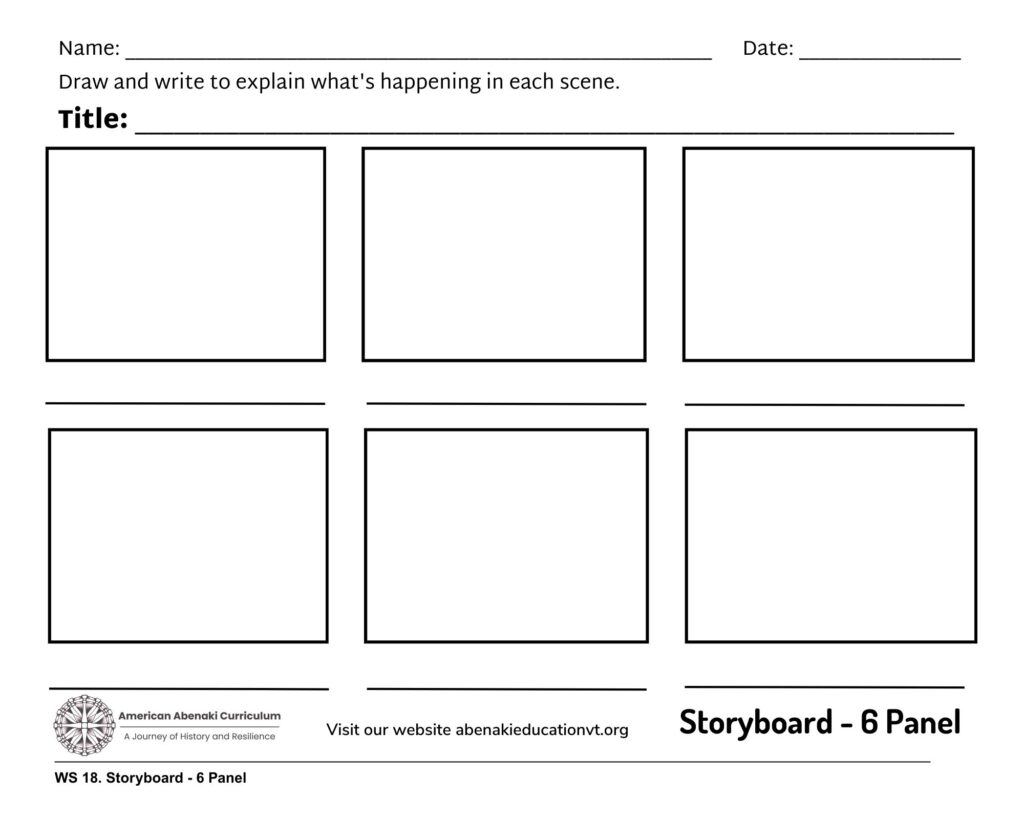
WS 18 – Storyboard 6 Panel

Resources

Consult the Resources by Subject Areas with Grade Levels section of this curriculum and choose recommended resources listed by the following keywords: food, clothing, shelter.

Guiding the Inquiry

  • Discuss Abenaki lifeways and how the Abenaki people have adapted to their environment.
  • Share with the class reference images or videos focusing on Abenaki lifeways, such as:
  • Hand out art-making materials and worksheets WS 17 and/or WS 18.
  • Ask your students to draw and label scenes about Abenaki lifeways, showing how they have changed over time.
  • Share students’ storyboards in a classroom or hallway exhibit.
  • These storyboards can later be shared in a student portfolio.
Sample Student Responses (Listed by Grade)
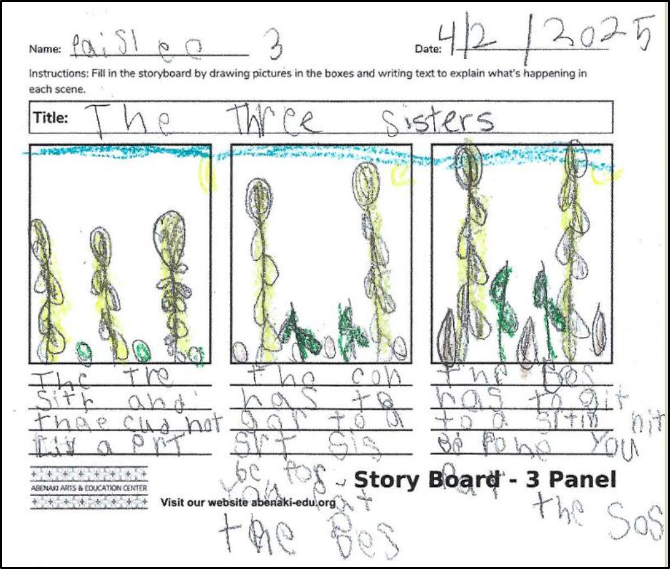
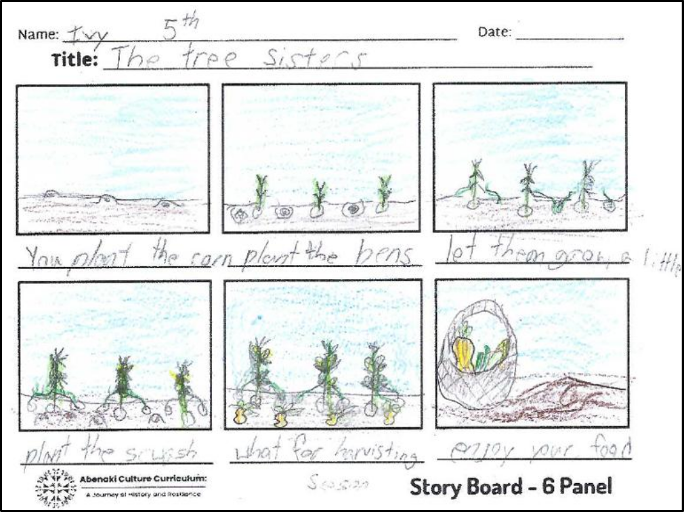
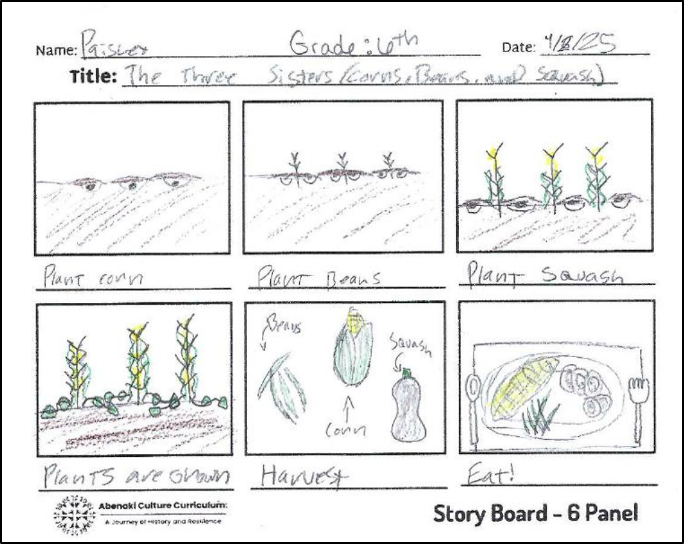
Sample Storyboard by Third Grader
Sample Storyboard by Fifth Grader
Sample Storyboard by Sixth Grader

Standards Alignment

Click + to view Standards Alignment guidance. Click to close the box when done.

Potential Alignment: National Core Arts Standards for Visual Arts

The Visual Arts Integration—Drawing Using Color activity can support the following sampling of standards and serve as a starting point for integrating the American Abenaki Curriculum with visual arts instruction and assessment.

Grade 3

VACr3.1.3a. Elaborate visual information by adding details in an artwork to enhance emerging meaning.

Grade 4

VACr2.3.4a. Document, describe, and represent regional constructed environments.

Grade 5VACr2.2.5a. Demonstrate quality craftsmanship through care for and use of materials, tools, and equipment.

SQ2 Writing Informational Text

For this activity, separate Worksheets, Resources, and Sample Student Responses have been provided for grade 3, grades 4–5, middle school, and high school.

Overview

Writing informational text helps students share what they are learning, reflect on their understanding of a nonfiction topic, and meet the “proficient” statement for the Assessment Objective. In this activity, students will do research and draft answers to worksheet prompts.

We encourage you to be flexible and adapt these worksheets to meet your students’ needs and your teaching style. Prompts can easily be modified by providing alternative instructions. For example, you might instruct lower grade level students to draw and describe their answers and higher grade level students to provide more analysis in their responses.

Materials

There are no materials needed for these activities.

Guiding the Inquiry

  • Have students read and interpret the prompts on their worksheets. Note that there is one activity for grades 4 and 5 for which you will have to read the prompt to students.
  • Next, have students plan and get your approval to do research using the resources you have chosen from the lists provided.
  • Then, have students gather information that will help them respond to the prompt. Invite them to ask questions if they find anything that needs to be clarified.
  • Provide sufficient time and scaffolding for students to write their responses to the prompt on the worksheet. For example, you may have them use a separate piece of paper to draft or outline their answers. Encourage them to include in their writing discussion of 21st century Abenaki culture.
  • Decide how to accommodate students who wish to type their responses or develop storyboards instead of essay-style text.
  • Have students meet with partners to share and revise their writing.

Worksheets Listed by Grade

SQ2 Writing Informational Text: High School

Worksheets, Resources, and Sample Student Responses Worksheet: WS 16. Architectural Styles Prompt: Analyze the architectural styles of Abenaki shelters. How did these structures accommodate their builders’ lifestyles while providing essential protection and comfort? WS 16 – Adapting Lifeways Resources Abenaki Homes and Structures [Poster] (Abenaki Arts & Education Center, 2025c) Building a Traditional Indigenous Peoples’…

Continue Reading SQ2 Writing Informational Text: High School


Standards Alignment

Click + to view Standards Alignment guidance. Click to close the box when done.

Potential Alignment: English Language Arts Standards

The Writing Informational Text activities can support the following sampling of standards and serve as a starting point for integrating the American Abenaki Curriculum with language arts instruction and assessment.

Grades 3–5

CCSS.ELA-Literacy.W.3.2.b. Develop the topic with facts, definitions, and details.

CCSS.ELA-Literacy.W.4.2.d. Use precise language and domain-specific vocabulary to inform about or explain the topic.

CCSS.ELA-Literacy.W.5.2.c. Link ideas within and across categories of information using words, phrases, and clauses (e.g., in contrast, especially).

Grade 6–8

CCSS.ELA-Literacy.W.6.1.a. Introduce claim(s) and organize the reasons and evidence clearly.

CCSS.ELA-Literacy.W.7.1.b. Support claim(s) with logical reasoning and relevant evidence, using accurate, credible sources and demonstrating an understanding of the topic or text.

CCSS.ELA-Literacy.W.8.1.c. Use words, phrases, and clauses to create cohesion and clarify the relationships among claim(s), counterclaims, reasons, and evidence.

Grade 9–12

CCSS.ELA-Literacy.W.9-10.1. Write arguments to support claims in an analysis of substantive topics or texts, using valid reasoning and relevant and sufficient evidence.

CCSS.ELA-Literacy.W.11-12.1.d. Establish and maintain a formal style and objective tone while attending to the norms and conventions of the discipline in which they are writing.