SQ2 Give One, Get One

For this activity, separate Prompts, Resources, and Sample Student Responses have been provided for grade 3, grades 4–5, middle school, and high school.

Overview

Give One, Get One is a simple collaboration strategy emphasizing the reciprocal nature of learning, where each student both “gives” and “gets” insights about a particular Abenaki lifeway, recording on a graphic organizer worksheet. The concise nature of the activity makes it accessible for students at various proficiency levels.

Materials

  • student journals, flip chart pad, or whiteboard, post-it notes or index cards, and markers
  • timer

Worksheet

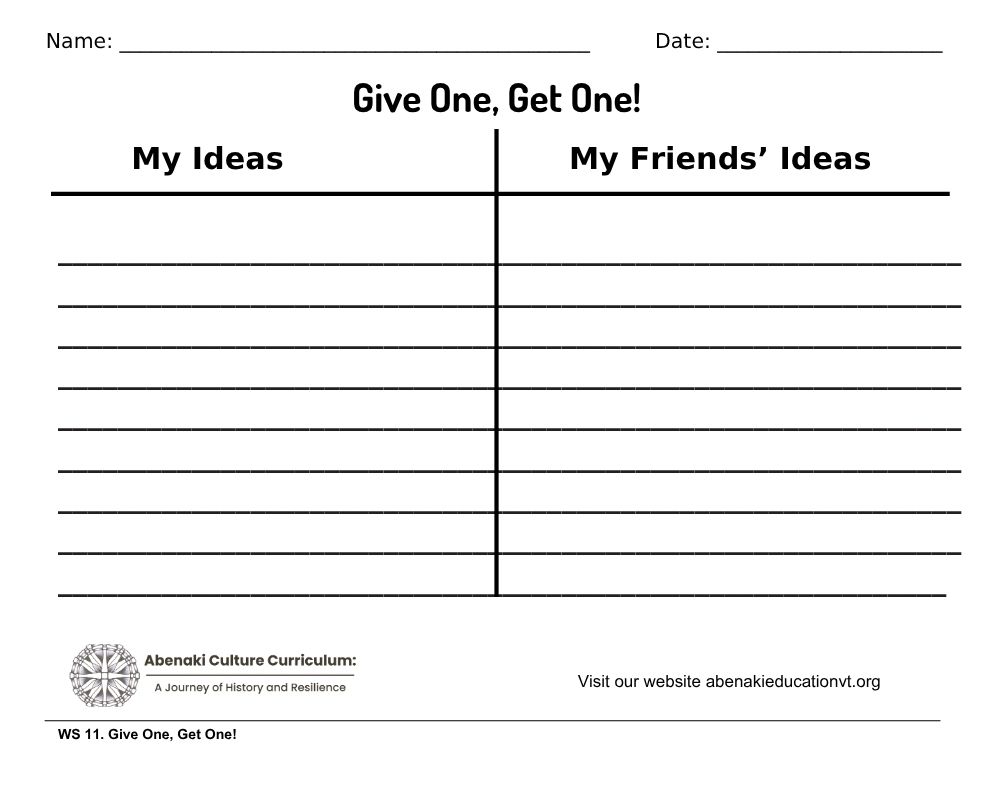
Give one - get one worksheet.
WS 11 – Give One, Get One

Resources

Resources about Abenaki lifeways (books, articles, posters, online materials) can be found in the Resource Bank section of this curriculum. It contains both Illustrated Resources and Resources by Subject Areas with Grade Levels. Teachers should review the Resources and select those that will be most appropriate for their students.

Guiding the Inquiry

  • Depending on the grade level or needs of the students you teach, choose a prompt from the choices that follow. Write it on the board and read it to students.
  • Distribute the WS 11. Give One, Get One! worksheet 
  • Make the resources you have chosen available to your students and have them work independently to complete the “My Ideas” column of the chart about a particular Abenaki lifeway.
  • Next, have students move around the room to interact with their peers.  Students “Give” their explanations and “Get” explanations and insights from others, recording new information in the “My Friends’ Ideas” column of the chart. 
  • After the interactive phase of the activity, hold a debriefing session in which you ask students to describe how Abenaki people have adapted to their environment. This can take the form of a class discussion using a whiteboard or a journal writing session.
  • Conclude with a summary and reflection that help bring the activity to a meaningful close.

Prompts by Grade Level

SQ2 Give One, Get One: Grade 3

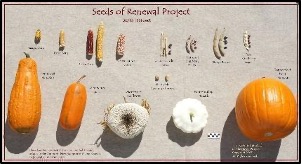
Prompt, Resources, and Sample Student Responses Prompt: List some kinds of food that the Abenaki people eat. Worksheet: WS 11 – Give One, Get One Resources: Seeds of Renewal Project: 2013 Harvest [Poster—Seeds of renewal poster.JPG] (Wiseman, 2013)   Abenaki Cultural Practices, Lifeways, and Natural Resources Card Game [Deck of Cards] (Abenaki Arts & Education…

Continue Reading SQ2 Give One, Get One: Grade 3

SQ2 Give One, Get One: Grades 4 – 5

Prompt, Resources, and Sample Student Responses Prompt: List materials Abenaki people used to make clothing for different seasons at different times in history. Worksheet WS 11 – Give One, Get One Resources [Resource coming soon] Abenaki Clothing [Poster] (Abenaki Arts & Education Center, 2025a)  (Under Construction) Abenaki Cultural Practices, Lifeways, and Natural Resources Card Game…

Continue Reading SQ2 Give One, Get One: Grades 4 – 5

SQ2 Give One, Get One: Middle School

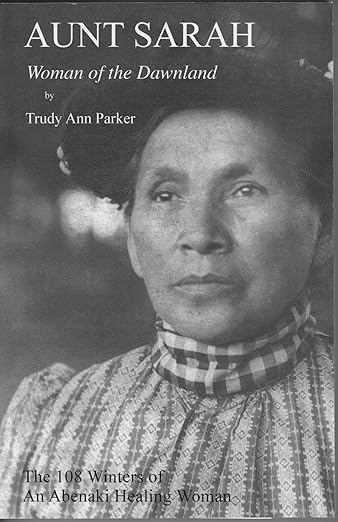
Prompt, Resources, and Sample Student Responses    Prompt: List ways the Abenaki people adapted their lifeways to their changing environment. Worksheet WS 11 – Give One, Get One Abenaki History Timeline [Poster] (Abenaki Arts & Education Center, 2023) [Resource coming soon] [Resource coming soon] Aunt Sarah: Woman of the Dawnland: The 108 Winters of an…

Continue Reading SQ2 Give One, Get One: Middle School

SQ2 Give One, Get One: High School

Prompt, Resources, and Sample Student Responses  Prompt: Describe how Abenaki maple sugaring traditions demonstrate resilience and cultural continuity. Worksheet WS 11 – Give One, Get One Resources ‘It’s Everyone’s Thing’: A Tale of Sugar and Community [Online article in Whetstone Magazine] (Kaiwar, n.d.) Sugaring in Wabanahkik (Land of the Dawn): An Abenaki History of Maple…

Continue Reading SQ2 Give One, Get One: High School

Standards Alignment

Click + to view Standards Alignment guidance. Click to close the box when done.

Potential Alignment: English Language Arts Standards

The Give One, Get One activity can support the following sampling of standards and serve as a starting point for integrating the American Abenaki Curriculum with language arts instruction and assessment.

Grades 3–5

CCSS.ELA-Literacy.SL.3.1.c. Ask questions to check understanding of information presented, stay on topic, and link their comments to the remarks of others.

CCSS.ELA-Literacy.SL.4.1.d. Review the key ideas expressed and explain their own ideas and understanding in light of the discussion.

CCSS.ELA-Literacy.SL.5.1.b. Follow agreed-upon rules for discussions and carry out assigned roles.

Grades 6–8

CCSS.ELA-Literacy.SL.6.1. Engage effectively in a range of collaborative discussions (one-on-one, in groups, and teacher-led) with diverse partners on grade 6 topics, texts, and issues, building on others’ ideas and expressing their own clearly.

CCSS.ELA-Literacy.L.7.3. Use knowledge of language and its conventions when writing, speaking, reading, or listening.

CCSS.ELA-Literacy.W.8.7. Conduct short research projects to answer a question (including a self-generated question), drawing on several sources and generating additional related, focused questions that allow for multiple avenues of exploration.

Grades 9–12

CCSS.ELA-Literacy.W.9-10.9. Draw evidence from literary or informational texts to support analysis, reflection, and research.

CCSS.ELA-Literacy.SL.11-12.4. Present information, findings, and supporting evidence, conveying a clear and distinct perspective, such that listeners can follow the line of reasoning, alternative or opposing perspectives are addressed, and the organization, development, substance, and style are appropriate to purpose, audience, and a range of formal and informal tasks.

SQ2 Using The Jigsaw Method

Overview

This activity is an adaptation of The Jigsaw Classroom (Social Psychology Network, 2025) learning technique described on Dr. Elliot Aronson’s website about his methods http//www.jigsaw.org/. This variation takes a holistic approach to learning about Abenaki lifeways and honors Abenaki culture bearers, their ways of knowing, and their values. 

If you are familiar with the Jigsaw Classroom, you may notice that some terms have been changed. We replaced the term “Jigsaw Group” with “Home Group,” and the term “Expert Group” with “Research Group” because students will not become experts by participating in this activity. Research Groups collaborate on finding out about a topic together. They share their ideas, findings, and perspectives about Abenaki culture. Dr. Aronson’s version of the activity calls on students to “craft a general statement.” In this version of the activity, we ask that students “craft an observational statement,” relying on facts and evidence from research, rather than personal interpretation.

Materials

  • materials for note taking and sharing (journal, flip chart paper, whiteboard, sticky notes or index cards)
  • markers
  • timer

Worksheet

There are no worksheets needed for this activity.

Resources

Resources about Abenaki lifeways (books, articles, posters, online materials) can be found in the Resource Bank section of this curriculum. This contains both Illustrated Resources by Type and Resources by Subject Areas with Grade Levels. Review the Resources and select those that will be most appropriate for your students.

Guiding the Inquiry

  • Use your classroom routines to divide students into four “Home Groups.” 
  • Assign at least one student in each “Home Group” to research an Abenaki lifeway, such that the group will research all four (food, clothing, shelter, and arts).
  • Once the topics are assigned, each “Home Group” student will move into a “Research Group.” All of the students researching food will form the food “Research Group,” students studying shelters will join the shelter “Research Group,” and so forth. 
  • Have students use the vetted resources from this curriculum for their research. 
  • When the time you allocate for research ends, allow students in each “Research Group” to share their findings and insights. Emphasize the importance of active listening and respectful communication.
  • Then have the students return to their “Home Group,” where they will share the knowledge they gained. In this way everyone can contribute to the collective understanding of how Abenaki people have adapted their lifestyles over the years.
  • Have each “Home Group” practice making observational statements about how Abenaki people adapted to their environment based on their lifeways. Be prepared to redirect the conversation if students describe stereotypes or myths. Students make a written list of the observational Statement so that the class can refer back to it. 
  • Conclude the group-sharing phase with a whole-class summary and reflection that helps bring the discussion to meaningful closure.

Standards Alignment

Click + to view Standards Alignment guidance. Click to close the box when done.

Potential Alignment: English Language Arts Standards

The Using the Jigsaw Method activity can support the following sampling of standards and serve as a starting point for integrating the American Abenaki Curriculum with language arts instruction and assessment.

Grades 3–5

CCSS.ELA-Literacy.SL.3.4. Report on a topic or text, tell a story, or recount an experience with appropriate facts and relevant, descriptive details, speaking clearly at an understandable pace.

CCSS.ELA-Literacy.SL.4.1.d. Review the key ideas expressed and explain their own ideas and understanding in light of the discussion.

CCSS.ELA-Literacy.SL.5.1.a. Come to discussions prepared, having read or studied required material; explicitly draw on that preparation and other information known about the topic to explore ideas under discussion.

Grades 6–8

CCSS.ELA-Literacy.SL.6.1Engage effectively in a range of collaborative discussions (one-on-one, in groups, and teacher-led) with diverse partners on grade 6 topics, texts, and issues, building on others’ ideas and expressing their own clearly.

CCSS.ELA-Literacy.SL.7.1.b. Follow rules for collegial discussions, track progress toward specific goals and deadlines, and define individual roles as needed.

CCSS.ELA-Literacy.SL.8.1.a. Come to discussions prepared, having read or researched material under study; explicitly draw on that preparation by referring to evidence on the topic, text, or issue to probe and reflect on ideas under discussion.

Grades 9–12

CCSS.ELA-Literacy.SL.9-10.1.d. Respond thoughtfully to diverse perspectives, summarize points of agreement and disagreement, and, when warranted, qualify or justify their own views and understanding and make new connections in light of the evidence and reasoning presented.

CCSS.ELA-Literacy.SL.11-12.1.b. Work with peers to promote civil, democratic discussions and decision-making, set clear goals and deadlines, and establish individual roles as needed.

SQ1 Writing Informational Text

For this activity, separate Worksheets, Resources, and Sample Student Responses have been provided for grade 3, grades 4–5, middle school, and high school.

Overview

The writing prompts on the worksheets for this activity give students an opportunity to organize information, share their ideas, and reflect on their understanding. We encourage you to adapt these worksheets to meet your students’ needs and your teaching style. Prompts can easily be modified by providing alternative instructions. For example, you might instruct lower-grade students to draw and describe their answers, and higher-grade students to provide more analysis in their responses.

Guiding the Inquiry

  • Have students read the prompts on their worksheets carefully.
  • Make available to students resources from the lists provided so that they can gather information needed to respond to the prompt.
  • Invite them to ask questions if they find anything that needs to be clarified.
  • Tell students to use the space on the worksheet or a separate piece of paper to draw pictures (grade 3) and write answers to the prompts.
  • Decide how to accommodate students who wish to type their responses.

Worksheets Listed by Grade

SQ1 Writing Informational Text: Grade 3

Worksheet, Resources, and Sample Student Responses Worksheet Prompt: How would living near mountains, valleys, woodlands or water affect Abenaki family life? Draw and describe some landforms and natural resources they would look for. WS 4 – Draw and Describe Resources and Landforms Resources Abenaki Cultural Practices, Lifeways, and Natural Resources Card Game [Deck of Cards]…

Continue Reading SQ1 Writing Informational Text: Grade 3

SQ1 Writing Informational Text: Middle School

Worksheet, Resources, and Sample Student Responses Worksheet Prompt: Sustainable practices assume that natural resources are limited and that people should act to ensure that resources will be available for people in the future. Discuss how knowledge of geography guided Abenaki natural resource utilization and conservation. How did their geographical awareness contribute to their sustainable practices?…

Continue Reading SQ1 Writing Informational Text: Middle School

SQ1 Writing Informational Text: High School

Worksheet, Resources, and Sample Student Responses Worksheet Prompt: Analyze how the Abenaki people’s familiarity with the region’s geography gave them advantages or challenges when dealing with neighboring tribes and colonial settlers WS 8 – Familiarity with Geography Resources [Resource coming soon] Famous Abenaki [Online reading] (Elnu Abenaki Tribe, 2023) Native Land Digital [Digital interactive] (Banaszak,…

Continue Reading SQ1 Writing Informational Text: High School

Standards Alignment

Click + to view Standards Alignment guidance. Click to close the box when done.

Potential Alignment: English Language Arts Standards

The Writing Informational Text activity can support the following sampling of standards and serve as a starting point for integrating the American Abenaki Curriculum with language arts instruction and assessment.

Grades 3–5

CCSS.ELA-Literacy.W.3.2.b. Develop the topic with facts, definitions, and details.

CCSS.ELA-Literacy.W.4.2.d. Use precise language and domain-specific vocabulary to inform about or explain the topic.

CCSS.ELA-Literacy.W.5.2.b. Develop the topic with facts, definitions, concrete details, quotations, or other information and examples related to the topic.

Grades 6–8

CCSS.ELA-Literacy.W.6.1.a. Introduce claim(s) and organize the reasons and evidence clearly.

CCSS.ELA-Literacy.W.7.2.d. Use precise language and domain-specific vocabulary to inform about or explain the topic.

CCSS.ELA-Literacy.W.8.2.b. Develop the topic with relevant, well-chosen facts, definitions, concrete details, quotations, or other information and examples.

Grades 9–12

CCSS.ELA-Literacy.W.9-10.2.e. Establish and maintain a formal style and objective tone while attending to the norms and conventions of the discipline in which they are writing.

CCSS.ELA-Literacy.W.11-12.2.b. Develop the topic thoroughly by selecting the most significant and relevant facts, extended definitions, concrete details, quotations, or other information and examples appropriate to the audience’s knowledge of the topic.

SQ1 Turn-and-Talk and Discussions

For this activity, separate discussion Prompts, Resources, and Sample Student Responses have been provided for grade 3, grades 4–5, middle school, and high school.

Overview

Students participate in a Turn-and-Talk discussion in which they explain the relationship between geography, natural resources, and the culture of the Abenaki. This peer-to-peer strategy helps students improve their communication skills by alternating between active listening and making meaningful contributions to conversations about Abenaki culture. Afterwards, the class reconvenes for a teacher-facilitated follow up discussion.

Materials

There are no materials needed for this activity.

Worksheets

There are no worksheets needed for this activity

Guiding the Inquiry

  • Choose from among the recommended resources those that are most appropriate for your students.
  • Divide the class into pairs. 
  • Share the Turn-and-Talk prompt with your students.
  • Provide the pairs with the resources you have chosen, allowing enough time to examine and discuss them.
  • In their discussion, have students develop an argument with one to three pieces of evidence to support their claim.
  • Encourage students to be active listeners, offering respectful feedback as peers share ideas and insights.
  • After pairs discussion, bring the class together to share their findings with one student presenting for each pair. 
  • Bring the discussion to a meaningful close, encouraging students to summarize and make connections between their varied perspectives for a broader understanding of Abenaki culture.
Abenaki Cultural Practices, Lifeways, and Natural Resources Card Game
Abenaki Cultural Practices, Lifeways, and Natural Resources Card Game Available through the Abenaki Arts & Education Center. abenaki.education@gmail.com
(Abenaki Arts & Education Center, 2025a)

Discussion Prompts by Grade

SQ1 Turn-and-Talk and Discussions: Grades 4 – 5

Prompt, Resources, and Sample Student Responses Prompt How could geography have influenced the Abenaki people’s relationships with other tribes? Think about alliances, trade, and conflicts. Resources Abenaki Cultural Practices, Lifeways, and Natural Resources Card Game [Deck of Cards] (Abenaki Arts & Education Center, 2025b). [Teachers:Email Abenaki Arts & Education Center for purchase details at: abenaki.edu@gmail.com]…

Continue Reading SQ1 Turn-and-Talk and Discussions: Grades 4 – 5

SQ1 Turn-and-Talk and Discussions: Middle School

Prompt, Resources, and Sample Student Responses Prompt How might geography and the environment have shaped the interactions between the Abenaki people and colonial settlers? Resources Abenaki Cultural Practices, Lifeways, and Natural Resources Card Game [Deck of Cards] (Abenaki Arts & Education Center, 2025b). [Teachers: Email Abenaki Arts & Education Center for purchase details at: abenaki.edu@gmail.com]…

Continue Reading SQ1 Turn-and-Talk and Discussions: Middle School

SQ1 Turn-and-Talk and Discussions: High School

Prompt, Resources, and Sample Student Responses Prompt Analyze and discuss how geography could have influenced the Abenaki people’s cultural beliefs about the land. Resources Abenaki Cultural Practices, Lifeways, and Natural Resources Card Game [Deck of Cards] (Abenaki Arts & Education Center, 2025b). [Teachers: Email Abenaki Arts & Education Center for purchase details at: abenaki.edu@gmail.com] Abenaki…

Continue Reading SQ1 Turn-and-Talk and Discussions: High School


Standards Alignment

Click + to view Standards Alignment guidance. Click to close the box when done.

Potential Alignment: English Language Arts Standards

The Turn-and-Talk Discussions activity can support the following sampling of standards and serve as a starting point for integrating the American Abenaki Curriculum with language arts instruction and assessment.

Grades 3–5

CCSS.ELA-Literacy.SL.3.1.b. Follow agreed-upon rules for discussions (e.g., gaining the floor in respectful ways, listening to others with care, speaking one at a time about the topics and texts under discussion).
CCSS.ELA-Literacy.SL.4.1.d. Review the key ideas expressed and explain their own ideas and understanding in light of the discussion.
CCSS.ELA-Literacy.SL.5.2. Summarize a written text read aloud or information presented in diverse media and formats, including visually, quantitatively, and orally.

Grades 6–8

CCSS.ELA-Literacy.SL.6.2. Interpret information presented in diverse media and formats (e.g., visually, quantitatively, orally) and explain how it contributes to a topic, text, or issue under study.
CCSS.ELA-Literacy.SL.7.1.d. Acknowledge new information expressed by others and, when warranted, modify their own views.
CCSS.ELA-Literacy.SL.8.1.b. Follow rules for collegial discussions and decision-making, track progress toward specific goals and deadlines, and define individual roles as needed.

Grades 9–12

CCSS.ELA-Literacy.SL.9-10.2. Integrate multiple sources of information presented in diverse media or formats (e.g., visually, quantitatively, orally) evaluating the credibility and accuracy of each source.
CCSS.ELA-Literacy.SL.11-12.1.a. Come to discussions prepared, having read and researched material under study; explicitly draw on that preparation by referring to evidence from texts and other research on the topic or issue to stimulate a thoughtful, well-reasoned exchange of ideas.

SQ1 Creating a Graphic Organizer (Grade 5 and up)

Overview

Graphic organizers vary in format and purpose. They are often used to help students process their ideas for another task, such as giving a presentation or writing an essay. This activity will prepare learners to answer the question “What is the relationship between the Abenaki and their environment?”

Worksheets

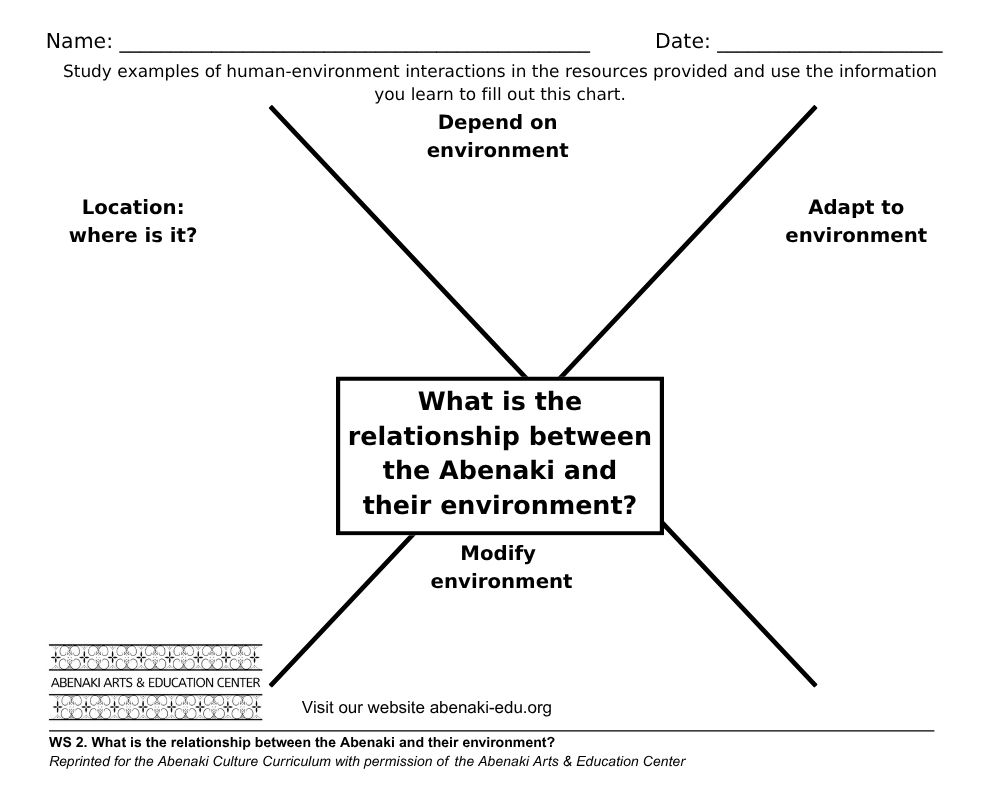
There is a choice of two worksheets, each accompanied by an answer key under Sample Student Responses. (Click the image to download a PDF version.)

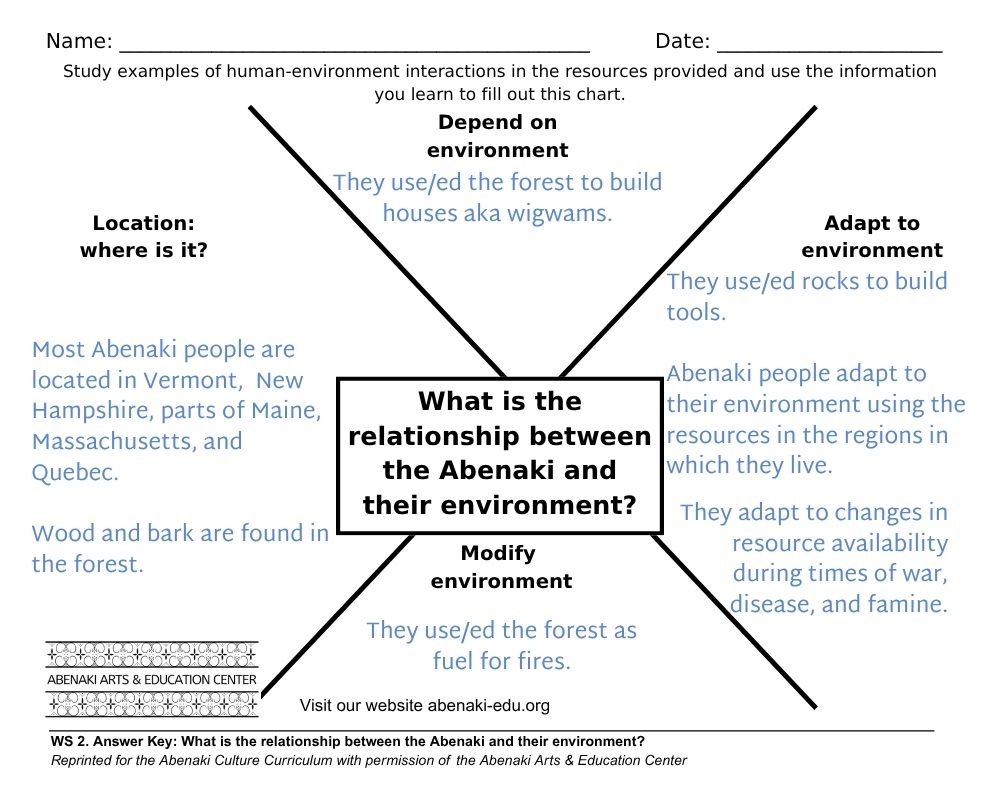
Supporting Question Number 1 worksheet
WS 2 – Relationship between Abenaki and Environment
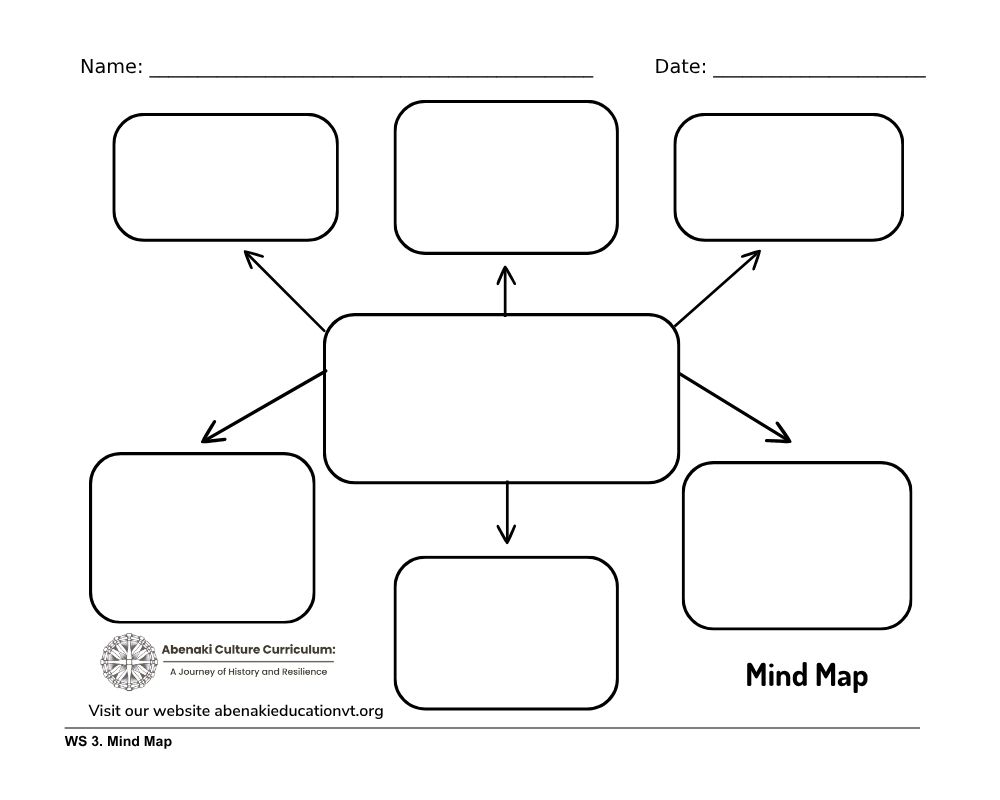
Mind map worksheet for Supporting Question 1
WS 3 – Mind map worksheet for Supporting Question 1

Resources:

Guiding the Inquiry

  • Select one of the two graphic organizers provided as worksheets or use another one if you prefer.
  • If your students are not familiar with graphic organizers you may need to explain how to complete one.
  • Explain to students that they should work in small groups using information from the resources to complete a graphic organizer about the relationship between Abenaki people and their environment.
  • If you choose WS 3, have students begin by writing “What is the relationship between the Abenaki and their environment?” in the center box on the mind map.

Sample Student Responses and Categories

WS 2. Answer Key: What is the relationship between the Abenaki and their environment? (see Worksheet section)
  • Top—They use/ed the forest to build houses aka wigwams.
  • Bottom—They use/ed the forest as fuel for fires.
  • Left—Most Abenaki people are located in Vermont, New Hampshire, parts of Maine, Massachusetts, and Quebec. Wood and bark are found in the forest.

Sample Student Responses

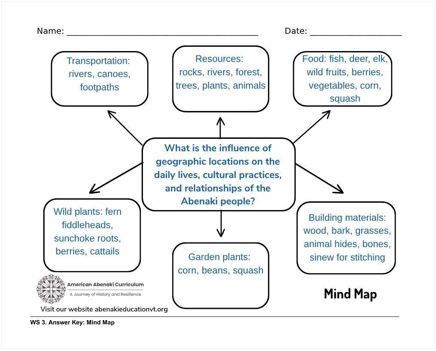
WS 3. Answer Key: Mind Map (see Worksheet section)

  • Resources: rocks, rivers, forest, trees, plants, animals;
  • Food: fish, deer, elk, wild fruits, berries, vegetables, corn, squash;
  • Building materials: wood, bark, grasses, animal hides, bones, sinew for stitching;
  • Garden plants: corn, beans, squash;
  • Wild plants: fern fiddleheads, sunchoke roots, berries, cattails;
  • Transportation: rivers, canoes, footpaths.

See Historical Context essay and Resources for additional potential responses

Standards Alignment

Click + to view Standards Alignment guidance. Click to close the box when done.

Potential Alignment: English Language Arts Standards

The Creating a Graphic Organizer activity can support the following sampling of standards and serve as a starting point for integrating the Abenaki Culture Curriculum with language arts instruction and assessment.

Grades 3–5 Standards

CCSS.ELA-Literacy.W.3.8. Recall information from experiences or gather information from print and digital sources; take brief notes on sources and sort evidence into provided categories.

CCSS.ELA-Literacy.W.4.7. Conduct short research projects that build knowledge through investigation of different aspects of a topic.

CCSS.ELA-Literacy.W.5.7. Conduct short research projects that use several sources to build knowledge through investigation of different aspects of a topic.

Grades 6–8 Standards

CCSS.ELA-Literacy.RI.6.7. Integrate information presented in different media or formats (e.g., visually, quantitatively) as well as in words to develop a coherent understanding of a topic or issue.

CCSS.ELA-Literacy.W.8.7. Conduct short research projects to answer a question (including a self-generated question), drawing on several sources and generating additional related, focused questions that allow for multiple avenues of exploration.

Grades 9–12 Standards

CCSS.ELA-Literacy.SL.9-10.1. Initiate and participate effectively in a range of collaborative discussions (one-on-one, in groups, and teacher-led) with diverse partners on grades 9-10 topics, texts, and issues, building on others’ ideas and expressing their own clearly and persuasively.

SQ1 Matching the Natural Resource to Its Use (Grade 3)

Overview

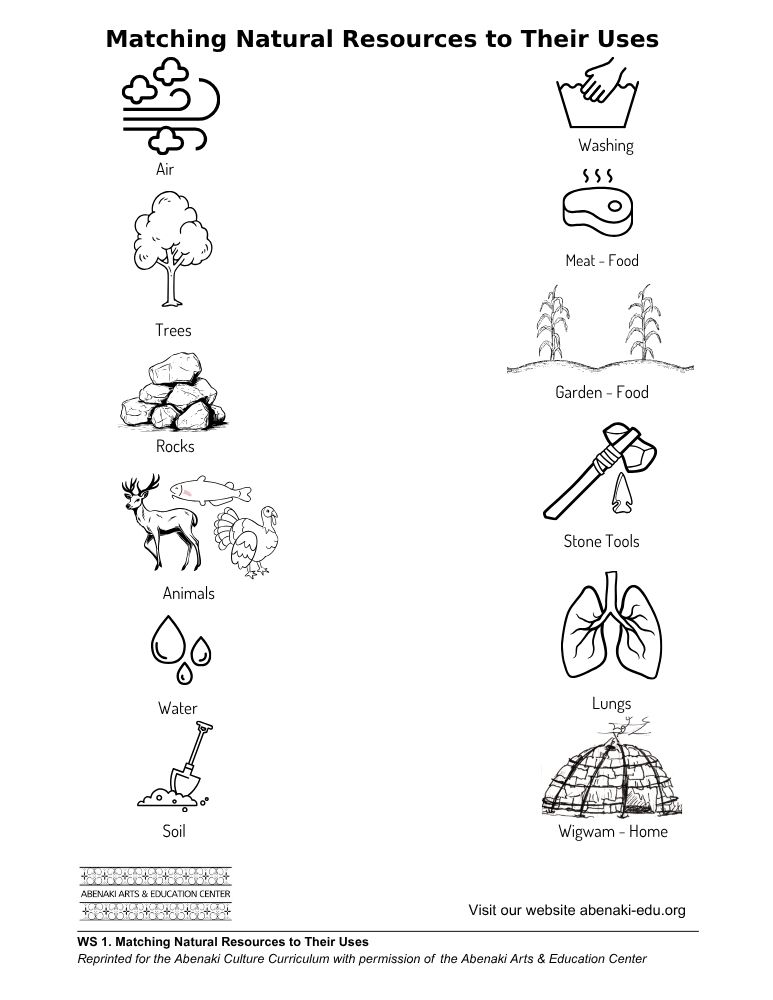
After a field trip, visiting one or more websites or exhibitions, and possibly using some of the other resources listed, students engage in a matching activity to identify the relationships between Abenaki culture and geography/natural resources.

Worksheet

You may obtain PDF versions of the worksheets from the Worksheets page or simply click the worksheet image to download the PDF version.

Resources

Guiding the Inquiry

  • Decide which of the recommended resources are most appropriate for your students.
  • Before taking a field trip or reviewing a website, familiarize your class with the Abenaki Uses of Natural Resources [Table—PDF] (Abenaki Arts & Education Center, 2025d) and where these resources may be found on a map.
  • Hand out WS 1. Matching Natural Resources to Their Uses (Abenaki Arts & Education Center, 2025e). Have students match cultural objects to the natural resources from which they are made.
  • Discuss where each natural resource might be found and how they might be categorized.

Technology Extension

Topographical maps can be uploaded to your digital collaboration medium of choice so that students can work with them in groups. This supports differentiated learning and allows students to use an overlay, such as Google Translate, to understand the material.

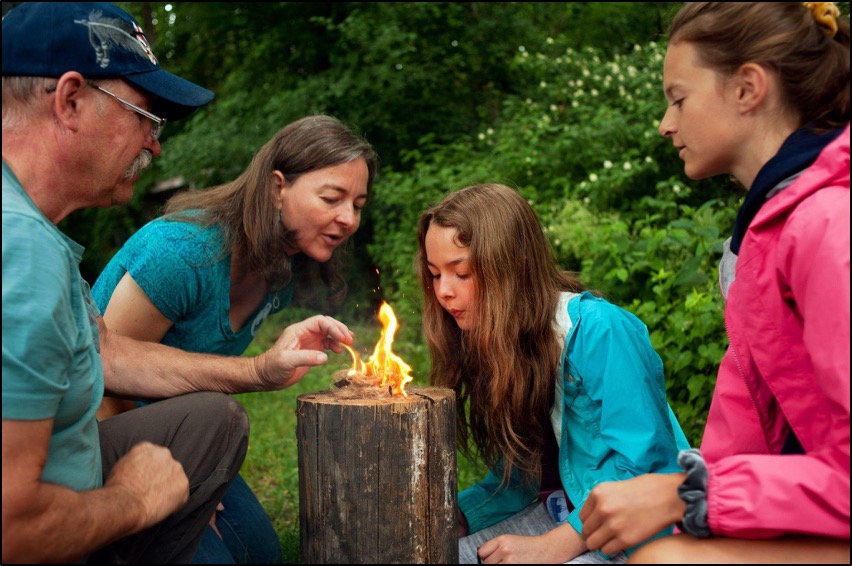
Koasek Traditional Band of the Koas Abenaki Nation citizen Doug Bent teaching a family how to make a fire using flint and steel into a bed tinder made from natural fibers during the Abenaki Heritage Weekend at the Lake Champlain Maritime Museum. (Butler, 2020). Courtesy of White River Valley Herald.

Our Story

A few years ago, the Vermont Commission on Native American Affairs was visited by a young student from Alburgh. She hoped the Commission could support her idea that public schools remain open on Indigenous Peoples’ Day so lesson plans might focus on Native Americans. Sage Gould, granddaughter of Missisquoi Chief Brenda Gagne, explained that her classmates had little idea why school was closed to celebrate a holiday they were unfamiliar with. They were aware of the controversy surrounding the discontinuation of Columbus Day in Vermont. Yet, they were relatively uninformed about the history, culture, or context surrounding Native Americans. Sage suggested that schools remain open so students could learn about the importance of the Native American presence. 

Commission members enthusiastically concurred with Sage that more emphasis was needed on teaching Native studies, with a focus on Abenaki history and culture, as the Abenaki were considered the original inhabitants of Vermont. In a short time, several schools in Franklin and Grand Isle Counties committed to staying in session on Indigenous Peoples’ Day. These schools were part of the Title VI Indian Education consortium, which consisted of the Missisquoi Valley, Maple Run, and Grand Isle Districts, where approximately 520 students identified as Abenaki. While Commissioners were pleased these schools were open, they knew school administrators wanted resources that their teachers could incorporate into the Indigenous Peoples’ Day celebration. Therefore, the Commission initiated discussions with the four State-Recognized Abenaki tribes to explore the possibility of developing an American Abenaki curriculum for use in public schools throughout Vermont. 

As the idea took shape, Commissioners and Tribal leaders realized a grassroots effort would require considerable time and resources. Thus, leaders began recruiting community members interested in education and cultural history. Every tribe was asked to support the project through hands-on contributions, such as collecting important documents in Tribal archives or providing monetary support. A “bare-bones” budget was developed, with considerable in-kind contributions from the tribes and their associated organizations. 

The curriculum you are viewing represents a three-year effort. A committee was formed to steer this initiative from the outset. There were no shortcuts in the development process, as critical feedback loops were established to ensure that all Tribal stakeholders had a voice in the project. By prioritizing Tribal input in ensuring the curriculum’s accuracy, the committee was confident that people marginalized for generations had finally told their own stories. 

In Vermont, a Social Studies teacher is responsible for researching, understanding, and conveying basic facts to her students while teaching them critical thinking skills. According to the State-adopted College, Career, and Civic Life (C3) Framework for Social Studies State Standards, young people should be taught to make informed and reasoned decisions for the public good as citizens of a culturally diverse, democratic society in an interdependent world (National Council for the Social Studies, 2025). Rather than accepting rote memorization as sacrosanct, we believe learners must be encouraged to actively construct their knowledge and understanding through experience, reflection, and interaction with their environment. This is what we seek to query Vermont students about. 

During a time when “evidence-based” educational materials are being scrutinized, we believe that history can be a great teacher. Ideas may be explored when taught in the spirit of rich conversation, and artistic expression may be appreciated for its intrinsic beauty and worth. Children must be encouraged to develop the skills that allow them to challenge commonly held assumptions. This curriculum centers on inquiry-based learning, with questions and discussions becoming more sophisticated in line with the students’ developmental and cognitive growth over time. If we have succeeded, students and teachers alike will share a new appreciation for a culture and history that spans thousands of years. In learning about Abenaki art, history, culture, and customs, students may develop curiosity and a desire to learn about other tribes and civilizations throughout their state, nation, and the world. If our curriculum has piqued such interest, we will have accomplished a small milestone in developing lifelong learning. Such hope sustains those of us committed to the vibrancy of the American Abenaki experience. 

Jeff Benay, Ed.D. 

Chair, American Abenaki Curriculum Committee 

Sample Resources for Supporting Question 1

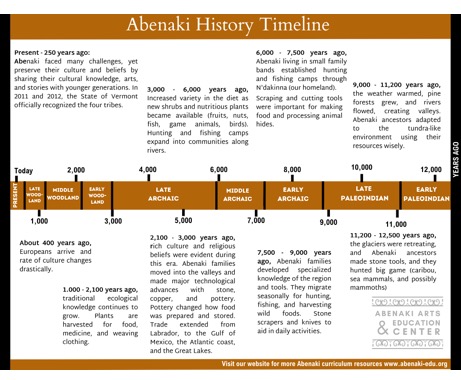
Abenaki History Timeline
Abenaki Cultural Practices, Lifeways, and Natural Resources Card Game
(Abenaki Arts & Education Center, 2025a)
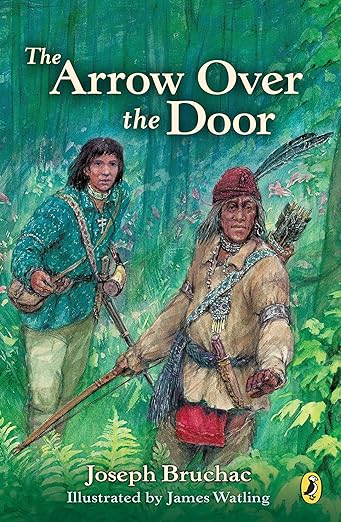
Cover Illustration for The Arrow Over the Door
The Arrow Over the Door (Bruchac, 2002)

A historical fiction story of goodwill between different cultures during the Revolutionary War.
Turtle swimming in water
Detail of the painting “Water is Life” (Francine Poitras Jones, 2018)

Field Trips

Abenaki Cultural Conservancy Collection, in the Research and Exhibition Gallery. Vermont Historical Society, Barry, VT. (Vermont Historical Society, 2025a)

Alnobaiwi at Ethan Allen Homestead, Burlington, VT (Alnobaiwi, 2025)

Burlington Airport Abenaki Display (Brown, 2019)

Vermont Abenaki Artists Association (current exhibit schedule) Museum Exhibitions state-wide (Vermont Abenaki Artists Association, 2021)

Vermont History Museum, Montpelier, VT (Vermont Historical Society, 2025a)