SQ3 Using Peer Review Partners: Middle School

Prompts and Resources

There are two writing prompts available for middle school students.

Materials

There are no materials needed for this activity.

Worksheet

WS 21. Lined Paper can be used at any stage of the writing process.

Prompt 1:

Compare and contrast the Abenaki culture of the past and the present. Use resources to research, if needed, and then write a draft and then a final response including at least three elements of Abenaki culture that have been retained as the culture has adapted over time. Describe the ways Abenaki people have continued certain practices, and how others have changed over time. Discuss the reasons for these changes. Share each of your drafts with a peer, discuss ways to improve it, and use these ideas as a guide for writing your final response.

Resources

History
Food
Language
Art
Cultural Practices
  • From Calumet to Crisis and Back—Part 1 [Video—6:13 min.] (Circle of Courage, 2009a) [Teachers: Please review before screening for your students. This video examines the sacred uses and the misuses of tobacco.]
  • From Calumet to Crisis and Back—Part 2 [Video—9:18 min.] (Circle of Courage, 2009b)[Teachers: Please review before screening for your students. This video examines the sacred uses and the misuses of tobacco.]

Sample Student Responses

Because students are doing independent research, there are no sample student responses for this activity.
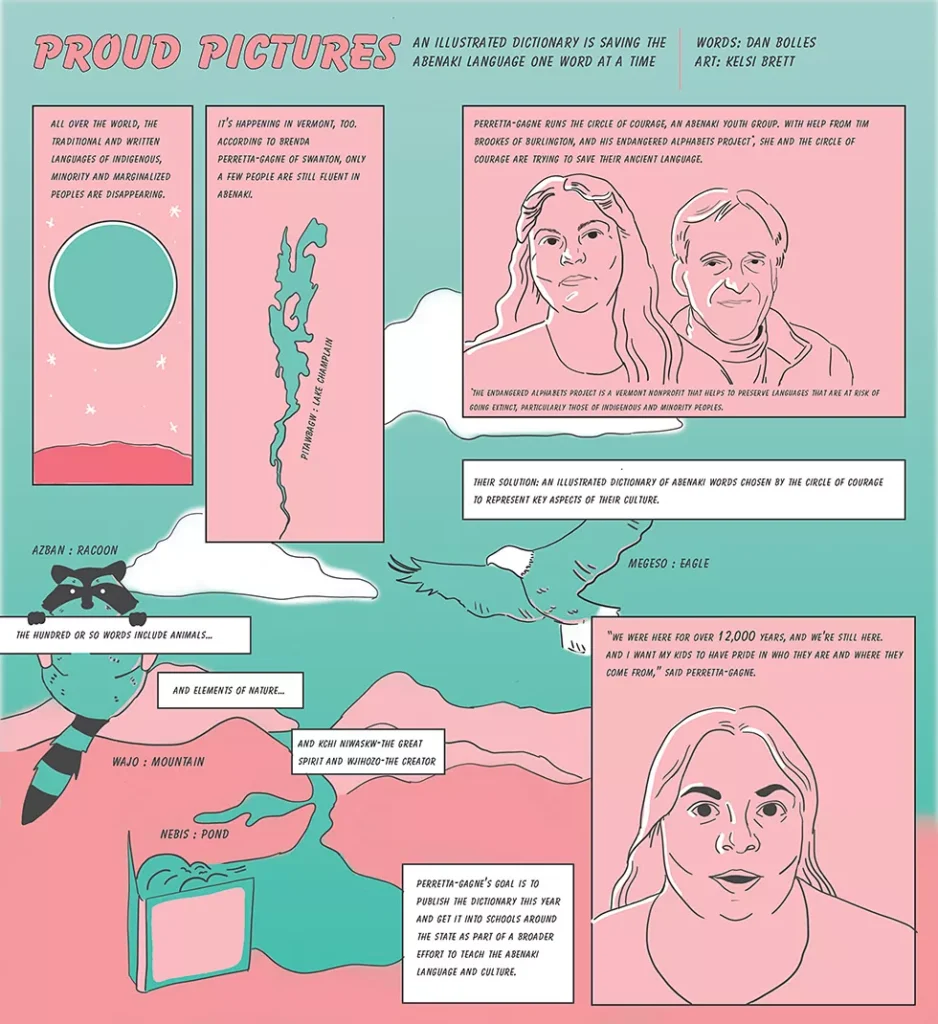
Proud Pictures cartoon.
Proud Pictures [Poster] (Bolles & Brett, 2019)

Prompt 2:

Reflect on the resourcefulness of the Abenaki people in adapting their lifeways to their environment. How did their ability to adapt contribute to their survival and success?

Materials

There are no materials needed for this activity.

Worksheet

WS 21. Lined Paper can be used at any stage of the writing process.

Resources

History
Food
Language
Art
Cultural Practices
  • From Calumet to Crisis and Back—Part 1 [Video—6:13 min.] (Circle of Courage, 2009a) [Teachers: Please review before screening for your students. This video examines the sacred uses and the misuses of tobacco.]
  • From Calumet to Crisis and Back—Part 2 [Video—9:18 min.] (Circle of Courage, 2009b)[Teachers: Please review before screening for your students. This video examines the sacred uses and the misuses of tobacco.]

Sample Student Responses

  • If the Abenaki had not been innovative, they would not have been able to survive colonization. These innovations allowed them to be present today.
  • Abenaki people intermarried with European neighbors and adopted European children.
  • Abenaki people taught European newcomers cultural practices to survive.
  • Abenaki people traded for newly available tools and textiles that made their tasks easier.

See Historical Context essay and Resources for possible additional responses.

Standards Alignment

Click + to view Standards Alignment guidance. Click to close the box when done.

Potential Alignment: English Language Arts Standards

The Peer Review Partners activity can support the following sampling of standards and serve as a starting point for integrating the American Abenaki Curriculum with language arts instruction and assessment.

Grades 3–5

CCSS.ELA-Literacy.W.3.5. With guidance and support from peers and adults, develop and strengthen writing as needed by planning, revising, and editing.

CCSS.ELA-Literacy.W.4.4. Produce clear and coherent writing in which the development and organization are appropriate to task, purpose, and audience.

CCSS.ELA-Literacy.W.5.5. With guidance and support from peers and adults, develop and strengthen writing as needed by planning, revising, editing, rewriting, or trying a new approach.

Grades 6–8

CCSS.ELA-Literacy.W.6.2. Write informative/explanatory texts to examine a topic and convey ideas, concepts, and information through the selection, organization, and analysis of relevant content.

CCSS.ELA-Literacy.SL.7.1.d. Acknowledge new information expressed by others and, when warranted, modify their own views.

CCSS.ELA-Literacy.SL.8.1.b. Follow rules for collegial discussions and decision-making, track progress toward specific goals and deadlines, and define individual roles as needed.

Grades 9–12

CCSS.ELA-Literacy.SL.9-10.1. Initiate and participate effectively in a range of collaborative discussions (one-on-one, in groups, and teacher-led) with diverse partners on grades 9–10 topics, texts, and issues, building on others’ ideas and expressing their own clearly and persuasively.

CCSS.ELA-Literacy.W.11-12.1. Write arguments to support claims in an analysis of substantive topics or texts, using valid reasoning and relevant and sufficient evidence.

Potential Alignment: American Association of School Librarians (AASL) Standards

Learners

VI.B.2. Learners use valid information and reasoned conclusions to make ethical decisions in the creation of knowledge by: Acknowledging authorship and demonstrating respect for the intellectual property of others.

School Librarians

I.C.1 School librarians guide learners to maintain focus throughout the inquiry process by:Assisting in assessing the inquiry-based research process.

School Libraries

I.D.2. The school library ensures an inquiry based process for learners by: Reinforcing the role of the school library, information and technology resources in maximizing learning and institutional effectiveness.

Potential Alignment: International Society for Technology in Education (ISTE) Standards

Students

1.6.a. Choose the appropriate platforms and digital tools for meeting the desired objectives of their creation or communication.

Educators

2.6.a. Foster a culture where students take ownership of their learning goals and outcomes in both independent and group settings.

Educational Leaders3.2.e. Share lessons learned, best practices, challenges and the impact of learning with technology with other education leaders who want to learn from this work.

Potential Alignment: English Language Arts Standards

Potential Alignment: English Language Arts Standards
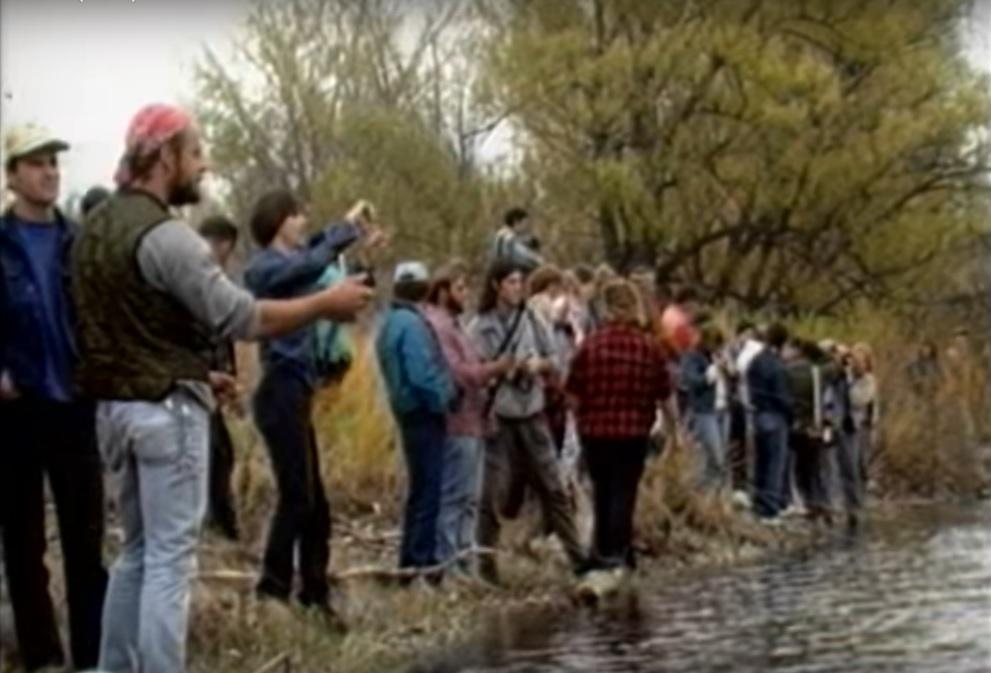
Fish-In Protests Along the Missisquoi River

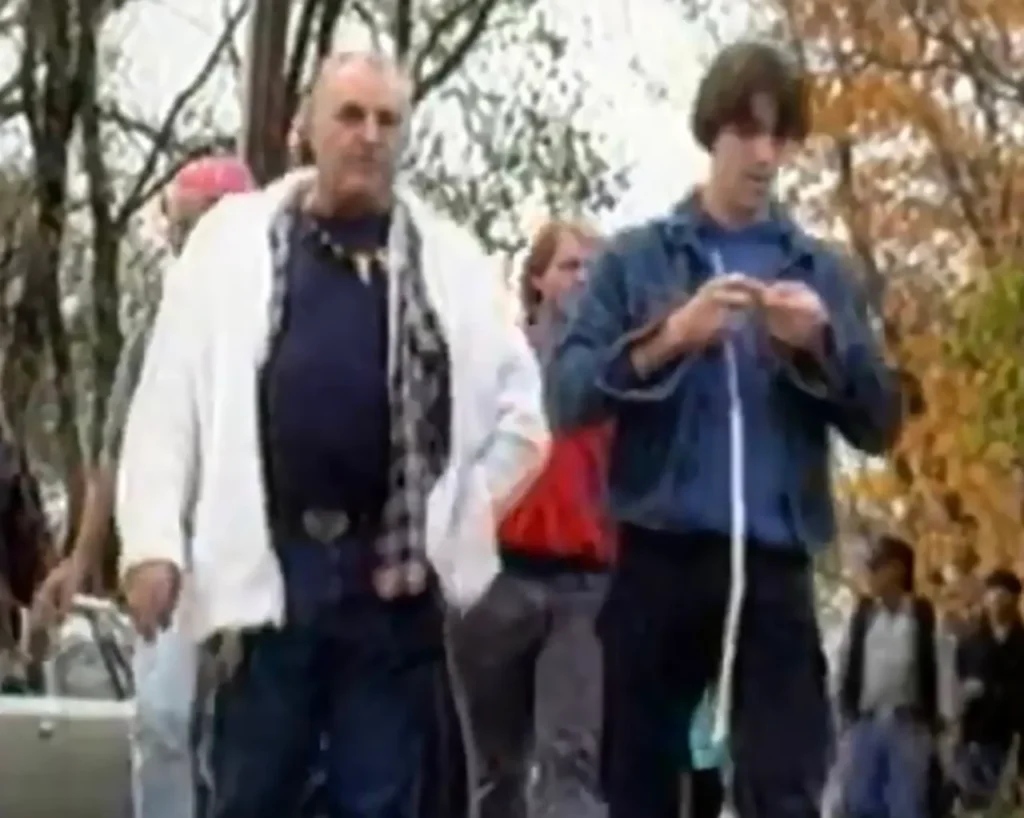
A group of people fishing on the bank of a river.
Photo Credit: “The Abenaki of Vermont. 1987” robinbirkw. YouTube. 2009.

Photos of the fish-in protest may appear blurry or grainy because of limitations of the photography and video technologies that were used at the event in 1987.

In this photo, Abenaki people wearing modern clothing are gathered along the banks of the Missisquoi River in northwestern Vermont during a “Fish-In” event. Some people are taking pictures to document the event, while others are fishing without the fishing licenses that are required by Vermont laws. This event was a form of protest, asserting traditional Indigenous hunting and fishing rights that had been denied by the State of Vermont. (Note that this photo appears blurry due to the limitations of available photographic technologies at that time.

During these “Fish-Ins,” game wardens issued fines, and Abenaki people went to court to prove their innocence, based on their long-standing use of Aboriginal hunting and fishing practices. For thousands of years, Abenaki communities had been built near lakes and rivers to provide people with easy access to clean water, food, and transportation.

Chief Homer St. Francis at the 1987 "Fish In."
Chief Homer St. Francis at the 1987 “Fish-In” on the Missisquoi River. Photo courtesy of Chief Brenda Perretta-Gagne. (Perretta-Gagne, 1987)

In the 1989 court case State of Vermont v. Harold St. Francis, John Churchill, Homer St. Francis, Judge Joseph Wolchik’s decision overruled the fines. Due to overwhelming evidence proving the Missisquoi Abenaki community has lived at the same location continuously for thousands of years, the judge ruled that they had maintained Aboriginal title over the land and did not need state fishing licenses. While this right to freely fish was acknowledged in 1987, it was not encoded into state law until three decades later. In 2011 and 2012, four Abenaki Tribes were recognized by the State of Vermont after a stringent petition process including a review by scholarly experts. (Bill Status S.222, Act 107, 2010). Finally, in 2020, Governor Phil Scott signed Bill H-716, conferring  free hunting, fishing, and trapping licenses to “certified citizens” of Vermont Abenaki Tribes. (H.716, Act 143, 2020).

For More Information

Bruchac, Joseph. (2025). “Vermont Abenaki Fish-ins: Nonviolence and Direct Confrontation.” October 13, 2025. https://joebruchac.com/blog-posts/f/missisquoi-fish-ins.

robinbirkw (Director). (2009, March 14). The Abenakis of Vermont (1987) [Video]. Youtube. https://www.youtube.com/watch?v=3BA5xYC3DLY

The above information comes from the “Deep Roots, Strong Branches” traveling exhibition, Vermont Abenaki Artists Association, curated by Vera Longtoe Sheehan (2025e). Printed with permission of the author. Share as much or as little with your students as needed to successfully complete the curriculum activities.

©2025. Vera Longtoe Sheehan. All Rights Reserved.

SQ3 Technology Extension

  • Older students can use PowerPoint or Google Slides to create a visual presentation that addresses the answer to the prompt they are answering.
  • You can also upload the documents to a digital collaboration platform so your students can work together.

SQ1 Technology Extension

  • Topographical maps can be uploaded to your digital collaboration medium of choice so that students can work with them in groups. This supports differentiated learning and allows students to use an overlay, such as Google Earth, to understand the material.
  • Upload the Vermont Topography [Road atlas of USA and Canada] (Vermont Topography Terrain Map Topographic State Large Scale Free Detailed Landscape, 2025) to a digital collaboration platform so your students can work in groups to complete the worksheet.
  • Use National Geographic Map Maker [Digital interactive] (National Geographic, 2022) to overlay the Indigenous Communities on a topographical map.

SQ3 Extension Activities

Revisit Students’ Questions

Revisit students’ questions from Generating Curiosity under Staging the Compelling Question. Have them now try to answer those questions using evidence from the original image of the “Fish-In” and what they have learned in the Supporting Question 2 activities to explain their thinking.


Use Research Tracker Sheets

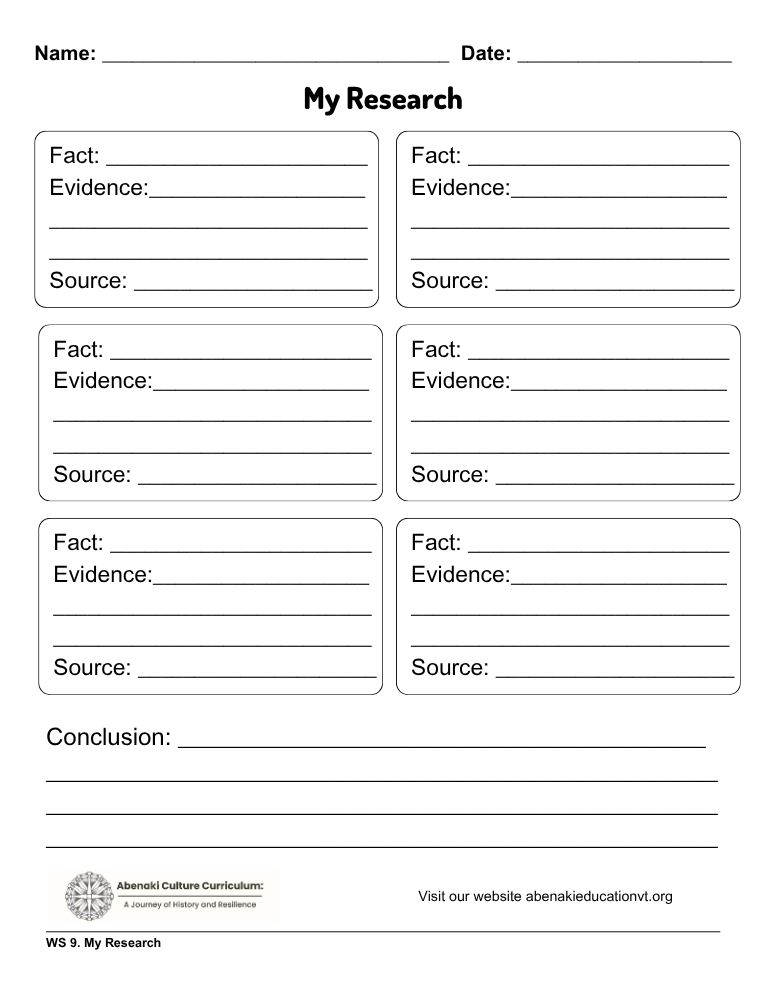
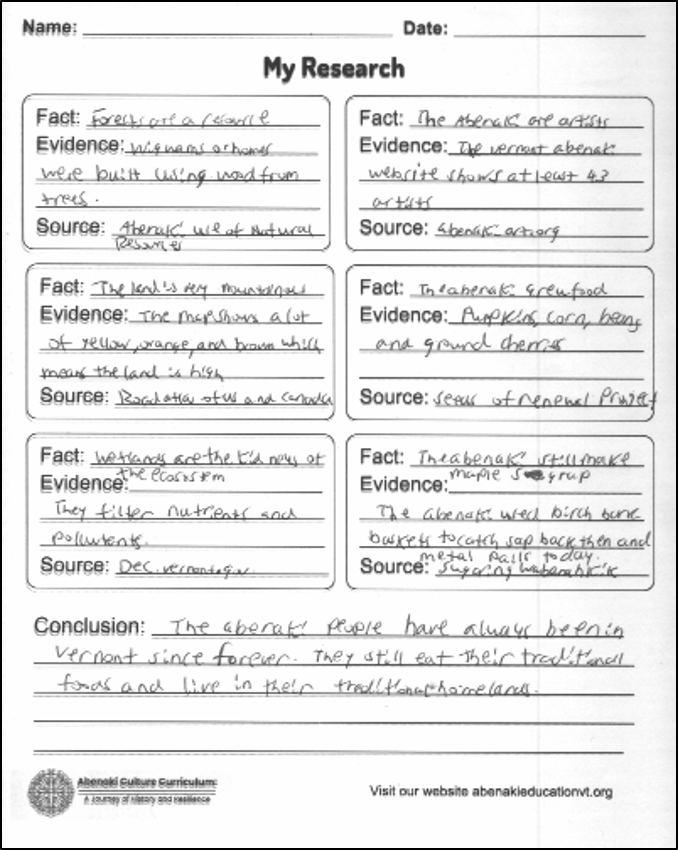
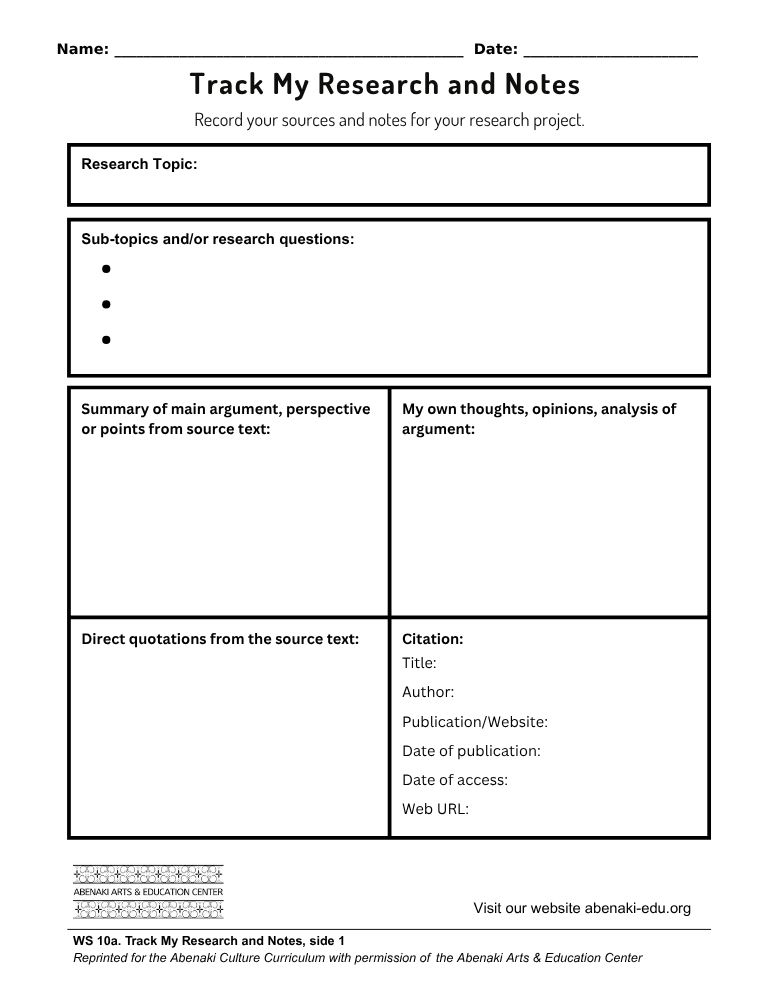
Throughout this learning journey, students conduct research and record evidence about their findings on either the WS 9. My Research or the WS 10a–b. Track My Research and Notes worksheets, which provide students with a structured way to document their research and aid in using citations.

Worksheets

WS 9 – My Research Worksheet
Sample completed WS 9. My Research
WS 10a – Track My Research and Notes, side 1
WS 10b – Track My Research and Notes, side 2

SQ1 Extension Activity

Revisit Students’ Questions

Revisit students’ questions from Generating Curiosity under Staging the Compelling Question. Have them now try to answer those questions using evidence from the original image of the “Fish-In” and what they have learned in the Supporting Question 2 activities to explain their thinking.


Use Research Tracker Sheets

Throughout this learning journey, students conduct research and record evidence about their findings on either the WS 9. My Research or the WS 10a–b. Track My Research and Notes worksheets, which provide students with a structured way to document their research and aid in using citations.

Worksheets

WS 9 – My Research Worksheet
Sample completed WS 9. My Research
WS 10a – Track My Research and Notes, side 1
WS 10b – Track My Research and Notes, side 2

Climate Change and Foodways

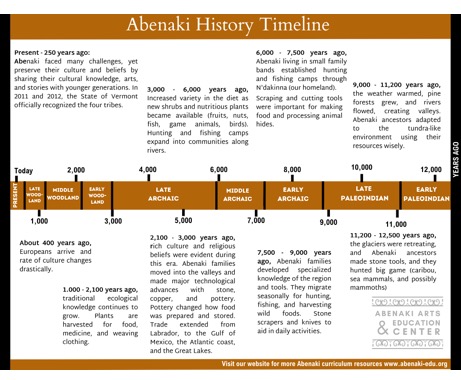
Timeline showing 13,000 years. Courtesy of Abenaki Arts & Education Center(Abenaki Arts & Education Center, 2023).

“The end of the glacial period in North America . . . brought with it momentous changes. . .  Many of the animals on which Paleoindians had depended for food, clothing, and shelter were no longer available to them.” —William Haviland and Marjorie Power.   From The Original Vermonters: Native Inhabitants, Past And Present. 1994.

You may be wondering what Abenaki people living in Vermont today have in common with their ancestors. The answer is “more than you might think.”

The timeline shown can serve as a reference tool for tracking the adaptations in Abenaki foodways.

Abenaki Paleoindian ancestors, approximately 11,000 years ago, lived in a tundra environment and relied on hunting large game animals (such as mastodons and caribou), sea mammals (such as whales), and anadromous fish (such as salmon and shad) for their survival. As the temperature rose during the Archaic period, approximately 8,000–9,000 years ago, glaciers retreated, and spruce and pine forests advanced into the region. Climate change also brought a wider variety of animals, shellfish, reptiles, and waterfowl to the region. Archeologists involved with Glacial Kame archeological sites (such as the Ewing Site in Shelburne) have found the remains of “bear, deer, turtle, fish, dog, [and] mussel” (Vermont Historic Preservation, n.d., p. 16).

The warming climate caused other changes in food resources. “By 7000 b.c., over 100 species of large mammals, such as the mammoth, mastodon, and moose-elk, became extinct. Others, like the caribou and musk ox, moved north with the tundra” (Haviland & Power, 1994). In place of these large animals, people turned to hunting other species, such as moose, beaver, lynx, and muskox, while also fishing for whitefish, and catfish.

Rising temperatures also gave rise to beech, birch, and maple trees, which are characteristic of the deciduous forests that Vermont and New Hampshire are known for. Three thousand years ago, the average temperature in Vermont was slightly warmer than today; this warming climate trend during the mid-Archaic period made for greater biodiversity. The variety of animals, nuts, fruits, and edible plants available to Archaic hunters and gatherers is remarkably similar to what we have today (Haviland & Power, 1994).

By the Woodland period, people shifted their lifeways, by living in relatively fixed settlements throughout the year. Smaller groups still came together to travel to smaller camps, where they hunted, fished, and gathered seasonal plant foods and medicines for their communities.

By roughly 1,000 years ago, a food plant imported from the Southwest – corn (Zea mays, also called maize) – was being cultivated in both Vermont and New Hampshire (Haviland & Power, 1994, p. 142). As just one example of the archaeological evidence, seven storage pits for corn were found at the Skitchewaug site (date to 1100 CE), demonstrating the importance of corn in the southern Connecticut River Valley diet (Mathewson, 2011, p. 29; Heckenberger et al, 1992; Haviland & Power, 1994, p. 86).

Corn made its way into the Champlain Valley around 1440–1700 CE (Bumstead, 1980; Haviland & Power, 1994). Beans, and squash also appeared in Vermont around the same time. During his regional travels in 1609, French colonial explorer Samuel de Champlain reported seeing “fertile fields of maize” (Heckenberger et al., 1992; Haviland & Power, 1994).

Abenaki people in Vermont continue to practice significant traditional hunting, fishing, and foraging lifeways in a culturally distinct way today; evidence of these practices (confirmed by independent scholars) can be found in the reviews of Tribal petitions for State-Recognition. Abenaki Tribes testified to ancient agricultural practices passed down in families, such as growing crops like corn, beans, and squash in mounds, and a shared cultural tradition of using “suckers” or “kikômkwa” (meaning “the garden fish”) as fertilizer. These skills are still part of the living memory and practices of families from the Elnu, Missisquoi, Koasek, and Nulhegan Abenaki Tribes, who vividly remember learning these traditions when they were children. (Elnu Abenaki Tribe, 2010; Koasek Traditional Band of the Koas Abenaki Nation, 2010; Nulhegan Band of the Coosuk-Abenaki Nation, 2010; Abenaki Nation of Missisquoi, 2011).

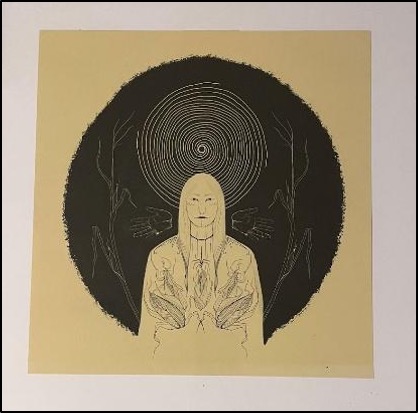
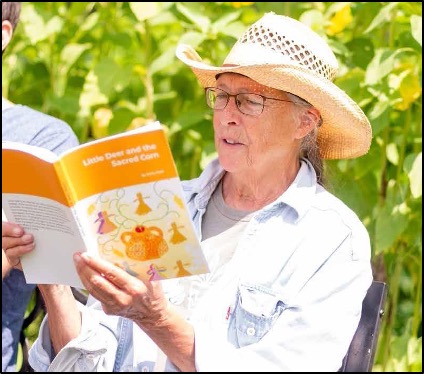
The addition of corn to the list of Abenaki food staples is immortalized in the story of “Corn Mother and First Man,” a story of love where the corn spirit sacrifices herself to feed the people. This story is still told after the “Green Corn Song” echoes through the mountains during the Elnu and Nulhegan Abenaki communities’ annual Green Corn events each August. The Corn Mother is commemorated, not just in song, but also in artwork by contemporary Abenaki artists. The importance of corn as a traditional food is reflected in the children’s book “Little Deer and the Sacred Corn,” by Chief Shirly Hook of the Koasek Abenaki Tribe (Calabro, 2023).

Green Corn Mother
Corn Mother, screen print on paper (A., 2025)
Shirly Hook reads from her new book, “Little Deer and the Sacred Corn”
Shirly Hook reads from her new book, “Little Deer and the Sacred Corn,” during a gathering at the Abenaki Heritage Garden she and her husband, Doug Bent, host on their Braintree property. (Calabro, 2023)

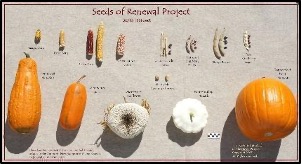
Traditional cultivation of food plants involves year-round seasonal cycles of planting, harvesting, and seed-saving techniques. Over time, some traditional heirloom plants were supplanted by newer commercial varieties.The Seeds of Renewal Project: 2013 Harvest poster (Wiseman, 2013), illustrates Abenaki corn, beans, squash, pumpkin, and sunflower varieties that have been restored to active cultivation by Vermont Abenaki people. Collectively, these traditional crops, together with Jerusalem artichokes (sunchokes) and tobacco, are now known as the Abenaki “Seven Sisters.”

Seeds of Renewal Project poster
Seeds of Renewal Project: 2013 Harvest [Poster] (Wiseman, 20

For More Information

Bumstead, M. P. (1980). VT-CH-94 Vermont’s earliest known agricultural experiment station. Man in the Northeast, 19, 73–82. [hard to find article can also be found at https://13c4.wordpress.com/2006/01/09/vt-ch-94-vermonts-earliest-known-agricultural-experiment-station/]

Haviland, William A. and Marjory W. Power. (1994)The Original Vermonters: Native Inhabitants, Past and Present. (Revised and Expanded Edition). University Press of New England. 

Wiseman, F. M. (2001) The Voice of the Dawn: An Autohistory of the Abenaki Nation. University Press of New England.

Wiseman, F. M. (2006) Reclaiming the Ancestors: Decolonizing a Taken Prehistory of the Far Northeast. University Press of New England.

Wiseman, F. M. (2018). Seven sisters: Ancient seeds and food systems of the Wabanaki people and the Chesapeake Bay region. Earth Haven Learning Centre Incorporated.

The above information comes from the “Deep Roots, Strong Branches” traveling exhibition, Vermont Abenaki Artists Association, curated by Vera Longtoe Sheehan (2025e). Printed with permission of the author. Share as much or as little with your students as needed to successfully complete the curriculum activities.

©2025. Vera Longtoe Sheehan. All Rights Reserved.

Abenaki Relationships with Neighbors

The Great Peace of Montreal stamp from Canada issued in 2001.
The Great Peace of Montreal, 2001 Canadian postage stamp (Tessier, 2001)

Historically, it was common for Northeastern tribal groups to respect each other’s individual hunting territories, and to come together at shared resource-gathering sites, without the need to draw fixed lines on a map. Sometimes, neighboring communities supported each other, but at other times (especially after colonial settlers arrived), tensions existed that had to be resolved through both war and peace.

For example, during the Beaver Wars of the mid-1600s, the arrival of Dutch colonial settlers in “New Netherlands” aggravated existing conflicts between Haudenosaunee people (primarily Mohawk) and their Mohican neighbors along the Mahicannituck (Hudson River) in present-day New York state. The Mohawk were supported by the Dutch during their efforts to conquer the Mohican and expand into Abenaki Territory. During that same era, Algonquin, Abenaki, and Huron people joined with their French allies in “New France” to protect traditional territories and trade routes threatened by English colonial settlers in “New England”. The disagreements among these different tribal groups were eventually settled in 1701 at the Great Peace of Montreal, which brought together 39 tribes (Beaulieu & Viau, 2001; Havard, 2014). In the aftermath of the Great Peace, Mohawk, Abenaki, and Huron people joined their French allies in conducting attacks on English settlements in western New England, as part of an effort to retake control of traditional homelands along the middle Connecticut River (Haefeli & Sweeney, 2003). During the subsequent “French and Indian Wars,” Governor Pierre de Rigaud de Vaudreuil tried to convince Abenaki people to relocate to New France, where they would be out of reach by the English. In 1704, he “invited several tribes to resettle on the St Lawrence. Some bands accepted, but the Cowasucks preferred to stay and fight in their homeland.” (Calloway, 1997)

If you return to the “Abenaki Territory” on “Native Land Digital” (Banaszak, 2022), you will notice that the colored overlay does not delineate the territories of individual Abenaki Tribes or make any distinctions between the Eastern and Western Abenaki Tribes. However, it is important to be aware that Abenaki communities (whether coalitions of family bands or organized tribes) have always maintained individual governance and autonomy from one another. No family band or tribal entity has any inherent authority over another; any such authority would have to be formally negotiated through treaties agreed upon by all sides.

To the east and northeast, you will find the tribes from the Wabanaki Confederacy (Abenaki, Mi’kmaq, Wolstaquey (also known as Wolastoq, Wolastoqiyik, and Malecite), Penobscot (Eastern Abenaki), and Passamaquoddy who were allies that fought British encroachment together (CraigBaird, 2020). In Asticou’s Island Domain: Wabanaki Peoples at Mount Desert Island 1500-2000, (Prins & McBride, 2007) Harold Prins and Bunny McBride explain:

Clearly, a problem with ethnic labels is that they do not reflect the fluid linguistic boundaries and migratory movements of transient Wabanaki groups. They also fail to indicate that Wabanaki peoples maintained cross-tribal kinship ties. Intermarriage between individuals from different ethnic groups was common, especially when population loss reduced opportunities for finding marriage partners within the community that were not too closely related. Exogamous relationships had the added advantage of binding various regional communities together and resulted in family ties between different groups. Such kinship bonds had great political advantages, as they increased opportunities for creating alliances and diminished risks of intertribal conflicts.

Gordon Day discussed similar complications in his book The Identity of the Saint Francis Indians (1981), which attempts to explain the origins of the Saint Francis/Odanak Tribe in Quebec. Day recounts how the village called Odanak was populated by refugees from the French and Indian War era who came from many different tribes and communities, including Sokoki, Pennacook, Cowass, Missisquoi, Pequawket, and elsewhere. Some families stayed at Odanak for a short time; some came and went at random; some came during wartime and returned to their home territories during peacetime.

 During the late 1600s, some Native families from tribes in the middle Connecticut River valley (Pocumtuck, Woronoco, Nonotuck) relocated to the refugee village at Schaghticoke in New York colony to live under the protection of English Governor Andros (Bruchac, 2005; Calloway, 1990; Haefeli & Sweeney, 2003; Spady, 1995). By the mid-1700s, when this village became crowded by English settlers, most of the refugees living at Schaghticoke left. Many people relocated to Missisquoi under the leadership of Grey Lock (Wawanolewat), a Woronoco man who used Missisquoi as a base of operations against the English during “Grey Lock’s War.” (Calloway, 1987; Day, 1974). Some families who left Schaghticoke relocated to Odanak, where they intermarried with other residents at the mission village who came from other regions. (Day, 1981)

Kinship ties among and between Abenaki communities, although complicated by these historic relocations and removals, persist into the present day. Evidence of some of these kinship ties, especially among the Elnu, Koasek, Nulhegan, and Missisquoi Abenaki Tribes, is recorded in the recognition applications that were submitted to the State of Vermont. Some ancestors of these present-day Vermont Abenaki people retreated to Canada and returned by the 1850s; other ancestors never left Vermont. Abenaki residents are fairly well-documented in 20th-century Vermont vital records (Wiseman, 2025b) and in the records of the Vermont eugenics movement (Dow, 2018; Gallagher, 1999; De Guardiola, 2023). For more information, watch Rep. Tom Stevens explain the impact of the Vermont eugenics movement on the American Abenaki community [begin at minute mark 7.28] (Vermont House of Representatives, 2021).

Some of the historic alliances among Abenaki people have also persisted into the present day. For example, in 2015, the members of the Wabanaki Confederacy invited the Vermont Abenaki Tribes (Elnu, Koasek, Nulhegan, and Missisquoi) to host the Confederacy in Vermont. (Moccasin Tracks, 2016) This momentous gathering was attended by Tribal citizens, Elders, and leaders of various tribes of the Six Nations (Haudenosaunee), Seven Nations (Mohawk, Huron, and Abenaki), Wolastoqiyik, Mi’kmaq, Passamaquoddy, Penobscot, Wampanoag.

For More Information

For More Information

Websites:

Abenaki Alliance. (n.d.). Abenaki Alliance. Abenaki Alliance. Retrieved August 9, 2025, from https://www.abenakialliance.org

Beaulieu, Alain and Roland Viau. (2001). The Great Peace: Chronicle of a Diplomatic Saga. Montreal, Quebec: Editions Libre Expression.

Davids, D. (2017). Brief History. https://www.mohican.com/brief-history/ 

Haefeli, Evan and Kevin Sweeney, eds. (2003). Captors and Captives: The 1704 French and Indian Raid on Deerfield. Amherst, MA: University of Massachusetts Press.

Haudenosaunee Confederacy (2025) Who We Are. Haudenosaunee Confederacy. https://www.haudenosauneeconfederacy.com/who-we-are/ 

Musée des Abénakis. (n.d.). Musée des Abénakis [Museum Website]. Musée Des Abénakis. Retrieved May 14, 2025, from https://museeabenakis.ca/en/

Saint Regis Mohawk Tribe (2025) About Us [Tribal Nation Website]. SRMT – NSN. https://www.srmt-nsn.gov/about 

Books:

Bruchac, Margaret M. (2005). “Founding Schaghticoke and Odanak.” Raid on Deerfield: The Many Stories of 1704. Deerfield, MA: Pocumtuck Valley Memorial Association. http://1704.deerfield.history.museum/scenes/nsscenes/founding.do?title=foundOdanak

Calloway, C. (Ed.). (May 15, 1997). After King Philip’s War: Presence and Persistence in Indian New England. University Press of New England.

Calloway, C. (Ed.). (1991). Dawnland Encounters: Indians and Europeans in Northern New England. University Press of New England. 

Calloway, C. G. (1987). Gray Lock’s War. Vermont History55(4), 212–227. https://vermonthistory.org/vermont-history-journal

Day, G. M. (1981). Identity of the Saint Francis Indians. University of Ottawa Press. https://www.jstor.org/stable/j.ctv16tjz

Haefeli, Evan and Kevin Sweeney, eds. (2003). Captors and Captives: The 1704 French and Indian Raid on Deerfield. Amherst, MA: University of  Massachusetts Press.

 Havard, G. (2014). Great Peace of Montreal of 1701: French-Native diplomacy in the seventeenth century. Montréal, QC: McGill-Queen’s University Press.

Speck, Frank G. 1915. “The Eastern Algonkian Wabanaki Confederacy.” American Anthropologist new series 17: 492-508. https://www.jstor.org/stable/660500

Article:

Brook, M. (2015). The Connections That Bind Us: The Colonial World of the Northeast – Abenaki Arts & Education Center. Originally written for the National Parks Service. https://abenaki-edu.org/the-connections-that-bind-us-the-colonial-world-of-the-northeast/

Dow, Judy A. (2018). “Understanding the Vermont Eugenics Survey and its Impacts Today.” In Global Indigenous Health: Reconciling the Past, Engaging the Present, Animating the Future, edited by Robert Henry, Amanda LaVallee, Nancy Van Styvendale, and Robert Alexander Innes, 76-96. Tucson, AZ: University of Arizona Press.

Bruchac, Margaret M. (2005). “Founding Schaghticoke and Odanak.” Raid on Deerfield: The Many Stories of 1704. Deerfield, MA: Pocumtuck Valley Memorial Association. http://1704.deerfield.history.museum/scenes/nsscenes/founding.do?title=foundOdanak

Calloway, Colin G. (1987). “Gray Lock’s War.” Vermont History 55 (4): 212-227. https://vermonthistory.org/vermont-history-journal/

Day, Gordon M. (1974). “Gray Lock.” In Dictionary of Canadian Biography Volume III, 256-267. Toronto, Canada: University of Toronto Press. http://www.biographi.ca/en/bio/gray_lock_3E.html

Dow, Judy A. (2018). “Understanding the Vermont Eugenics Survey and its Impacts Today.” In Global Indigenous Health: Reconciling the Past, Engaging the Present, Animating the Future, edited by Robert Henry, Amanda LaVallee, Nancy Van Styvendale, and Robert Alexander Innes, 76-96. Tucson, AZ: University of Arizona Press.

Spady, James (1995). “As If In a Great Darkness: Native American Refugees of the Middle Connecticut River Valley in the Aftermath of King Philip’s War.” Historical Journal of Massachusetts, 23 (2): 183-197. 

Geographic Features Across N’Dakinna

Travelers in Abenaki territory followed an intricate network of foot trails and waterways. Rivers enabled people in canoes to travel faster than people on foot, making it easier to visit family, friends, and allies. Rivers also made it easier for other people (strangers and newcomers) to travel into the territory. In some areas, strong river rapids and mountains acted as natural barriers, making it harder to travel for trade and alliance. But a close familiarity with river currents and mountain passes could also provide protection from attacks. Abenaki people have long depended on local knowledges to find and access natural resources, and to figure out how best to navigate rivers and natural landscapes. For example, if people want to build a wigwam (a bark-covered lodge used as a home) they need access to the forest to harvest saplings for the frame, bark for the roof, and reeds to weave into mats. If people want to plant, they need to know where to find a meadow with fertile soil for growing crops.

The various groups of Indigenous people who lived in the Northeastern parts of the North American continent had much in common. They preferred to live near rivers and forested areas, where they could find abundant natural resources that met their daily needs for food, clothing, and shelter (hunting, fishing) and that provided tools and inspiration for cultural practices (crafts, art, oral traditions).

Using “Native Land Digital,” (Banaszak, 2022) you can identify some early Abenaki neighbors. This website offers a searchable interactive map with colored overlays. If you conduct a search for “Abenaki Territory,” the map quickly provides a visual representation of the historical Abenaki homelands that we call “Ndakinna”. Neighboring tribes, such as the Mohawks to the west and the Mohicans at the southwest corner of Vermont, are represented through additional color overlays. You may notice that these colored overlays are quite different from a topographic map (showing geographic features that form natural boundaries), or from a modern state map (showing political divisions). Before colonization, there were no hard and fast dividing lines that separated tribal communities; accommodations were negotiated to ensure peaceful travel and access.

You can find additional information about geographical features and natural resources in the Resources listed for each formative performance task.

The above information comes from the “Deep Roots, Strong Branches” traveling exhibition, Vermont Abenaki Artists Association, curated by Vera Longtoe Sheehan (2025e). Printed with permission of the author. Share as much or as little with your students as needed to successfully complete the curriculum activities.

©2025. Vera Longtoe Sheehan. All Rights Reserved.

Environmental Changes in N’Dakinna

Abenaki History Timeline
Abenaki History Timeline. (Abenaki Arts & Education Center, 2023)

After living in the same region for thousands of years, Abenaki people were experts in using renewable resources and sustainable practices.

The “Abenaki History Timeline” poster (Abenaki Arts & Education Center, 2023) and the “Summary of 12,000 Years of Abenaki History” (Sheehan, 2025k) provide clues about the daily lives of Abenaki ancestors. Some 11,500 years ago, at the end of the last Ice Age in North America, resources were limited, so people in this region lived in small family groups. They chipped local flint, chert, and quartz into projectile points and cutting instruments that facilitated hunting and processing game animals and sea mammals. These creatures provided meat and skins for food and clothing; large animal bones and skins were also used to build shelters. Slowly, over thousands of years, the climate warmed and arctic tundra evolved into woodland forests, hosting new varieties of wildlife and abundant trees, shrubs, and edible plants. The Abenaki people who lived through these changes innovated new ways of harvesting and using different natural resources (Day, 1953).

By 3,000 years ago, regional resources included a wide variety of wild animals, fowl, fish, edible and medicinal plants, fruits, and nuts. Settlement patterns changed as families began to move from high terraces overlooking waterways into flatland settlements closer to lakes and rivers. As food sources and materials for clothing and shelter became more readily available, Abenaki people were able to live in larger extended families. New techniques and cultural practices were developed, such as tooling copper nuggets into knives and ornaments and making pottery vessels for cooking and storage (Haviland & Power, 1994). When Abenaki people began practicing maize horticulture, this expansion into farming enabled larger villages to flourish (Petersen & Cowie, 2002). (Read more about agriculture under Supporting Question 2)

Ceremonial burial sites and petroglyphs reflect religious beliefs that were present as long as 3,000 years ago. Archeological evidence shows that Abenaki people moved beyond a mere subsistence economy of hunting and gathering into a robust economy of producing food and participating in extended trading networks. For example, Ramah Bay chert (a type of rock from Newfoundland and Labrador), sea shells, and seeds have been found at archeological sites in Vermont, evidence of pre-Columbian trade routes that extended from the Atlantic Ocean to Labrador, the Great Lakes, the Caribbean, and beyond. Roughly 1,000 years ago, the food plant maize (commonly called corn, which originated as the teosinte plant in Mesoamerica) was transported along trade networks from the Southwest to the Northeast. Maize, interplanted with beans and squash, flourished when planted along the river intervales (flood plains) in Abenaki territory. (Haviland & Power, 1994)

For More Information

Books:

Day, Gordon M. (1953). “The Indian as an ecological factor in the northeastern forest.” Ecology 34: 329–346. https://www.jstor.org/stable/1930900

Haviland, William A. and Marjory W. Power. The Original Vermonters: Native Inhabitants, Past and Present. (Revised and Expanded Edition). University Press of New England.

Klyza, C. M., & Trombulak, S. C. (1999). The Story of Vermont: A Natural and Cultural History. University Press of New England.

Petersen, James B. and Ellen R. Cowie. (2002). “From Hunter-Gatherer Camp to Horticultural Village: Later Prehistoric Indigenous Subsistence and Settlement in New England.” In Northeast Subsistence Settlement Change A .D. 700-1300, edited by J. P. Hart and Christina B. Rieth, 265-288. Albany, NY: NY State Museum Bulletin 496. On-line: https://exhibitions.nysm.nysed.gov/publications/bulletin/496-14644.pdf

Wiseman, F. M. (2005). Reclaiming the Ancestors: Decolonizing a Taken Prehistory of the Far Northeast. University of New England Press.

Wiseman, F. M. The Voice of the Dawn: An Autohistory of the Abenaki Nation. University Press of New England, 2001.

Wiseman, F. M. The Voice of the Dawn: An Autohistory of the Abenaki Nation. University Press of New England, 2001.

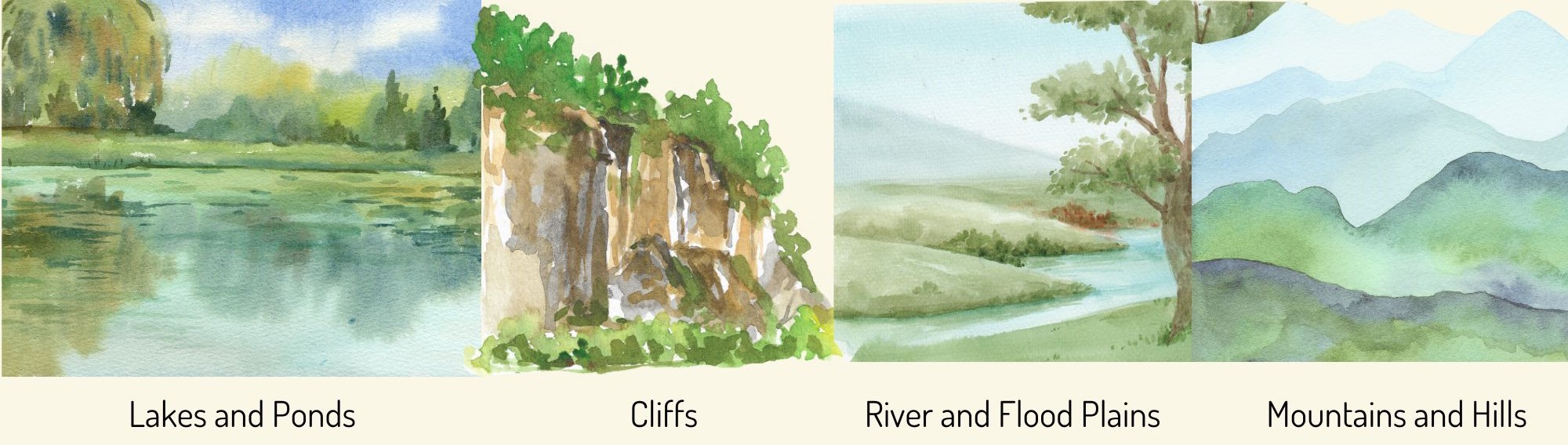
Landforms poster header
Detail from Landforms poster, Abenaki Arts & Education Center (Abenaki Arts & Education Center, 2024)

The above information comes from the “Deep Roots, Strong Branches” traveling exhibition, Vermont Abenaki Artists Association, curated by Vera Longtoe Sheehan (2025e). Printed with permission of the author. Share as much or as little with your students as needed to successfully complete the curriculum activities.

©2025. Vera Longtoe Sheehan. All Rights Reserved.